Free guide
Free
The Midlife Essentials and the talk
A 75-page PDF guide plus the 1 hour 43 minute talk, The Entire Midlife Journey.
Send me the guide
By Daniela Hess, MSEd13 min readOctober 2026
'My body was telling me for years something was not right, and nobody would listen.' Every Autoimmune condition needs 3 factors to line up: genetic susceptibility, a loosened gut barrier, and triggers. Here is how your immune system tells self from non-self, what the years before a diagnosis look like, and why about 80 percent of Autoimmune conditions occur in Women.
By some counts, there are more than 80 documented Autoimmune conditions, and the exact number varies depending on who is counting and how. What does not vary, without exception, is the pattern underneath every single one of them. Every one needs 3 things to line up before it develops.
Hashimoto's settles on the thyroid, and rheumatoid arthritis settles in the joints. Multiple sclerosis targets the myelin that wraps your nerves, and type 1 diabetes targets the insulin-making cells of the pancreas.
Lupus can move through many tissues at once. Psoriasis shows up on the skin, celiac disease in the small intestine, and Sjögren's in the glands that keep your eyes and mouth moist. Different addresses, 1 underlying mechanism.
That shared mechanism is why the same foundational work, on the gut and on the triggers, speaks to so many different diagnoses.
The trouble lives in the immune system that is aiming at your thyroid, your joints, or your pancreas, more than in the tissue itself. That opens a bigger question, right alongside 'how do I support the struggling organ?' The bigger question is 'how do I calm the system that is aiming at it?'
The 3 factors play out across decades. Your genetics are set at birth, and the gut barrier and triggers of your 20's and 30's shape the immune system you carry into your 40's and 50's, often years before a diagnosis. How you tend factors 2 and 3 in your 40's and 50's shapes the Autoimmune story you live at 60 and beyond.
The 3 factors make the most sense once you see the job your immune system does every minute of your life. It reads the molecular surface of everything it meets, and it asks 1 question: is this me, or is this something else?
Self or non-self. Friend or foe. Every defense your body mounts depends on getting that 1 answer right.
Your immune system learns the answer early, and it keeps relearning it for the rest of your life.
So tolerance of your own tissue is something your body actively maintains, every day. It depends on a calm gut, well-supported calming cells, and a Nervous System that is not stuck in alarm. When the conditions that support tolerance slip, the immune system can begin to misread you.
The most studied way that misreading happens is called molecular mimicry.
Every protein, in your food, in a virus, and in your own tissue, is a string of building blocks called amino acids. Your immune system learns a target by that sequence, almost the way you learn a face.
When a food protein or a microbe carries a sequence that closely resembles a stretch of your own tissue, the defense your body builds against the intruder can land on the look-alike too.
In Dr. Datis Kharrazian's model, the gliadin protein in gluten and your thyroid tissue are 1 such pair, and the Thyroid chapter walks through it in detail. The immune system is doing exactly the job it was built for, with confused information.
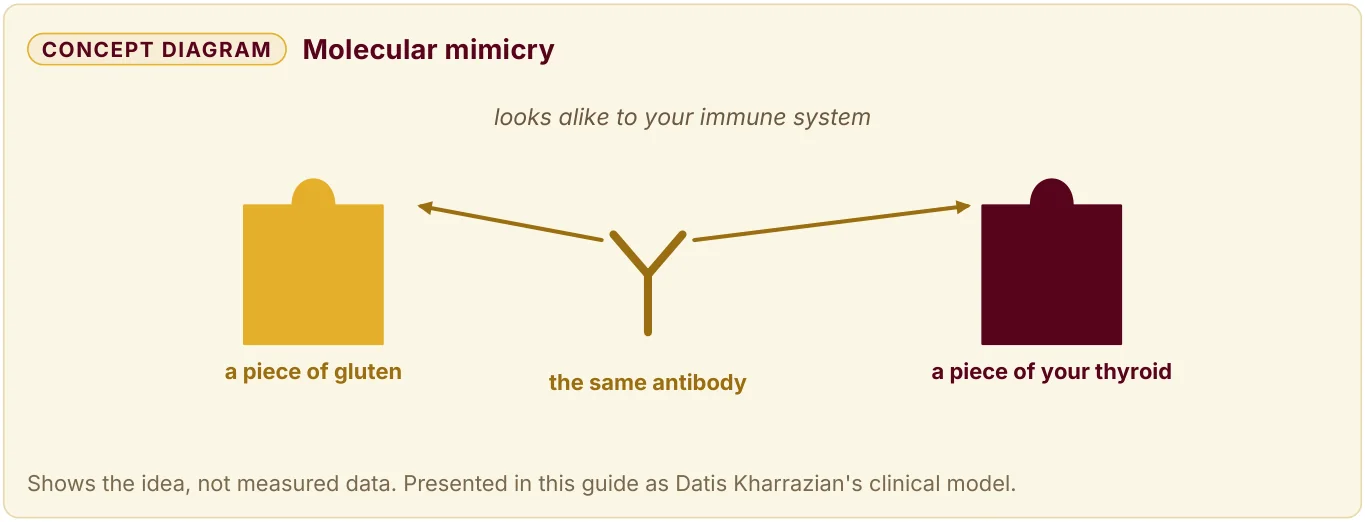
Diagram titled 'Molecular mimicry.' Text across the top: looks alike to your immune system. On the left, a piece of gluten. On the right, a piece of your thyroid. In the middle, the same antibody, with an arrow to each piece. The chart shows the idea, not measured data, and is presented in the guide as Datis Kharrazian's clinical model.
The language around Autoimmune needs an upgrade too.
I also want to upgrade the language around Autoimmune. Maybe when you were diagnosed with an Autoimmune condition, somebody used the word attacking. Your Autoimmune is your body attacking itself. Now, through a kinder and truer lens, that is not exactly what is happening. The immune system is not malicious. It is actually an unbelievably devoted, exhausted protector. It is working with crossed signals, mounting a real defense against a target it has misidentified. Autoimmune is more like a case of mistaken identity. For some of us, the misidentified target happens to be the thyroid. For some of us, it is the joints. For some of us, it might be the nerve endings. Whatever tissue it lands on, that tissue is the casualty.
I say this because language shapes how a Woman relates to her own body, and some of the language out there has done real damage.
I have even met Women who felt shame around Autoimmune. They looked up Louise Hay and found that Autoimmune supposedly means self loathing, or all kinds of things like that. I do not think any of that is helpful, because there is so much going on with our physiology. I would love for that language to be tossed out, personally.
Nothing about your genetics is a reflection of your character. Nothing about a trigger you could not have predicted, a virus, a loss, a season of your life that asked too much of you, is a reflection of your worthiness. The 3 factors are mechanism, plain and simple.
A truer sentence to carry, and to return to whenever the old phrase creeps back in, is this: 'My immune system is a devoted protector that crossed a signal, and I am living in conditions that can change.' Say it in your own words, and let it become the voice you answer with on the inside.
When someone hands you the old framing, even with love, you can meet them gently. Autoimmunity is a case of mistaken identity in the immune system, the body doing exactly what it was built to do, with 1 signal crossed.
Notice, too, that you are still here, reading, learning, and choosing to understand your own body. A body can be tired and inflamed and years into a hard story, and the Woman living inside it can still be reaching toward her own healing. That reaching is the part of you no diagnosis has touched.
The first factor is genetic susceptibility, an inherited tendency. This part we cannot change. It is written in before you were ever symptomatic, and no amount of clean eating or willpower rewrites your DNA.
I often put it this way: your genes may 'load the gun', but they do not fully pull the trigger.
The genes involved are a collection of small tendencies spread across many genes.
Many of them sit in a region called HLA, the genes your immune cells use to show the rest of the immune system what they have found. Some versions of these genes make certain tissues easier to misread.
The clearest evidence that genes are only part of the story comes from identical twins. They share the same DNA, and yet when 1 twin develops an Autoimmune condition, the other often does not. For many Autoimmune conditions, identical twins match less than half the time.
Maybe Hashimoto's runs in your family, or psoriasis, or rheumatoid arthritis, or lupus, or something no one ever named out loud. A family history is useful information. It tells you where to look first, and it is a good reason to ask for your antibodies to be checked years before any symptoms appear.
Researchers call the layer of instructions written on top of your DNA epigenetics: chemical marks that decide which genes get read, how often, and in which tissues. What you eat, how you sleep, how much you move, what you are exposed to, and how stressed you are all shape those marks. Your genes work more like a dimmer switch than a sentence.
The second factor is your gut barrier. The third factor necessary for an Autoimmune condition to develop is triggers.
We cannot change the first factor, the genetics. But the second and third, the gut barrier and the triggers, these are ours. These are the ones we can bring our full attention to and actually work on.
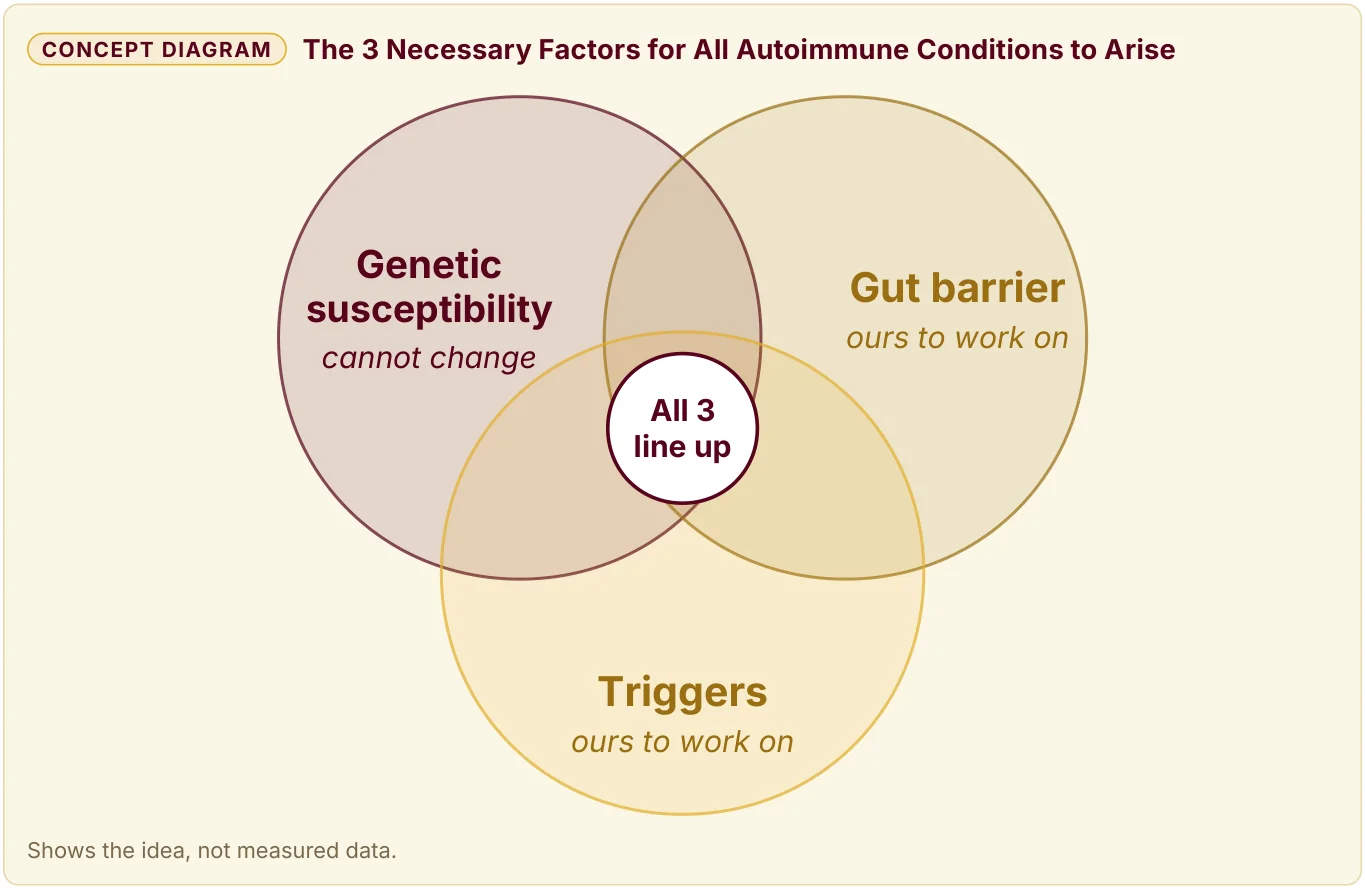
The 3 necessary factors for an Autoimmune condition to arise: genetic susceptibility, which cannot change; a gut barrier, which is ours to work on; and triggers, which are ours to work on. All 3 line up.
The gut barrier is the factor most Women are told the least about.
The lining of your small intestine is a single layer of cells, held together by seams called tight junctions. When those seams stay closed, nutrients pass through the cells in a controlled way and everything else stays in the gut.
When the seams loosen, partly digested food proteins, bacterial fragments, and toxins slip into your bloodstream. Your immune system meets them there as intruders, and it responds.
What loosens those seams? Gluten is the most studied. Its gliadin protein prompts your gut to release zonulin, a molecule that opens the tight junctions.
Alcohol, sugar and processed food, chronic stress, frequent use of anti-inflammatory painkillers such as ibuprofen, infections, an imbalanced microbiome, and low stomach acid all add to the load.
Most of what loosens the gut barrier also appears on the list of triggers. Factors 2 and 3 feed each other, which is exactly why working on both at once is so powerful. Together they act as the hand on the dimmer switch, turning the genetic tendency up or down.
Triggers go far beyond stress, though stress is real and it counts. A trigger can be a significant, stressful event. It can be grief. It can be loss.
It can be chronic stress carried across years of the unnaturally busy lives so many of us have lived. Other triggers are infections, including COVID and Epstein-Barr virus. Toxins. Mold. Your hormones shifting. Certain foods, for certain bodies.
Nearly every trigger on that list works through the same channel: inflammation.
That last one, hormones shifting, is exactly why this belongs in a guide about Midlife specifically. Autoimmune rarely arrives on its own. It tends to come in as part of a domino effect.
Years of chronic stress leave the body's stress response system running on empty, a real, describable pattern even without a formal diagnostic label attached to it (the earlier 'Cortisol, the stress hormone' section says more about why 'adrenal fatigue' is not a diagnosis I offer, and what I mean instead). From there, the thyroid often starts to underperform. Sex hormones begin their shift.
And somewhere in the middle of all of that, an Autoimmune condition that may have been building quietly for years finally tips into view. Perimenopause is often the moment that quiet process becomes visible.
This chain does not run its course in a week. Autoimmunity develops in stages, often quietly, often long before anyone names it.
The research backs up the long, quiet build.
In Women later diagnosed with Autoimmune thyroid disease, TPO antibodies were already elevated in stored blood samples up to 7 years before the diagnosis. In lupus, antibodies appeared in blood samples years before diagnosis, up to about 9 years in some people.
If you have lived in Stage 2, the long, lonely middle, your experience was real. The absence of a diagnosis is not the same as the absence of disease.
My body was telling me for years something was not right, and nobody would listen.
Looking back, 1 of my practitioners thinks it is very likely my Autoimmune condition began after my first pregnancy. In hindsight, the signs were there for years.
Those were signs, and no doctor said anything about them or looked into them. Feeling cold, feeling tired, and constipation are classic signs of an underactive thyroid, according to the American Thyroid Association, and 'Your Nails: A Window You Can Look Through Every Day', in 'Hair Loss, Skin, and Nails: What Your Body Is Telling You About Your Health', explains what brittle nails can mean.
Roughly 80 percent of Autoimmune conditions occur in Women. That number surprises people, and the biology behind it is well studied.
A Woman's immune system is built to be more reactive. Women mount stronger immune responses to infections and to vaccines than men do. The same strength that protects a Woman can also tip toward her own tissue.
Part of this traces to your chromosomes. Women carry 2 X chromosomes, and the X chromosome is packed with immune-related genes. Some of those genes stay active on both copies, which gives the female immune system more firepower and more ways for its signals to cross.
Estrogen amplifies immune activity too. Layer on the hormonal tides of menstrual cycles, pregnancy, the months after birth, and Perimenopause, each of which moves immune reactivity up or down, and you can see why so many Women find a condition surfacing or worsening around a hormonal threshold.
You may notice this book calls estrogen both an amplifier of your immune system and a brake on inflammation. Both are true. In a 2007 review in Endocrine Reviews, Dr. Rainer Straub described estrogen calming inflammation or fueling it depending on how much is present, which immune cells it reaches, and which tissue it lands in.
In Perimenopause, estrogen swings high and low from month to month, and your immune system may ride every swing. After Menopause, it falls and stays low. For an immune system that spent decades tuned to a steadier rhythm, that is a great deal of change at once.
Then there is the long wait for a name.
Many Women spend years with symptoms, labs that are 'a little off', and repeated reassurance that nothing is wrong. That stretch is part of the 5th Midlife crisis this guide names: no one is designated to guide a Woman through all of this at once.
Part of that wait traces back to the research itself. In 1977, the FDA advised keeping Women who could become pregnant out of early drug trials, and it reversed that guidance only in 1993, the same year Congress passed the NIH Revitalization Act requiring Women in the clinical research the National Institutes of Health funds.
Care has been catching up ever since. A more reactive immune system, living through the hormonal swings of Perimenopause and the fall into Menopause, deserves to be studied on its own terms.
Sugar, processed food, and chronic stress push the body toward insulin resistance. Insulin resistance is associated with higher inflammation. As estrogen drops, 1 of the brakes on that inflammation comes off. And sustained inflammation is hard on the gut lining.
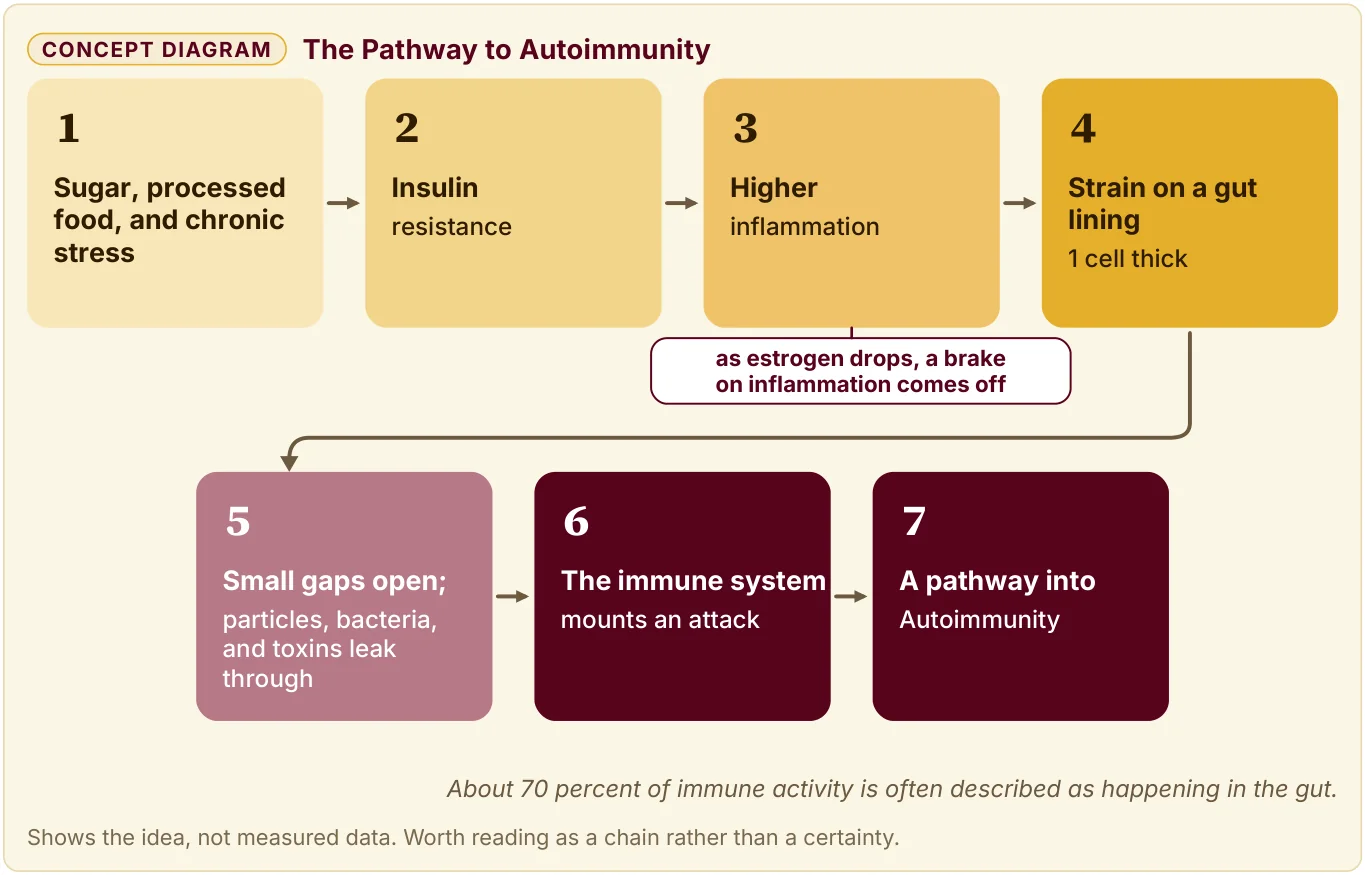
A 7-step chain, in boxes joined by arrows. 1, sugar, processed food, and chronic stress. 2, insulin resistance. 3, higher inflammation, with a note beneath it: as estrogen drops, a brake on inflammation comes off. 4, strain on a gut lining 1 cell thick. 5, small gaps open; particles, bacteria, and toxins leak through. 6, the immune system mounts an attack. 7, a pathway into Autoimmunity. A line at the bottom: about 70 percent of immune activity is often described as happening in the gut. The chart shows the idea, not measured data, and is worth reading as a chain rather than a certainty.
A chain can be interrupted at every link, and each link you loosen takes pressure off the rest.
Progress on 1 link counts, even while the others wait their turn.
This article is a section of The Midlife Bible: The Essential Guide to the Women's Midlife Journey, by Daniela Hess, MSEd. It is the book's own text, so where it says 'this book' or points to another part, that means the Bible. The book has the full chapters, charts, and the Lab Wish List.
Educational content, not medical advice. Please work with your own practitioner before you change a medication or a supplement.
These 3 connect to what you just read.
3 words I wish someone had said to me the day my diagnosis arrived: Remission is possible. Here is what Remission means and does not mean, why 1 condition can become more than 1, and the 2 paths in front of you at diagnosis.
Read this article →Your gut and digestion'My bloating and my thyroid symptoms got treated as separate problems.' Your gut lining is 1 cell thick, and Midlife stacks several changes on it in the same decade. Here is how the lining works, what loosens it, why estrogen, stress, and medications matter, and which foods and habits feed its repair.
Read this article →The roots underneathInflammation is your immune system's repair response, and the trouble is the kind that never switches off. Here is where it hides, where it comes from, the damage it does, and a plan to cool it.
Read this article →FAQ
Every Autoimmune condition needs 3 factors to line up: genetic susceptibility, a gut barrier that has loosened, and triggers. The first you cannot change. The second and third are ours to work on, and they feed each other, since most of what loosens the gut barrier also appears on the list of triggers.
Triggers include significant stress, grief, loss, infections such as COVID and Epstein-Barr virus, toxins, mold, shifting hormones, and certain foods for certain bodies. Nearly every trigger works through inflammation.
Your genes may 'load the gun', and they do not fully pull the trigger. For many Autoimmune conditions, identical twins match less than half the time, even though they share the same DNA. Epigenetics, the chemical marks on top of your DNA, decides which genes get read, and what you eat, how you sleep, how much you move, what you are exposed to, and how stressed you are all shape those marks.
A family history is useful information. It tells you where to look first, and it is a good reason to ask for your antibodies to be checked years before any symptoms appear.
Yes. In Stage 1, silent Autoimmunity, antibodies are rising and you feel well. In Stage 2, antibodies are up, symptoms are present, and standard testing may not show definite damage yet. In Stage 3, enough tissue is affected that it shows up on imaging or function tests. In stored blood samples from Women later diagnosed with Autoimmune thyroid disease, TPO antibodies were already elevated up to 7 years before the diagnosis, and lupus antibodies up to about 9 years in some people.
The absence of a diagnosis is not the same as the absence of disease. Normal vs Optimal Labs covers how to ask for antibody testing.
Roughly 80 percent of Autoimmune conditions occur in Women. A Woman's immune system is built to be more reactive, with stronger responses to infections and vaccines than men have. Women carry 2 X chromosomes, and the X chromosome is packed with immune-related genes. Estrogen amplifies immune activity too, and the hormonal tides of menstrual cycles, pregnancy, the months after birth, and Perimenopause each move immune reactivity up or down.
In Perimenopause, estrogen swings high and low from month to month, and after Menopause it falls and stays low.
Autoimmunity is a case of mistaken identity. When a food protein or a microbe carries a sequence that closely resembles a stretch of your own tissue, the defense your body builds can land on the look-alike too. That is molecular mimicry. The immune system is doing the job it was built for, with confused information.
Nothing about your genetics is a reflection of your character, and nothing about a trigger you could not have predicted is a reflection of your worthiness. I think of the immune system as a devoted, exhausted protector with crossed signals. Autoimmune Remission Is Possible covers what Remission means.

A 75-page PDF guide plus the 1 hour 43 minute talk, The Entire Midlife Journey.
Send me the guideYour thyroid, your gut, your hormones, and your labs.
Get The Midlife Bible3 hours with Daniela Hess and Kim Beekman, recorded live. The Midlife Bible is included.
See the workshop60 to 90 minutes one-on-one. Send a request to work with Daniela.
Work with Daniela