Free guide
Free
The Midlife Essentials and the talk
A 75-page PDF guide plus the 1 hour 43 minute talk, The Entire Midlife Journey.
Send me the guide
By Daniela Hess, MSEd13 min readOctober 2026
Bone loss in Midlife makes no sound, and in SWAN, the Study of Women's Health Across the Nation, it ran fastest from 1 year before the final period to 2 years after. This article covers how osteopenia differs from osteoporosis, what the LIFTMOR trial found about lifting heavy, and why I teach calcium from food first.
Bone loss in Midlife makes no sound. There is no ache that warns you, no lab that flags it at a routine physical, and no symptom until a wrist snaps on an icy step or a vertebra quietly compresses. The good news is that bone answers to what you ask of it, at any age.
The Estrogen section of 'What Is Actually Happening in Your Midlife Body' traced the line from estrogen decline, to osteopenia, to osteoporosis, to fracture, and 'Bone: What the Evidence Shows' in the Hormone Therapy 101 chapter covered what hormones can do. This chapter goes deeper, into how bone is built, how to read your scan, what builds strength, and what quietly thins bone.
This is how I explain it to the Women in my community:
Strength training, number 1, and jumping. Whether it's jumping rope, or just jumping down the sidewalk for 10 minutes, just hopping, anything, because our bones need the command to keep building. And once we pass about 50, they need the reminder.
My own daily chart includes a line for jumping rope. Your skeleton is waiting for your instructions.
Bone looks like the most permanent part of you. It is living tissue, taken apart and rebuilt every day of your life.
2 teams of cells do this work:
This constant cycle is called remodeling. When the clearing crew works faster than the building crew, bone thins.
Estrogen supervises the clearing crew. In research in mice, estrogen shortened the lifespan of osteoclasts, and removing their estrogen receptor produced bone loss that looked like postmenopausal osteoporosis. That was an animal study, and the fact it explains is well established in Women: as estrogen falls, bone breakdown speeds up.
Think of your skeleton as a savings account. According to the Bone Health and Osteoporosis Foundation (BHOF), about 85 to 90 percent of adult bone mass is in place by age 18 in girls. Your bones reach their peak density by your late 20's or around 30, and the exact timing differs between your hip and your spine.
A National Osteoporosis Foundation position statement estimated that lifestyle shapes about 20 to 40 percent of peak bone mass. Midlife is the season when the withdrawals speed up, which makes every deposit you add now count.
Your skeleton is the clearest proof I know that what you do in your 20's and 30's creates what you live in your 40's and 50's. The account you built by 30 is the account you draw on in Perimenopause. How you load it with strength training and protein in your 40's and 50's decides how much is left to carry you at 60 and beyond.
If you were underweight, missed periods, or took long courses of steroids when you were younger, you may have started Midlife with a smaller account, and that is a reason to look sooner.
The Study of Women's Health Across the Nation, SWAN, measured Women's bone density year by year through the Menopause transition:
Over the 10 years around the final period, Women in SWAN lost an average of 10.6 percent of the bone density in their lower spine, and 7.38 percentage points of that loss happened inside the transmenopause window. At the femoral neck, the top of the thigh bone just below the hip joint, they lost 9.1 percent, with 5.8 points of it in the same window. Most of a decade's spine loss happened in about 3 years, often while no one was measuring.
Averages hide a wide range. BHOF reports that some Women lose up to 20 percent of their bone density in the 5 to 7 years after Menopause. In SWAN, Japanese and Chinese Women tended to lose bone faster, and African American Women and Women with a higher body mass index more slowly.
BHOF also reports that between ages 20 and 80, white Women lose about a third of their hip bone density. A Woman who begins caring for her bones at 45 has the most to protect and the most room to change the curve.
These 2 words describe points along the same road.
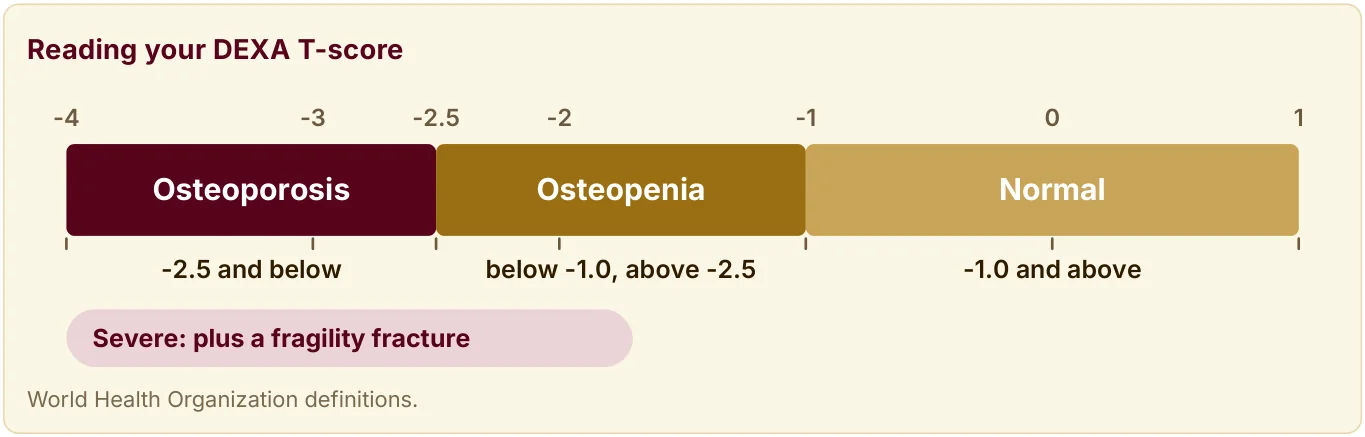
A scale of DEXA T-scores running from -4 to 1, with marks at -4, -3, -2.5, -2, -1, 0, and 1. Osteoporosis: -2.5 and below. Osteopenia: below -1.0, above -2.5. Normal: -1.0 and above. Severe: osteoporosis plus a fragility fracture. World Health Organization definitions.
A CDC report on national data from 2017 to 2018 measured Women aged 50 and older:
Together, roughly 7 in 10 Women past 50 had low bone mass or osteoporosis. Healthy bone density after 50 is now the less common result.
BHOF estimates that about 1 in 2 Women over 50 will break a bone because of osteoporosis, and that osteoporosis causes about 2 million broken bones a year in the United States. BHOF also reports that a Woman's risk of breaking a hip equals her combined risk of breast, uterine, and ovarian cancer. Many Women know when their next mammogram is due, and far fewer know their T-score.
A broken hip in older age is a turning point for the whole body. BHOF reports that 24 percent of hip fracture patients aged 50 and older die in the year after the fracture. It also reports that 6 months after a hip fracture, only 15 percent of patients can walk across a room without help.
The fracture is often the start of a slide: time in bed, lost muscle, lost steadiness, and lost independence.
Independence at 80 is built in our 40s and 50s. Cognitive clarity at 75 is built in our 40s, in our 50s, in our 60s.
Dr. Vonda Wright put it this way in an interview: 'People don't die of hot flashes... but they do die of hip fractures.' Most hip fractures begin with a fall, so protecting your hips means building strong bone and a steady, strong body to carry it.
Bone builds where it is loaded. When muscles pull hard on bone and when your body meets the ground with force, the building crew gets its signal. Gentle movement feels good, and bone asks for more than gentle.
The LIFTMOR trial. In this trial, 101 postmenopausal Women with low bone mass, average age 65, were split into 2 groups for 8 months. 1 group did 30-minute supervised sessions twice a week of high-intensity resistance and impact training: 5 sets of 5 repetitions at more than 85 percent of the most they could lift once, in the deadlift, overhead press, and back squat, plus jumping chin-ups with drop landings. The other group did a gentle home program.
The results:
The safety came from careful screening, a gradual build, and trained supervision at every session.
Load plus impact works best. A review of exercise after Menopause found that mixed programs, such as impact combined with resistance training, reduced bone loss at the hip and spine, while high impact alone did not raise bone density at any site.
Walking alone is not enough for your spine. A review of 10 trials found that walking had no significant effect on bone density at the lower spine, wrist, or whole body in Women in and after Perimenopause. Hip density improved only in programs longer than 6 months. Keep walking for your heart, your mood, and your blood sugar, and add lifting and jumping for your bones.
Dr. Wright teaches the same principle in her interviews:
She suggests jumping up and down 20 times on a regular surface. If that hurts, she suggests a mini trampoline or walking in water as a starting point.
What I do for my bones. I lift small weights every day. I also jump: a little hopscotch, an extra stomp in my step when I walk, or jumping up and down on the bottom step of my stairs, because I want my legs to feel that jolt.
I also use a rebounder, and I do not count on it for my bones. Its springy mat absorbs part of the impact, and in a 2019 randomized trial of 40 Women with osteopenia, 12 weeks of mini-trampoline training twice a week improved balance, strength, walking speed, and fear of falling, while spine and hip density did not improve significantly more than in the control group. For bone, I jump on solid ground, and a mini trampoline is a starting point if jumping hurts.
Progressive loading. Your bones adapt to the load you give them, and then they need more. Master each movement with light weight, then add weight or sets over weeks and months.
In Dr. Wright's words, 'Lifting for strength means lower reps and heavier weights.' The weight that challenged you in January should feel manageable by spring.
Safety and supervision. If you have osteoporosis, a prior spine fracture, or you are new to lifting, learn under a qualified trainer or physical therapist who works with Women with low bone density. Ask which movements suit your spine and how to build toward heavier loads. A few sessions of skilled coaching can protect years of training.
A sample week, as education. Here is 1 way a week can look for a healthy Woman who has learned her lifts with a qualified coach. Let your trainer or physical therapist shape it to your body and your scan.
This mirrors LIFTMOR and the mixed-loading research: 2 days of heavy lifting, regular impact, and daily movement. Months of consistency build bone.
'Movement in Midlife: Strength, Walking, Your Heart, and When Exercise Becomes Too Much' sets this week beside walking, your heart and lungs, balance and power, and your pelvic floor, and shows how my own week of walking, Qigong, and weights fits together.
Calcium is the main mineral in bone. According to the National Institutes of Health, Women over 50 need 1,200 mg of calcium a day, and the upper limit is 2,000 mg a day.
My approach is food first, and for an Autoimmune body, that means dairy-free. Some of the richest dairy-free sources, per the National Institutes of Health:
Other good sources, with approximate values:
Almonds and tahini are paused during the 90 days of the Autoimmune Protocol and can often return during reintroduction. Canned sardines and salmon with their bones fit every phase, and they bring omega-3 fats and protein along with the calcium.
Spinach looks high in calcium on paper, and it is poorly absorbed because of its oxalate, so count on other greens for calcium.
If you have lived dairy-free for years, the research is reassuring. In a 2015 review in the BMJ, most studies of milk, 25 of 28, found no link with fracture risk, and the authors concluded that dietary calcium intake is not associated with fracture risk. Your bones need calcium, and your body can receive it from fish, greens, nuts, and seeds.
A simple practice: log what you eat for 3 days, add up your calcium, and review it with your practitioner. A dairy-free Woman may need to plan deliberately to come close to her target.
I do not eat dairy, and I get plenty of calcium from my food. The lists above show how a dairy-free Woman does it: fish with its soft bones, dark cooked greens, and, after reintroduction, nuts and seeds.
I recommend calcium from food, and I leave calcium supplements out. 3 findings shape that choice.
A supplement offers an uncertain benefit and raises real questions. Food brings calcium in smaller doses through the day, along with other nutrients bone needs. That is why I teach food first.
If you already take calcium, or your prescriber recommends it alongside an osteoporosis medication, bring this research to that conversation and decide together. If you take thyroid medication, the Thyroid chapter explains why calcium in any form needs a 4-hour gap from your dose.
Estrogen puts the brake back on bone breakdown directly. In the Women's Health Initiative trial of combined estrogen and progestin, 16,608 Women aged 50 to 79 took part. Women taking hormones had 34 percent fewer hip fractures than Women on placebo.
A follow-up analysis found:
The study used an oral horse-derived estrogen and a synthetic progestin, as the Hormone Therapy 101 chapter explains. Systemic estrogen is FDA-approved for preventing postmenopausal osteoporosis, and The Menopause Society's 2022 position statement supports it for Women under 60 or within 10 years of Menopause who are at elevated risk of bone loss or fracture and have no reason to avoid it.
In an interview, Dr. Wright said, 'A very low dose estrogen will lessen the musculoskeletal syndrome.' That is her clinical view; the research on joints and muscles is younger than the research on bone.
As 'Bone: What the Evidence Shows' explains, the protection lasts while you take it. If hormone therapy is part of your plan, strength training, protein, and a DEXA to track your progress are its partners.
This article is a section of The Midlife Bible: The Essential Guide to the Women's Midlife Journey, by Daniela Hess, MSEd. It is the book's own text, so where it says 'this book' or points to another part, that means the Bible. The book has the full chapters, charts, and the Lab Wish List.
Educational content, not medical advice. Please work with your own practitioner before you change a medication or a supplement.
These 3 connect to what you just read.
Heart disease takes roughly 7 times as many Women's lives as breast cancer, and Menopause changes your cholesterol, your blood vessels, and your body fat. Here is how a heart attack can look in a Woman, which tests to ask about, and what protects your heart every day.
Read this article →Food, movement, and breathThe workouts that carried you at 30 may be too little in some ways and too much in others at 50. Here is why lifting comes first, what the walking research says about 7,000 steps, how to protect your pelvic floor while you train, and the signs that exercise has become another stress, with a weekly shape you can adjust to your own labs and energy.
Read this article →Your hormones and your thyroidHormone therapy is 1 of the most effective tools for the Midlife years and 1 of the most misunderstood. Here is what happened in 2002, what changed in 2025, and what the evidence shows on timing, bones, heart, and breast cancer.
Read this article →FAQ
They are 2 points along the same road. Osteopenia, also called low bone mass, means your bone density is lower than that of a healthy young adult and not yet low enough to be called osteoporosis. Osteoporosis means bones break with far less force than they should. Severe osteoporosis means osteoporosis plus a fragility fracture that already happened.
In CDC data from 2017 to 2018, 19.6 percent of Women aged 50 and older had osteoporosis and 51.5 percent had low bone mass, roughly 7 in 10 together.
In SWAN, bone loss began about 1 year before the final menstrual period and ran fastest from 1 year before to 2 years after it. Over the 10 years around the final period, Women lost an average of 10.6 percent of their lower spine density, with 7.38 percentage points of it inside that fast window. Loss slowed after that, and it did not stop.
Estrogen supervises the cells that clear old bone, so as estrogen falls, bone breakdown speeds up. Whether hormone therapy fits you belongs with your prescriber, and Hormone Therapy 101 lays out the evidence.
Bone loss gives no warning: there is no ache, and no lab flags it at a routine physical. Many Women know when their next mammogram is due, and far fewer know their T-score. If you were underweight, missed periods, or took long courses of steroids when you were younger, you may have started Midlife with a smaller account, and that is a reason to look sooner.
Ask your prescriber whether a DEXA scan fits your history. If you use hormone therapy, a DEXA also tracks your progress. The Midlife Bible shows how to read your DEXA, TBS, FRAX, and bone markers.
A review of 10 trials found that walking had no significant effect on bone density at the lower spine, wrist, or whole body in Women in and after Perimenopause. In the LIFTMOR trial, 101 Women with low bone mass did supervised heavy lifting and impact training for 8 months. Lumbar spine density rose 2.9 percent in the lifting group and fell 1.2 percent in the gentle group, with only 1 adverse event, a minor lower back spasm.
Keep walking for your heart, and add lifting and jumping for your bones. If you have osteoporosis, a prior spine fracture, or you are new to lifting, learn under a qualified trainer or physical therapist. Movement in Midlife has more.
I teach food first. Canned sardines and canned pink salmon with their bones, turnip greens, kale, bok choy, and collard greens all carry calcium, and they work for a dairy-free Autoimmune body. In a 2015 review in the BMJ, 25 of 28 studies of milk found no link with fracture risk.
Calcium supplements raise real questions. A 2010 BMJ analysis found about a 30 percent higher risk of heart attack, a finding that is debated, and in the Women's Health Initiative kidney stones rose by 17 percent, though some later reviews did not confirm it. If you already take calcium, or your prescriber recommends it alongside an osteoporosis medication, bring this research to that conversation and decide together.

A 75-page PDF guide plus the 1 hour 43 minute talk, The Entire Midlife Journey.
Send me the guideYour thyroid, your gut, your hormones, and your labs.
Get The Midlife Bible3 hours with Daniela Hess and Kim Beekman, recorded live. The Midlife Bible is included.
See the workshop60 to 90 minutes one-on-one. Send a request to work with Daniela.
Work with Daniela