Free guide
Free
The Midlife Essentials and the talk
A 75-page PDF guide plus the 1 hour 43 minute talk, The Entire Midlife Journey.
Send me the guide
By Daniela Hess, MSEd15 min readOctober 2026
Podcasts promise autophagy, brown fat, and a longer life from fasting, saunas, and cold, and many of those promises rest on studies of young men. Here is how your cycle, cortisol, and thyroid change your answer to fasting, heat, and cold, what the sauna research shows, and for whom each practice can backfire.
Fasting, saunas, and cold plunges fill the wellness world right now. Podcasts promise autophagy, brown fat, a dopamine lift, and a longer life, and many of those promises are built on studies of young men.
A Midlife Woman lives in a different body. Her cycle, her shifting hormones, her cortisol, and her thyroid all change how she answers a stress, and fasting, heat, and cold are each a stress.
A well-chosen stress can make a body stronger. The same stress, laid on a body that is already depleted, can pull it further down. The question is always the same: does this practice fit the body I live in today?
This chapter walks through all 3: what each can do, what the research actually shows and who was studied, how a Woman's physiology changes the picture, and for whom each 1 backfires. I share my own practice too, because I use 1 of these daily, 1 gently, and 1 not at all.
If you have ever struggled with an eating disorder, please begin with 'If You Have a History of Disordered Eating', later in this chapter, and skip the fasting details.
Your reproductive system listens closely to how much energy is coming in. It evolved to protect a pregnancy, so when food runs short, it reads scarcity and adjusts.
Kisspeptin. In female rats, intermittent fasting lowered kisspeptin and GnRH, the signals upstream of ovulation. Reviews of the research conclude that females appear more sensitive than males to the reproductive effects of eating too little, especially when young and lean. Most of this comes from animals, and the human data are thin.
Ovulation. In controlled studies of regularly cycling Women, the pulses of LH, the signal that drives ovulation, became disrupted when energy intake fell too low relative to exercise. When a Woman's body decides food is scarce, the first thing it trims is the work of making hormones.
Perimenopause and Menopause. A 2022 review of human fasting trials found no studies at all in Women in Perimenopause or after Menopause at that time. In a small 2022 trial that excluded Women in Perimenopause, eating windows of 4 and 6 hours for 8 weeks left estrogen, progesterone, and testosterone unchanged in postmenopausal Women, and DHEA fell by about 14 percent, still within the normal range. Perimenopause, the very season when many Women try fasting, is the season we know least about.
Cortisol. A meta-analysis found that fasting raises plasma cortisol in the short term, while milder calorie restriction did not. Cortisol helps you through a fast by releasing stored sugar, and it is the same hormone so many Midlife Women are already running too high or too low.
Your thyroid. A 2026 meta-analysis of 15 studies of water fasts lasting from 24 hours to 10 days found large drops in Free T3 and total T3, a moderate drop in TSH, and no change in Free T4, a pattern consistent with slower conversion of T4 to T3. Fasts longer than 3 days lowered Free T3 more.
T3 is the hormone that sets your pace, and a long fast turns it down. What a daily eating window does to T3 over months has not been well studied.
Muscle. Women in the Menopause transition already lose lean mass, as the Movement chapter explains. A fasting window that squeezes out protein stacks a second loss on the first.
Dr. Stacy Sims, the exercise physiologist whose work appears in the Joints chapter, advises active Women in Perimenopause and after to avoid intermittent fasting and fasted training. She explains that fasting on top of training raises cortisol further, suppresses thyroid activity, and disrupts kisspeptin, and she recommends eating before morning training. That is her expert reading of the mechanisms above.
Dr. Mindy Pelz, whose books appear in 'What Is Actually Happening in Your Midlife Body', times fasting to the cycle: longer fasts in the first half, and no fasting in the week before your period. No trial has tested cycle-synced fasting, and her framework works best as a way to watch your own body.
The word 'fasting' covers very different practices.
A gentle overnight fast has the best Women-specific support. In a 2016 study of 2,413 Women with early breast cancer, those who fasted fewer than 13 hours overnight had a 36 percent higher risk of their cancer returning than those who fasted 13 hours or more. A shorter nightly fast was also linked to a higher HbA1c and shorter sleep. That study shows an association, and it is the strongest evidence we have that the overnight fast matters for Women.
Earlier eating may matter more than less eating. In a small, carefully controlled 2018 trial, men with prediabetes who ate inside a 6-hour window ending by 3 PM improved insulin sensitivity, blood pressure, and oxidative stress, even without losing weight. Only 8 men took part, and no Women.
Longer windows have not beaten ordinary meals for weight. In a 2020 trial of 116 adults, eating only between noon and 8 PM produced no more weight loss over 12 weeks than 3 meals a day, and the fasting group lost significantly more lean mass from their arms and legs. The researchers warned that this kind of eating could speed muscle loss in people already at risk.
In a 2022 trial of 139 adults, adding an 8-hour eating window to calorie restriction added no weight loss or metabolic benefit over 12 months. In a 2017 trial of 100 adults, most of them Women, alternate-day fasting was no better than daily calorie restriction over a year, and more people dropped out.
Autophagy. Autophagy is the cell's recycling program, and fasting clearly switches it on in cells and animals. In humans it is hard to measure, and the first small human studies suggest some increase. The popular timelines, autophagy 'starting' at hour 16 or hour 24, come from animal data, and no validated human timeline exists.
Your gut's cleaning wave. Between meals, your small intestine runs the Migrating Motor Complex, a sweeping wave that moves leftover food and bacteria forward, and eating interrupts it. Resting your gut overnight, and 4 to 5 hours between meals, gives that wave room, as 'SIBO: The 3 Kinds, How to Test for Them, and How Each Is Treated' explains.
Headlines in both directions outrun the data. A 2024 American Heart Association conference abstract linked an eating window under 8 hours with a 91 percent higher risk of cardiovascular death. It estimated the window from 2 days of food recall and had not been peer reviewed. Treat the alarm headlines and the miracle headlines with the same caution.
Fasting can make a symptom fade while its cause stays exactly where it was. These patterns come from reasoning about physiology, and I see them often.
Women with cortisol issues. In my work with Women with Autoimmune conditions, a dysregulated cortisol pattern is common, and it often goes undiagnosed, because a standard panel rarely maps cortisol across the day. Fasting raises cortisol and removes the meal that steadies your morning blood sugar.
No trials have tested fasting in people with a diagnosed cortisol problem, and a flat cortisol curve has very little reserve to spend on an empty stomach. 'Cortisol and Midlife Burnout: Too High, Too Low, and How We Test for It' shows how to map yours.
Hashimoto's and hypothyroidism. Fasting slows conversion of T4 to T3, as the meta-analysis above found. Research on fasting in Hashimoto's itself is very thin, and no guideline yet tells a Woman with Hashimoto's how to fast. If you take thyroid medication on an empty stomach, its timing also has to fit around any eating window.
Low ferritin or iron deficiency. No trials have tested fasting in Women with low ferritin. Fewer meals mean fewer chances to eat the iron, protein, and B12 your body is trying to rebuild, and the fatigue of low iron leaves little reserve.
Blood sugar crashes. If you get shaky, irritable, light-headed, or wake at 3 AM with a pounding heart, your blood sugar may already be swinging. A fast can deepen the low.
Diabetes medications. Insulin and sulfonylureas can drop blood sugar dangerously during a fast, and SGLT2 inhibitors carry a risk of ketoacidosis. Any fasting plan on these medications belongs with your prescriber, and every dose decision stays with them.
Heavy training. Fasting on top of a hard training load raises the risk of low energy availability, which the Movement chapter explains.
Pregnancy and breastfeeding. Fasting is not advised.
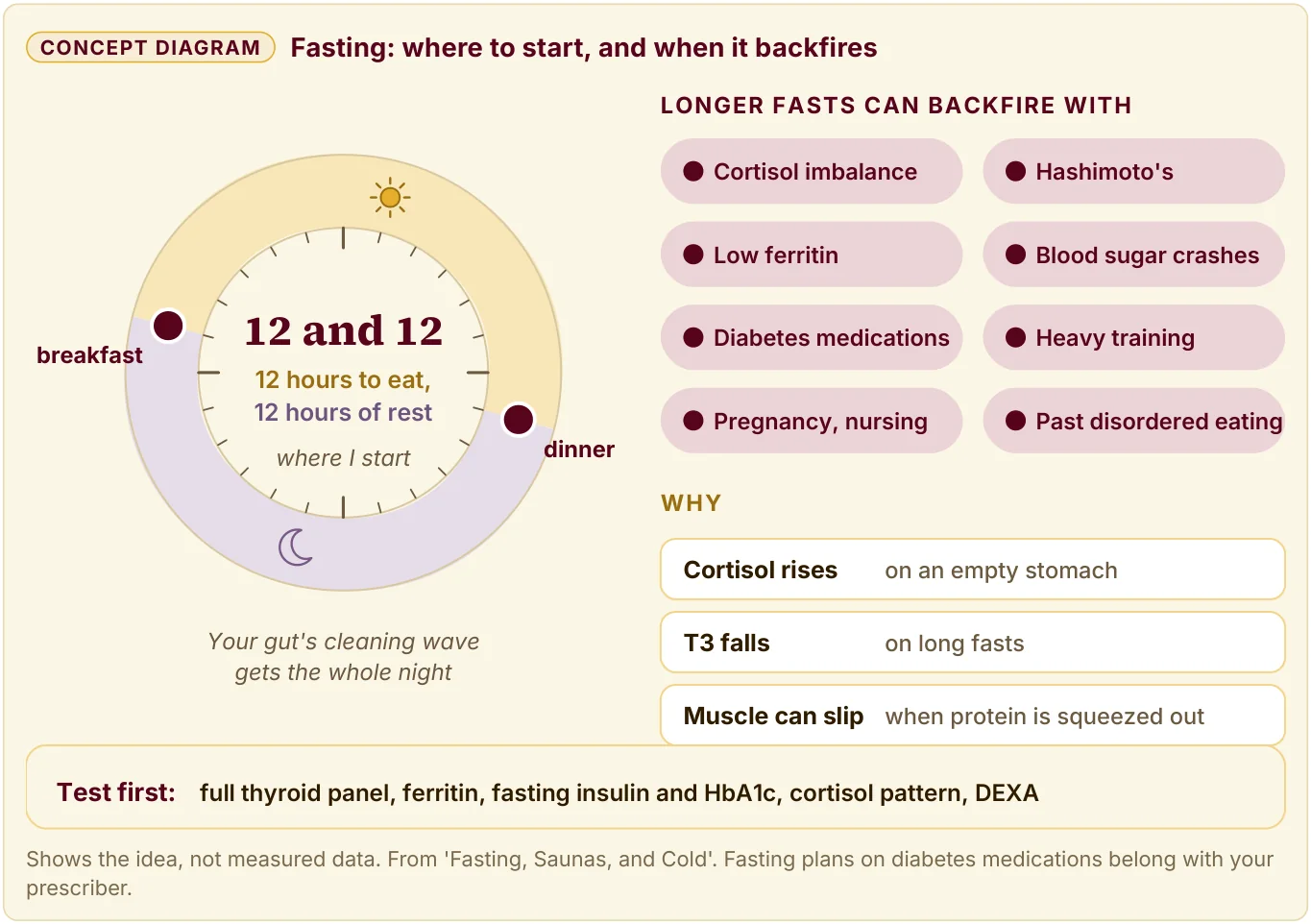
Concept diagram titled 'Fasting: where to start, and when it backfires'. On the left, a clock ring labeled '12 and 12: 12 hours to eat, 12 hours of rest, where I start', with breakfast and dinner marked on the ring, a sun over the eating half and a moon over the resting half. Beneath it: 'Your gut's cleaning wave gets the whole night'. On the right, 'Longer fasts can backfire with': cortisol imbalance, Hashimoto's, low ferritin, blood sugar crashes, diabetes medications, heavy training, pregnancy and nursing, and past disordered eating. 'Why': cortisol rises on an empty stomach; T3 falls on long fasts; muscle can slip when protein is squeezed out. 'Test first': full thyroid panel, ferritin, fasting insulin and HbA1c, cortisol pattern, DEXA. Note: shows the idea, not measured data. From 'Fasting, Saunas, and Cold'. Fasting plans on diabetes medications belong with your prescriber. Note, not part of the chart: Fasting is not recommended for any Woman with a history of an eating disorder. In the United States, the ANAD Eating Disorders Helpline is 1-888-375-7767.
Fasting is not recommended for any Woman with a history of an eating disorder. In observational research, fasting was linked over time with more eating disorder symptoms and less intuitive eating.
Your recovery is the priority, and regular, nourishing meals are part of it. If any part of this chapter stirs old patterns, please talk with a clinician who specializes in eating disorders. In the United States, the ANAD Eating Disorders Helpline is 1-888-375-7767, Monday to Friday, 9 AM to 9 PM Central time, and they return messages left outside those hours.
My fasting is typically 9 to 9. And I break fast with bone broth and decaffeinated tea with full-fat coconut milk.
That is a 12-hour overnight fast, every day. The broth brings warmth, minerals, and a little protein, and the coconut milk brings fat, so my blood sugar rises gently into the day.
I have tried longer fasts. On longer fasts, I felt extremely shaky, a little hyper, and ungrounded.
When a Woman asks me about intermittent fasting, I start with 12 and 12: 12 hours of eating, 12 hours of rest, so her digestive system gets a full night off. Before she chooses any other fasting method, I want her labs in hand.
Fasting may not be the remedy based on her lab results.
If your labs are steady, and you want to explore a longer window:
Then ask the InSight Question: 'Does this strengthen, nourish, and move me toward my Aliveness, or deplete, weaken, and move me away?'
The famous findings come from Finnish men. In 2,315 middle-aged men in eastern Finland, followed for about 20 years, those who used a sauna 4 to 7 times a week had about 63 percent lower risk of sudden cardiac death, about 50 percent lower risk of dying from cardiovascular disease, and 40 percent lower risk of dying from any cause than men who went once a week. Longer sessions were linked to lower risk.
Women came later. In a Finnish study of 1,688 men and Women with an average age of 63, frequent sauna was linked to lower cardiovascular death in both sexes, as the Heart chapter describes. In 1,628 Finnish men and Women, sauna 4 to 7 times a week was linked to about 61 percent lower risk of stroke than once a week.
These are observational studies. Finnish sauna users who go 4 to 7 times a week may also be healthier, more active, and wealthier, so the research shows a strong association and cannot prove the sauna did the work. A Mayo Clinic Proceedings review described the evidence as promising for the heart, blood pressure, and pain, with most of it from Finnish cohorts and small trials.
In young Women. In a 2025 study of 28 young, healthy Women new to the sauna, 3 rounds of 10 minutes at about 194 degrees Fahrenheit, with cold showers and short cold plunges between them, raised heart rate and briefly raised systolic blood pressure by about 9 points in the first round. Pressure trended down across the rounds, with no building strain.
I use a Sunlighten infrared sauna at least 4 times a week. My Sunlighten has preset programs, and I use the Detox program, on its gentle setting. It is 1 of the most nourishing parts of my week.
They help with sleep. Don't do them right after you eat. Do them after you exercise.
After exercise. I sit in the heat once my body has already moved.
Away from meals. The physiology is simple: heat draws blood toward your skin, and digestion draws it toward your gut, so I give a meal time to settle before I sit in the heat.
It helps me sleep. Many sauna users say the same in surveys, and my own nights tell me so.
When my cortisol was very low, I began much more gently. An educator in Hashimoto 411 suggested a warm setting, 10 to 15 minutes, 2 or 3 times a week, with water and electrolytes before and after.
'Blood Sugar, Light, Sleep, and Saying No', in 'Burnout and Fatigue', tells that part of the story. Start where your body is, and let your body set the pace as it grows stronger.
A 2025 meta-analysis of 83 studies found that Women have lower skin temperatures and feel colder than men in cold environments, while their core temperature runs slightly higher. The same plunge can feel much harsher to a Woman, and that is physiology.
Brown fat shows up on scans more often in Women than in men, and Women's hormones shift their response to cold across the cycle. In the second half of the cycle, core temperature runs higher, and cold may feel harsher. Dr. Susanna Søberg, the Danish metabolism researcher whose work popularized cold and heat protocols, advises shorter exposures in the second half of the cycle and around your period, and she reminds Women that colder is not always better.
The weekly 'doses' quoted online, about 11 minutes of cold and 57 minutes of heat, describe the habits of the winter swimmers Dr. Søberg studied. They are observations, and nobody has tested them as a dose.
Heart conditions and high blood pressure. Cold water sets off a cold shock: a gasp, a racing heart, fast breathing, and a spike in blood pressure. Cold shock combined with breath-holding or putting your face in the water can trigger dangerous heart rhythms.
Raynaud's. Raynaud's is most common in Women. Secondary Raynaud's often appears in Midlife alongside Autoimmune and connective tissue conditions such as lupus, scleroderma, Sjögren's, and rheumatoid arthritis, and cold is its main trigger. If your fingers turn white or blue in the cold, a plunge is a poor fit.
Low cortisol. Cold is a strong stress signal. No studies have tested cold exposure in people with a flat cortisol pattern, and a body already short on stress reserve has little to answer it with.
Hypothyroidism and Hashimoto's. Feeling cold is a classic symptom of low thyroid. Adding cold stress to a thyroid that cannot yet keep you warm has not been studied, and some Women with Hashimoto's feel worse for it. Optimize your thyroid first, as 'Your Thyroid, In Depth' explains.
If you always run cold. Cold hands and feet, a low body temperature, and needing a sweater when others are comfortable are signals to test your thyroid, your iron, and your cortisol, before you add more cold.
Pregnancy. Avoid cold plunging.
If you do choose the cold, follow the safety basics Dr. Søberg teaches. Never hyperventilate before you enter, keep your head above the water when you are starting, go with a companion, and skip the cold when you are unwell or under heavy stress.
I don't do the cold. My body always runs cold. It's too hard on my adrenals, and warm is what feels nourishing for my body.
Definitely not cold, for me. My body has told me so clearly.
For a Woman like me, with Hashimoto's and a cortisol curve that once sat near the floor, warmth is the medicine: the sauna, warm food, warm drinks, a warm bath with Epsom salts, a warm bed. When your body runs cold, warmth is how you tell it that it is safe.
If you love the cold and your labs are steady, a gentle place to start is 30 to 60 seconds of cool water at the end of a warm shower, on a calm day, away from your lifting. Notice how you feel for the rest of that day and the next morning. Your own response is the most important study you will ever read.
This article is a section of The Midlife Bible: The Essential Guide to the Women's Midlife Journey, by Daniela Hess, MSEd. It is the book's own text, so where it says 'this book' or points to another part, that means the Bible. The book has the full chapters, charts, and the Lab Wish List.
Educational content, not medical advice. Please work with your own practitioner before you change a medication or a supplement.
These 3 connect to what you just read.
'You don't have room for error in Midlife.' That can sound like pressure, and I mean it as good news: when the buffer thins, every nourishing meal counts for more. Here is how protein at each meal, 6 to 15 kinds of vegetables a day, meals spaced 4 to 5 hours apart, and a clear look at alcohol fit together.
Read this article →Food, movement, and breathThe workouts that carried you at 30 may be too little in some ways and too much in others at 50. Here is why lifting comes first, what the walking research says about 7,000 steps, how to protect your pelvic floor while you train, and the signs that exercise has become another stress, with a weekly shape you can adjust to your own labs and energy.
Read this article →The roots underneath'I'm fine, just busy.' If that is your sentence, your body may be carrying a load you stopped feeling a long time ago. This article walks through what stress does inside you, step by step, how it loosens the gut lining, why the load adds up across Midlife, and how a longer exhale gives your Nervous System a signal of safety.
Read this article →FAQ
The research is thin. A 2022 review of human fasting trials found no studies at all in Women in Perimenopause or after Menopause at that time, and Perimenopause is the season when many Women try fasting. Reviews conclude that females appear more sensitive than males to the reproductive effects of eating too little, although most of that comes from animals.
A meta-analysis found that fasting raises plasma cortisol in the short term. Dr. Stacy Sims advises active Women in Perimenopause and after to avoid intermittent fasting and fasted training.
A 2026 meta-analysis of 15 studies of water fasts lasting from 24 hours to 10 days found large drops in Free T3 and total T3, a moderate drop in TSH, and no change in Free T4. That pattern is consistent with slower conversion of T4 to T3, and fasts longer than 3 days lowered Free T3 more.
Research on fasting in Hashimoto's itself is very thin, and no guideline tells a Woman with Hashimoto's how to fast. If you take thyroid medication on an empty stomach, its timing also has to fit around any eating window, so bring that question to your prescriber. Hypothyroidism vs Hashimoto's has the thyroid picture.
A gentle overnight fast has the best Women-specific support. In a 2016 study of 2,413 Women with early breast cancer, fasting fewer than 13 hours overnight was linked to a 36 percent higher risk of the cancer returning, compared with 13 hours or more. That shows an association, in Women with early breast cancer. When a Woman asks me, I start with 12 and 12, which means 12 hours of eating and 12 hours of rest, and I want her labs in hand before she tries anything longer.
Fasting is not recommended for any Woman with a history of an eating disorder, and it is not advised in pregnancy or breastfeeding. In the United States, the ANAD Eating Disorders Helpline is 1-888-375-7767.
The famous findings come from Finnish men. In 2,315 men followed for about 20 years, sauna 4 to 7 times a week was linked to about 63 percent lower risk of sudden cardiac death than once a week. Women came later, and frequent sauna was linked to lower cardiovascular death in both sexes. These are observational studies, so they show an association and cannot prove the sauna did the work.
People with unstable angina, a recent heart attack, or severe aortic stenosis should avoid the sauna, and anyone with heart disease should ask a cardiologist first. Ask your prescriber about diuretics and blood pressure medications. Never drink alcohol before or during a sauna.
A 2025 meta-analysis of 83 studies found that Women feel colder than men in cold environments, so the same plunge can feel much harsher to a Woman. Cold plunges can backfire with heart conditions, high blood pressure, Raynaud's, low cortisol, and Hashimoto's. If your fingers turn white or blue in the cold, a plunge is a poor fit.
Cold water sets off a cold shock: a gasp, a racing heart, and a spike in blood pressure. If you always run cold, test your thyroid, your iron, and your cortisol before you add more cold. Avoid cold plunging in pregnancy.

A 75-page PDF guide plus the 1 hour 43 minute talk, The Entire Midlife Journey.
Send me the guideYour thyroid, your gut, your hormones, and your labs.
Get The Midlife Bible3 hours with Daniela Hess and Kim Beekman, recorded live. The Midlife Bible is included.
See the workshop60 to 90 minutes one-on-one. Send a request to work with Daniela.
Work with Daniela