Free guide
Free
The Midlife Essentials and the talk
A 75-page PDF guide plus the 1 hour 43 minute talk, The Entire Midlife Journey.
Send me the guide
By Daniela Hess, MSEd12 min readOctober 2026
'My periods never kept a calendar, and now my chin, my part, and my waist are all changing.' PMOS, the new name for PCOS, reaches well past the ovaries. Here is how insulin sits at the root, which risks it raises for your heart, blood sugar, and uterine lining, and what shifts in Perimenopause and after Menopause.
Your periods may never have kept a calendar. A cycle of 35 days, then 60, then 2 months of nothing, and as a teenager someone handed you the pill and the question was closed.
Now you are in your 40's. There are new hairs on your chin, acne along your jaw, hair thinning at your part, a waist that grows no matter how carefully you eat, and a 3 PM crash that sends you looking for something sweet.
For many Women, these are the signs of 1 underlying pattern, and it now has a new and more accurate name. PMOS, formerly called PCOS, reaches far past the ovaries, and its story keeps unfolding through Perimenopause and after Menopause.
This is education. Every medication and dose decision stays with your prescriber. What I can give you is the map, and the words to ask for the care you deserve.
On May 12, 2026, polycystic ovary syndrome was officially renamed polyendocrine metabolic ovarian syndrome, PMOS. The change was published in The Lancet and presented at the European Congress of Endocrinology, after a decade of work led by Professor Helena Teede at Monash University in Australia.
The process gathered about 22,000 responses across 3 global surveys, from Women living with the condition, doctors, researchers, and advocacy groups. The American Society for Reproductive Medicine reports that 56 patient organizations and medical societies took part, and that Women with lived experience were the biggest drivers of the change.
Each word now describes something real.
The old name pointed at cysts that are not cysts. The small 'cysts' seen on ultrasound are follicles, the sacs that hold developing eggs, paused partway through their growth. STAT News reported that the old name led Women to blame cysts for their symptoms, risked missed diagnoses, and left Women without visible 'cysts' dismissed despite their metabolic and fertility problems.
The diagnosis itself has not changed. The American Academy of Family Physicians notes that it still requires 2 of 3 features: signs of high androgens, in your body or your blood; irregular or absent ovulation; and polycystic ovaries on ultrasound or a high AMH. International guidelines are expected to adopt the new name in 2028, so you will see both names on paperwork for a while.
The American Society for Reproductive Medicine estimates that PMOS affects about 1 in 8 Women, more than 170 million worldwide. STAT News reports the World Health Organization's estimate that up to 70 percent are undiagnosed.
Insulin resistance sits at the center of PMOS for most Women. The American Academy of Family Physicians notes that insulin resistance affects up to 85 percent of Women with the condition, including 75 percent of those at a lower weight, with a BMI of 25 or under.
That second number matters. Lean PMOS is real, and a Woman who looks slim can still carry high insulin, irregular cycles, and chin hair.
Here is the chain, in plain steps:
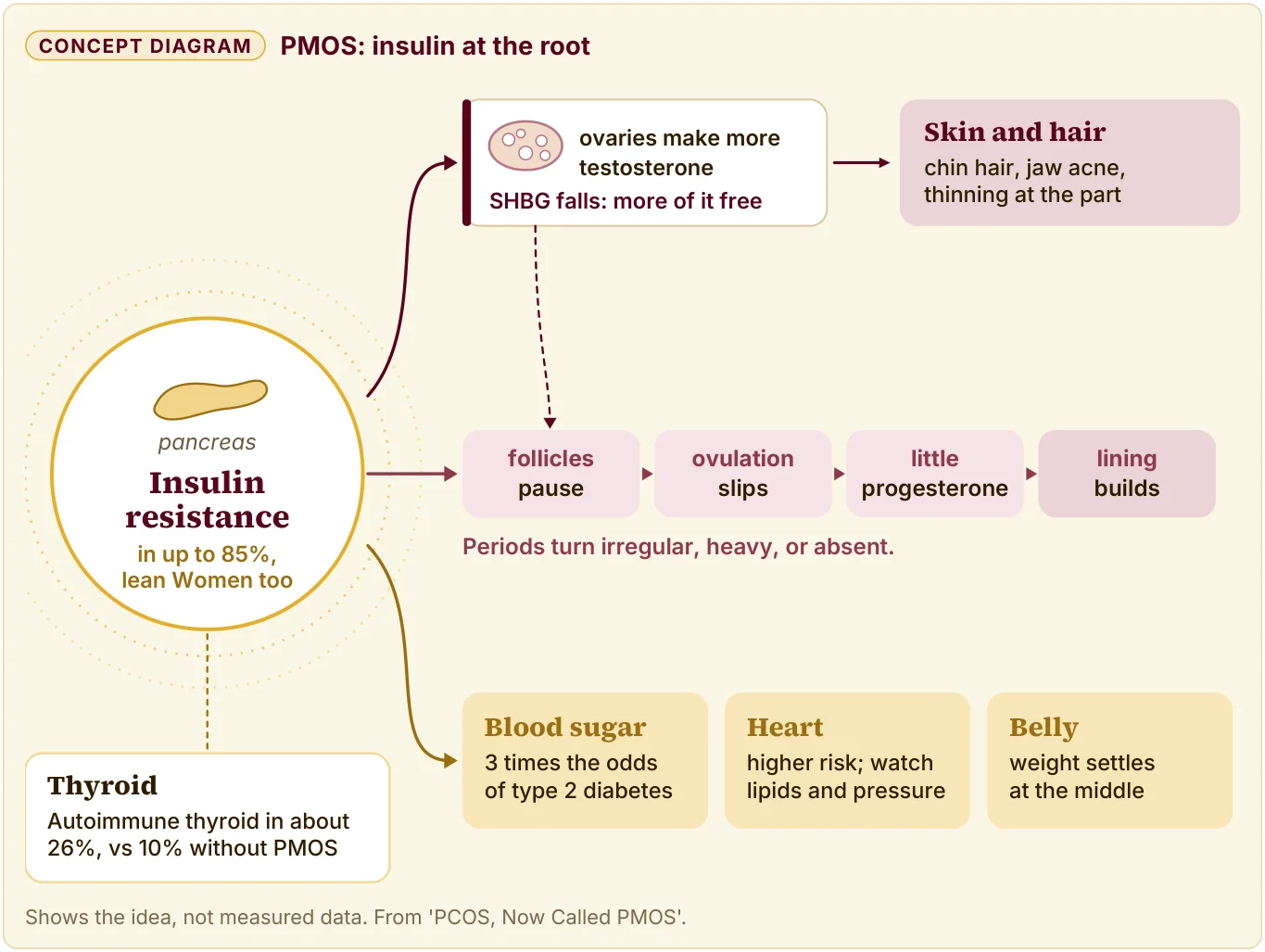
Concept diagram titled 'PMOS: insulin at the root'. At the center is the pancreas and the words 'Insulin resistance, in up to 85%, lean Women too'. From the center, 3 paths lead outward. Path 1: the ovaries make more testosterone, and SHBG falls so more of it is free. This leads to 'Skin and hair': chin hair, jaw acne, thinning at the part. A dotted line from this box also points down to the ovulation steps. Path 2, in the middle: follicles pause, then ovulation slips, then little progesterone, then the lining builds. The note reads: 'Periods turn irregular, heavy, or absent.' Path 3: 3 boxes. Blood sugar: 3 times the odds of type 2 diabetes. Heart: higher risk; watch lipids and pressure. Belly: weight settles at the middle. Below the center, a dotted line connects to a Thyroid box: 'Autoimmune thyroid in about 26%, vs 10% without PMOS'. Footer note: 'Shows the idea, not measured data. From PCOS, Now Called PMOS.'
'Insulin Resistance, Step by Step', in 'Sugar, and the Addiction Nobody Names', goes deeper into the first link.
The order you eat that plate in matters more than most people realize. Start with vegetables first. Fiber creates a kind of mesh in your digestive tract that slows how quickly glucose hits your bloodstream. Then protein and fat.
Your cycles. Johns Hopkins Medicine lists missed periods, irregular periods, or very light periods. Some Women have heavy, long bleeds after long gaps.
Your hair. Coarse, dark hair on the chin, upper lip, chest, belly, or back, and thinning hair on the scalp in a male pattern, at the crown and the part. 'Hair Loss, Skin, and Nails' walks through every cause of hair loss, including high DHT and low SHBG.
Your skin. Acne, especially along the jaw, skin tags, and dark, thick, velvety patches on the back of the neck or in the armpits, which Johns Hopkins lists among the signs. Those dark patches, called acanthosis nigricans, are a visible sign of high insulin.
Your weight and your waist. Weight that settles around the belly, and that can be very hard to move while insulin runs high. 'Weight Gain and Belly Fat' explains why Midlife adds its own layer.
Your mood. The 2023 international guideline notes a high prevalence of moderate to severe depression and anxiety in Women with PMOS and recommends screening every Woman. It also asks practitioners to watch for disordered eating at any weight, and to be aware of weight stigma when they talk about lifestyle.
Your sleep. The same guideline asks practitioners to check every Woman with PMOS for symptoms of obstructive sleep apnea, such as snoring, gasping, and waking unrefreshed. 'Sleep Apnea: The Diagnosis Women Miss', in the Sleep chapter, goes deeper.
Your fertility. Irregular ovulation makes conception harder, and the guideline now names letrozole as the first-line medication to help ovulation, for Women who are still building their families.
Blood sugar. A 2018 analysis of 40 studies found that Women with PMOS had about 3 times the odds of type 2 diabetes and of impaired glucose tolerance, the step before it. The 2023 guideline says the risk is raised at every age and every weight, and recommends checking blood sugar at diagnosis and again every 1 to 3 years.
Your heart. The guideline states that Women with PMOS should be considered at increased risk of cardiovascular disease, while noting that the overall risk before Menopause is low. It recommends a lipid panel at diagnosis and a blood pressure check every year.
The 2026 cholesterol guideline from the American College of Cardiology and the American Heart Association lists polycystic ovary syndrome among the factors that raise heart risk, as 'Your Heart' describes.
Your uterine lining. Before Menopause, Women with PMOS have a markedly higher risk of endometrial hyperplasia and endometrial cancer, because the lining can build for months without progesterone to shed it. The guideline adds that the overall chance of endometrial cancer is low, so routine screening is not recommended, and it names regular progestogen therapy, cycle regulation, and weight care as protective steps.
Knowing you have PMOS is how you protect your heart and your blood sugar for the decades ahead.
You don't have room for error in Midlife. You just generally don't. What you do in your 20s and 30s creates the situations you have in your 40s and 50s, and how you treat yourself in your 40s and 50s will determine 60 and up.
PMOS and Hashimoto's often travel together. A 2018 analysis of 13 studies found Autoimmune thyroid disease in about 26 percent of Women with PMOS, compared with about 10 percent of Women without it, roughly 3 times the odds. The authors recommended considering thyroid function and thyroid antibody tests in Women with PMOS, even without obvious symptoms.
The 2 conditions also tangle each other's signals. Dr. Datis Kharrazian describes how high insulin drives testosterone up, and how high testosterone can speed the conversion of T4 into T3 so much that cells turn down their own T3 receptors. The result can be a Woman with every symptom of low thyroid and hormone levels that look adequate on paper, as 'Sugar and Your Hormones' explains.
A slow thyroid also makes ovulation less likely and lowers SHBG, adding to the androgen picture. The guideline lists a TSH among the tests that rule out look-alike conditions, and I want every Woman with PMOS to have a full thyroid panel with both antibodies. 'Your Thyroid, In Depth' goes deeper.
Myo-inositol connects these 2 stories, since it supports both insulin signaling and the TSH signal inside your thyroid. 'Myo-Inositol, In Depth', in the Supplements chapter, explains the 2013 study in which myo-inositol with selenium lowered TSH in people with Hashimoto's.
Some features ease with age. In a 2000 study of 205 Women with PMOS aged 30 and older, cycles grew shorter and more regular with age, as the number of follicles fell. AMH, which runs high in PMOS, also falls as you approach Menopause.
Others build. A 2022 review in Fertility and Sterility describes the menopausal transition in PMOS: some reproductive features improve, while BMI, insulin resistance, type 2 diabetes, and high blood pressure increase. The cycles may calm down just as the metabolic risks speed up, which is why Midlife is the time to look closely.
Androgens persist. The 2023 guideline says PMOS could be considered a lifelong condition, and that higher androgens, in the body and in the blood, persist after Menopause. Chin hair and scalp thinning can continue even after your periods have stopped.
A diagnosis can still be made after Menopause. The guideline says PMOS could be diagnosed after Menopause if you were diagnosed earlier, or if you had long-standing irregular cycles with signs of high androgens or polycystic ovaries between about 20 and 40. Old cycle records, old ultrasound reports, and photos of your skin at 25 become useful evidence.
New, severe, or worsening androgen signs after Menopause need a work-up. The guideline recommends ruling out androgen-secreting tumors and ovarian hyperthecosis in a postmenopausal Woman with new-onset, severe, or worsening hair growth or other androgen signs. 'Hair Loss, Skin, and Nails' names the signs that call for a prompt visit.
Midlife overlaps with PMOS in confusing ways. Falling estrogen tips the balance toward androgens for many Women, so a few chin hairs at 50 do not, on their own, mean PMOS. The pattern over your lifetime, read together with your labs, is what tells the story.
Hormone therapy remains a protection. 'Hormone Therapy 101' walks through the forms, and for a Woman with PMOS who still has a uterus, how her lining is protected with progesterone deserves its own question. Every choice of form and dose stays with your prescriber.
Every step that lowers insulin works on the root. The 2023 guideline names healthy eating and physical activity as the foundation of care, at every weight.
Steady your blood sugar.
'Sugar, and the Addiction Nobody Names' has the full plate, the food order, and the after-meal walk, and 'Eating for Midlife' covers protein, fiber, and healthy fats.
Build muscle. Muscle is where much of your blood sugar goes after a meal, so every pound you build gives insulin somewhere to work.
The 2023 guideline recommends 150 to 300 minutes of moderate activity or 75 to 150 minutes of vigorous activity a week, plus muscle-strengthening work on 2 non-consecutive days a week. 'Movement in Midlife' shows how to begin, and how to tell when exercise has become too much.
Protect your sleep. Short or broken sleep raises insulin resistance the next day, and sleep apnea is more common in PMOS. 'Sleep' holds the full routine.
Lower your stress load. Cortisol raises blood sugar, and your adrenal glands make some of your androgens, so a body on high alert can feed the pattern. 'Stress' and 'Cortisol and Midlife Burnout' go deeper.
Set alcohol down. It disrupts blood sugar overnight, adds to your liver's load, and breaks sleep. I want Women not drinking in Midlife.
Care for your liver and gut. Your liver clears hormones and helps regulate SHBG, and a calm gut lowers the inflammation that travels with insulin resistance. 'Your Liver, Your Kidneys, and Your Gut' and 'The Gut, In Depth' go deeper.
The Resource Directory lists Fem Excel, a doctor-led telehealth practice for Perimenopause, Menopause, and PMOS, for Women who want a provider who works with these hormones every day.
This article is a section of The Midlife Bible: The Essential Guide to the Women's Midlife Journey, by Daniela Hess, MSEd. It is the book's own text, so where it says 'this book' or points to another part, that means the Bible. The book has the full chapters, charts, and the Lab Wish List.
Educational content, not medical advice. Please work with your own practitioner before you change a medication or a supplement.
These 3 connect to what you just read.
Sugar is, in my view, the single largest addiction in our culture, and the 1 most often left off the list. Here is the craving loop, a blood sugar day hour by hour, why Midlife changes the math, and how to build a steady plate.
Read this article →Your hormones and your thyroid'I fall asleep easily, then I am wide awake at 3 in the morning with my mind racing.' If anxiety, heavier periods, and tender breasts showed up in your 40's, progesterone may be falling while estrogen is still normal or even high. Here is where progesterone works in your body, why it falls first, and what estrogen dominance means in Functional Medicine.
Read this article →What you may be feelingYou may be eating exactly what you ate at 35 and gaining anyway. Here is what can sit behind it, what helps, and what to know about GLP-1 medications before you start.
Read this article →FAQ
On May 12, 2026, polycystic ovary syndrome was officially renamed polyendocrine metabolic ovarian syndrome, PMOS. About 22,000 responses across 3 global surveys, from Women with the condition, doctors, and researchers, shaped the change. The old name pointed at cysts, and the small 'cysts' on ultrasound are follicles paused partway through their growth.
The diagnosis itself has not changed. International guidelines are expected to adopt the new name in 2028, so you will see both names on paperwork for a while.
Yes. Lean PMOS is real. Insulin resistance affects up to 85 percent of Women with the condition, including 75 percent of those with a BMI of 25 or under, so a Woman who looks slim can still carry high insulin, irregular cycles, and chin hair.
Here is the chain: your cells stop answering insulin well, so your pancreas makes more. High insulin pushes the ovaries to make more testosterone and lowers SHBG, so more testosterone circulates free and active. Without ovulation there is little progesterone, and periods turn irregular, heavy, or absent. Sugar and the Addiction Nobody Names goes deeper.
The 2023 guideline recommends checking blood sugar at diagnosis and again every 1 to 3 years, a lipid panel at diagnosis, and a blood pressure check every year. It lists a TSH among the tests that rule out look-alike conditions, and I want every Woman with PMOS to have a full thyroid panel with both antibodies.
A 2018 analysis of 13 studies found Autoimmune thyroid disease in about 26 percent of Women with PMOS, compared with about 10 percent of Women without it. The full list of tests, with timing and the optimal ranges, is in The Midlife Bible.
No, and PMOS could be considered a lifelong condition, according to the 2023 guideline. Some features ease and others build. In a 2000 study of 205 Women with PMOS aged 30 and older, cycles grew shorter and more regular with age. A 2022 review in Fertility and Sterility describes BMI, insulin resistance, type 2 diabetes, and high blood pressure increasing, so cycles may calm down just as the metabolic risks speed up. The 2023 guideline says higher androgens persist after Menopause, so chin hair can continue.
New, severe, or worsening androgen signs after Menopause need a work-up, so please call your doctor promptly. The same goes for any bleeding once you have gone 12 months without a period.
Every step that lowers insulin works on the root, and the 2023 guideline names healthy eating and physical activity as the foundation of care, at every weight. Build each meal around protein and healthy fat, start your plate with vegetables, eat starches last, and take a 10-minute walk after your largest meal. Build muscle too, since muscle is where much of your blood sugar goes after a meal.
Protect your sleep and lower your stress load, since cortisol raises blood sugar. Conventional options exist, and every medication decision stays with you and your prescriber.

A 75-page PDF guide plus the 1 hour 43 minute talk, The Entire Midlife Journey.
Send me the guideYour thyroid, your gut, your hormones, and your labs.
Get The Midlife Bible3 hours with Daniela Hess and Kim Beekman, recorded live. The Midlife Bible is included.
See the workshop60 to 90 minutes one-on-one. Send a request to work with Daniela.
Work with Daniela