Free guide
Free
The Midlife Essentials and the talk
A 75-page PDF guide plus the 1 hour 43 minute talk, The Entire Midlife Journey.
Send me the guide
By Daniela Hess, MSEd14 min readOctober 2026
'You don't have room for error in Midlife.' That can sound like pressure, and I mean it as good news: when the buffer thins, every nourishing meal counts for more. Here is how protein at each meal, 6 to 15 kinds of vegetables a day, meals spaced 4 to 5 hours apart, and a clear look at alcohol fit together.
Food is the practice you return to 3 times a day, every day, for the rest of your life. No other daily choice touches your muscle, your bones, your blood sugar, your gut, your liver, your sleep, and your mood all at once.
My own plate is the Autoimmune Protocol and a personalized Paleo way of eating. I eat no grains, and I get my carbohydrates from vegetables, along with quinoa and buckwheat, which are seeds. I eat a nutrient-dense diet of animal protein with plenty of cooked vegetables, very little fruit, and no added sugar, and that is how my brain came back.
I say this to the Women I work with, gently and honestly:
You don't have room for error in Midlife. You just generally don't.
That sentence can sound like pressure. I mean it as good news. When the buffer thins, every nourishing meal counts for more.
This chapter gathers the daily foundations in 1 place: protein, vegetables and fiber, healthy fats, water and salt, the rhythm of your meals, and alcohol. The Sugar chapter and the Autoimmune Protocol chapter go deeper on blood sugar and on healing the gut, and this chapter points you to them at every turn.
Your body in your 40's and 50's is quietly rebuilding its own rules.
None of this calls for a diet. It calls for a plate built on purpose, meal after meal.
Muscle is rebuilt every day from the protein you eat. With age, muscle responds less to a small serving, a change researchers call anabolic resistance, so a Midlife Woman needs more protein at each meal to send the same signal.
Per day. The 2025 to 2030 Dietary Guidelines for Americans suggest 1.2 to 1.6 grams of protein per kilogram of body weight a day. For a 150-pound Woman, about 68 kilograms, that is about 80 to 110 grams a day.
The European geriatric experts behind PROT-AGE recommend 1.0 to 1.2 grams per kilogram for adults over 65, and 1.2 or more for active adults. In a 2018 analysis of 49 trials in people who lifted weights, the extra muscle gain from protein leveled off at about 1.6 grams per kilogram a day. For most Women, the biggest gap sits between the old minimum of 0.8 grams and 1.2 grams per kilogram.
Per meal. Research suggests about 25 to 30 grams of high-quality protein at a meal gives muscle its full signal, and less than about 20 grams blunts it in older adults. In a small 2014 study of 8 healthy adults, spreading about 30 grams across each of 3 meals produced 25 percent more muscle building over 24 hours than the same protein skewed toward dinner.
That study was small and mostly in men, and it points the same way as the larger research. Your muscle answers to each meal, so feed it at each meal.
What 25 to 30 grams looks like. According to USDA data, each ounce of cooked meat, poultry, or fish carries about 7 to 8.5 grams of protein. So a portion about the size and thickness of your palm, roughly 4 ounces, lands you near 30 grams.
Dr. Gabrielle Lyon recommends at least 30 grams at each meal, with 30 to 50 grams as her sweet spot, and about 1 gram per pound of ideal body weight a day. Her target sits above the trial-supported range, and 'How Much Protein, Really? Dr. Lyon, the RDA, and PROT-AGE', in the Autoimmune Protocol chapter, sets every target side by side, with a sample AIP day at about 110 grams.
If you have kidney disease, your protein target belongs with your doctor.
If counting grams or tracking food has ever stirred an eating disorder or old patterns, set the numbers in this chapter aside, and let a clinician who specializes in eating disorders guide your plate.
Protein and your bones. Bone is built on a protein framework, mostly collagen, with minerals set into it, and 'Protein: The Frame Your Bones Are Built On', in the Bones chapter, shows why protein and calcium work as a team.
When protein sits heavy. If meat feels like a brick in your stomach, or you belch and bloat after a protein meal, low stomach acid may be part of your picture. 'Your Stomach: Low Stomach Acid, Heartburn, and Why You May Not Be Absorbing Your Nutrients' explains how to test and what helps. Protein you cannot digest cannot rebuild you.
Breakfast is where most Women fall short. Coffee, toast, a piece of fruit, or a bowl of cereal spends the whole morning below the line muscle needs, and it sets up the blood sugar swing the Sugar chapter describes.
Your first full meal of the day is the 1 to protect most. Aim for 25 to 30 grams of protein, with vegetables and healthy fat beside it.
Breakfast does not have to look like breakfast. Last night's salmon over greens, a hash of ground pork with sweet potato and kale, or turkey patties with sautéed zucchini all count.
My own rhythm is fat and protein soon after waking, then meals about 4 to 5 hours apart. I break my overnight fast gently, with bone broth and decaffeinated tea with full-fat coconut milk, and 'Fasting, Saunas, and Cold: What Helps a Woman's Body, and When It Backfires' tells the rest of that story.
Breakfast within the first hour spares your adrenals their first rescue of the day. If you wake with no appetite at all, notice it, and read 'When Fasting Can Mask a Problem', in the fasting chapter, since a missing morning appetite can be a clue to your thyroid, your cortisol, or your stress.
Aim for 6 to 15 different kinds of vegetables a day, with more vegetables than fruit. Variety matters as much as volume, because each plant feeds a different group of the microbes in your gut.
Cooked vegetables are gentler on your gut while it heals. Raw vegetables are fine if you tolerate them, and for some Women raw can constipate or bloat.
What fiber does for a Midlife Woman.
How much. In a 2019 series of reviews in The Lancet, people who ate the most fiber had 15 to 30 percent lower rates of death and of heart disease, stroke, type 2 diabetes, and colorectal cancer than those who ate the least, with the greatest benefit at about 25 to 29 grams a day. In US national diet data, Women averaged about 15 grams. That research is observational, and the gap it shows is large.
Variety, counted weekly. In the American Gut Project, a citizen science study of more than 15,000 people, those who ate more than 30 different plant types a week had more diverse gut microbes than those who ate 10 or fewer. 6 different vegetables a day carries you past 30 kinds by the end of a week.
A grain-free plate draws its fiber from vegetables, roots and tubers, berries, avocado, olives, and, once they pass reintroduction, seeds.
Count your vegetables for 3 days. Onion, garlic, and herbs count. So do the 3 kinds of greens in 1 salad. You may discover you eat the same 3 vegetables every week, and adding 1 new kind at each meal changes the whole picture.
If fiber bloats you, go slowly. A sudden jump in fiber can bring gas and bloating for a few weeks while your gut adjusts. If more vegetables bring more pain, more distension, or constipation, read 'Bloating: Why Your Belly Swells, and How to Find the Cause' and 'SIBO: The 3 Kinds, How to Test for Them, and How Each Is Treated', since an overgrowth can make fiber feel like the enemy.
Aim for 3 real meals, spaced 4 to 5 hours apart. The quiet test of a well-built plate is that it holds you for 4 to 5 hours.
The space between meals has a job. In the fasted state, your small intestine runs a cleansing wave called the Migrating Motor Complex about every 90 to 120 minutes, sweeping leftover food and bacteria forward, and eating interrupts it. Spacing meals to give that wave room is a reasonable inference from physiology, and 'SIBO' explains why it matters if you have had an overgrowth.
If you feel like you are eating all day, the meals themselves are usually too light. The aim is fewer, fuller meals, with no less food across the day. If your blood sugar is shaky in the first weeks, eating a little more often for a short stretch can steady you, as a temporary bridge.
Earlier is kinder. In a 2022 study at Brigham and Women's Hospital, 16 adults ate the exact same meals about 4 hours later in the day. The late schedule raised hunger, lowered leptin, the hormone that signals fullness, slowed calorie burning, and shifted fat tissue toward storing fat. Only 5 of the participants were Women, so the findings need larger studies, and they fit what many Women notice.
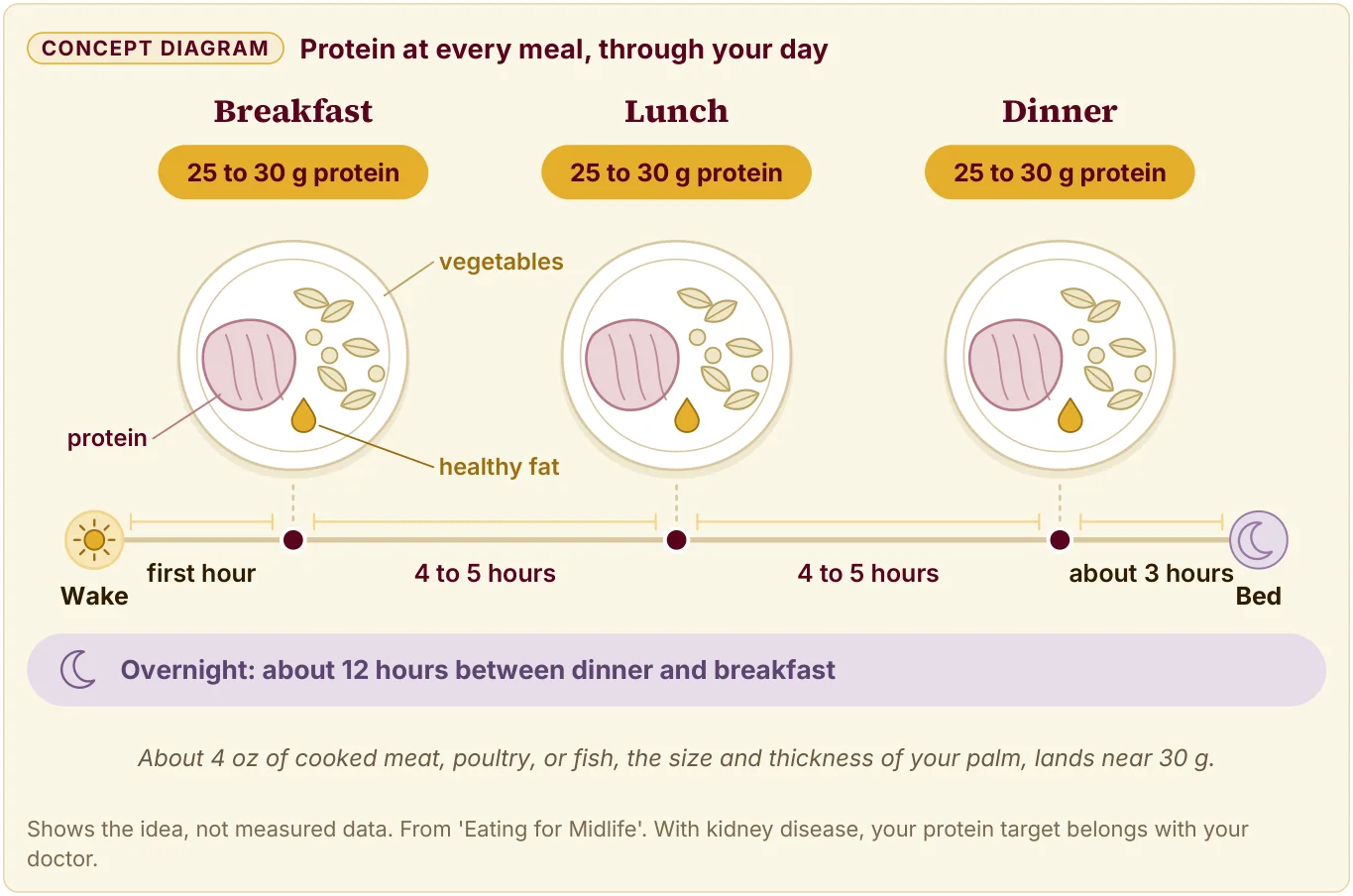
A day from wake to bed with 3 meals, each with 25 to 30 g of protein plus vegetables and healthy fat: breakfast in the first hour after waking, lunch 4 to 5 hours later, dinner 4 to 5 hours after that, bed about 3 hours after dinner, and about 12 hours overnight between dinner and breakfast. About 4 oz of cooked meat, poultry, or fish, the size and thickness of your palm, lands near 30 g. With kidney disease, your protein target belongs with your doctor. Note, not part of the chart: if counting grams has ever stirred an eating disorder, set the numbers aside.
For an Autoimmune body, the Autoimmune Recovery Method asks for grain-free eating, beyond gluten-free, and dairy-free eating, and gluten and dairy are never reintroduced. 'Gluten and Dairy Stay Out: Grain-Free, Not Just Gluten-Free', in the Autoimmune Protocol chapter, explains why.
If you have an Autoimmune condition, or symptoms that make you suspect 1, the Autoimmune Protocol for 90 days is the most powerful food step in this book. It calms the gut, quiets the immune system, and shows you which foods your own body answers to. 'The Autoimmune Protocol: 90 Days to Calm the Gut and Rebuild' walks you through it, from preparing your kitchen to reintroduction.
Sugar is its own conversation, because for many Women it behaves like a habit with a grip. 'Sugar, and the Addiction Nobody Names' covers the rollercoaster, insulin resistance, where sugar hides, the great grandmother test, and how to come off it.
Everything in this chapter fits inside those 2 chapters. Think of this chapter as the plate, and of those chapters as the deeper healing.
Alcohol: we really want to not be doing it.
This is the part of the chapter many Women would rather skip. I understand. The glass of wine at the end of a long day can feel like the 1 thing that belongs only to you.
I say what follows with no judgment on that glass. I say it because Midlife changes what alcohol does inside a Woman's body, and almost nobody tells her. My wish for every Woman reading this is a life without alcohol in it.
The research has moved in the same direction.
Alcohol asks something of every system in a Midlife Woman's body.
Your breasts. The Surgeon General's advisory estimated that about 16.4 percent of breast cancers in US Women in 2019, about 44,180 cases, were linked to alcohol. For Women who drink less than 1 drink a week, the lifetime risk of breast cancer was about 11.3 percent, rising to about 13.1 percent at 1 drink a day and about 15.3 percent at 2. The National Institute on Alcohol Abuse and Alcoholism states that even 1 drink a day can raise a Woman's breast cancer risk by 5 to 15 percent compared with not drinking.
Part of the reason is estrogen. In a controlled feeding study, premenopausal Women who drank about 2 drinks a day for 3 cycles had estradiol levels 27.5 percent higher around ovulation than in their alcohol-free cycles. A 2024 analysis of cohort studies found that each additional 10 grams of alcohol a day, a little less than 1 drink, was linked to higher estrogen and testosterone and lower SHBG in Women. 'Breast Care' shows how to care for your breasts, and 'Your Risk Number', in that chapter, how to know your own risk.
Your liver. Your liver is asked to clear the alcohol and your used estrogen at the same time, along with everything else it handles. In people with fatty liver, even moderate drinking raises the odds of advanced scarring, and alcohol and insulin resistance magnify each other.
Your liver keeps an honest record of the evening glass, even when the glass feels small. 'Your Liver, Your Kidneys, and Your Gut' goes deeper.
Your sleep. Alcohol helps you fall asleep and holds the first half of the night together, and then sleep breaks apart in the second half. The glass of wine that helps you drift off is often the same glass that wakes you at 3. 'The 3 AM Wake-Up, Taken Apart', in the Sleep chapter, explains why.
Your hot flashes. Mayo Clinic names alcohol among the common triggers of hot flashes, and the Hot Flashes chapter shows how to find your own triggers with a 2-week log.
Your blood sugar. Alcohol slows your liver's ability to make new glucose, a process called gluconeogenesis, so blood sugar can drop in the hours after drinking. Your body answers a low in the night with cortisol and adrenaline, and you may wake hot, heart pounding, mind switched on. Sweet wines, cocktails, and mixers can add sugar on top.
Your gut. Alcohol loosens the tight junctions between the cells of your gut lining and shifts your microbiome toward the organisms we are trying to calm. The second glass of wine asks more of your gut than the first. 'Alcohol and Gut Permeability', in 'The Gut, In Depth', explains.
Your mood and your anxiety. Anxiety that peaks the morning after drinking points toward alcohol rebound, as the Anxiety chapter explains. If you use a glass of wine to soften anxiety, you may find the anxiety itself grows softer once the wine is gone.
Your bones and your weight. Chronic heavy drinking is a significant risk factor for osteoporosis, and FRAX, the fracture calculator in the Bones chapter, counts alcohol in its score. Several drinks a week can add weight too, especially around your middle.
Why Women feel it more. The National Institute on Alcohol Abuse and Alcoholism explains that Women have less water in their bodies than men, so after drinking the same amount, a Woman of the same weight reaches a higher blood alcohol level. It also reports that over the past 2 decades, alcohol-related emergency visits, hospitalizations, and deaths have climbed faster in Women than in men.
On AIP, alcohol comes out for the full 90 days, and many Women tell me how much better they sleep within the first couple of weeks. Many AIP guides list alcohol among the Stage 3 reintroductions, and the Autoimmune Protocol chapter leaves it out.
A reintroduction test can tell you whether your immune system reacts loudly. It cannot tell you what alcohol is doing to your breasts, your liver, or your sleep.
This article is a section of The Midlife Bible: The Essential Guide to the Women's Midlife Journey, by Daniela Hess, MSEd. It is the book's own text, so where it says 'this book' or points to another part, that means the Bible. The book has the full chapters, charts, and the Lab Wish List.
Educational content, not medical advice. Please work with your own practitioner before you change a medication or a supplement.
These 3 connect to what you just read.
Sugar is, in my view, the single largest addiction in our culture, and the 1 most often left off the list. Here is the craving loop, a blood sugar day hour by hour, why Midlife changes the math, and how to build a steady plate.
Read this article →Food, movement, and breathThe workouts that carried you at 30 may be too little in some ways and too much in others at 50. Here is why lifting comes first, what the walking research says about 7,000 steps, how to protect your pelvic floor while you train, and the signs that exercise has become another stress, with a weekly shape you can adjust to your own labs and energy.
Read this article →What you may be feelingYou may be eating exactly what you ate at 35 and gaining anyway. Here is what can sit behind it, what helps, and what to know about GLP-1 medications before you start.
Read this article →FAQ
Research suggests about 25 to 30 grams of high-quality protein at a meal gives muscle its full signal, and less than about 20 grams blunts it in older adults. In a small 2014 study of 8 healthy adults, mostly men, spreading about 30 grams across 3 meals produced 25 percent more muscle building over 24 hours than the same protein skewed toward dinner.
A portion of cooked meat, poultry, or fish the size and thickness of your palm lands you near 30 grams. If you have kidney disease, your protein target belongs with your doctor. If counting grams has ever stirred an eating disorder, set the numbers aside and let a clinician who specializes in eating disorders guide your plate.
Aim for 6 to 15 kinds of vegetables a day, with more vegetables than fruit. Variety matters as much as volume, because each plant feeds a different group of your gut microbes. In the American Gut Project, a study of more than 15,000 people, those who ate more than 30 different plant types a week had more diverse gut microbes than those who ate 10 or fewer.
In a 2019 series of reviews in The Lancet, the greatest benefit came at about 25 to 29 grams of fiber a day, and in US national diet data, Women averaged about 15 grams. That research is observational. If fiber bloats you, go slowly. Bloating in Midlife helps you find the cause.
Between meals, your small intestine runs a cleansing wave called the Migrating Motor Complex about every 90 to 120 minutes, sweeping leftover food and bacteria forward, and eating interrupts it. Spacing meals to give that wave room is a reasonable inference from physiology. The aim is fewer, fuller meals, with no less food across the day. If your blood sugar is shaky in the first weeks, eating a little more often for a short stretch can steady you.
Earlier is kinder too. In a 2022 study at Brigham and Women's Hospital, 16 adults ate the same meals about 4 hours later, and the late schedule raised hunger and lowered leptin. Only 5 were Women, so the findings need larger studies.
My wish for every Woman is a life without alcohol in it, with no judgment on the glass. In 2023, the World Health Organization's European office stated that no level of alcohol use is safe for health. In January 2025, the US Surgeon General's advisory linked alcohol to at least 7 cancers, breast cancer among them.
For Women who drink less than 1 drink a week, the advisory put lifetime breast cancer risk at about 11.3 percent, rising to about 13.1 percent at 1 drink a day and about 15.3 percent at 2. Part of the reason is estrogen. In a controlled feeding study of premenopausal Women, about 2 drinks a day for 3 cycles meant estradiol levels 27.5 percent higher around ovulation than in their alcohol-free cycles.
If meat feels like a brick in your stomach, or you belch and bloat after a protein meal, low stomach acid may be part of your picture. Stomach acid and the enzyme that begins protein digestion can both fall in Midlife, so you may eat well and still absorb less. Protein you cannot digest cannot rebuild you.
Ask your practitioner how to check. At the table, sit down and take 1 slow breath before the first bite: inhale deep, exhale long, because a meal eaten in fight or flight starts behind. Low Stomach Acid and Heartburn explains how to test and what helps.

A 75-page PDF guide plus the 1 hour 43 minute talk, The Entire Midlife Journey.
Send me the guideYour thyroid, your gut, your hormones, and your labs.
Get The Midlife Bible3 hours with Daniela Hess and Kim Beekman, recorded live. The Midlife Bible is included.
See the workshop60 to 90 minutes one-on-one. Send a request to work with Daniela.
Work with Daniela