Free guide
Free
The Midlife Essentials and the talk
A 75-page PDF guide plus the 1 hour 43 minute talk, The Entire Midlife Journey.
Send me the guide
By Daniela Hess, MSEd11 min readOctober 2026
'I'm bloated by the end of every day, no matter what I eat.' Bloating usually has a findable cause. This article starts with the red flags that need a doctor promptly, then maps the drivers, including stomach acid, SIBO, your thyroid, and progesterone, and shares what helps, from how you eat to a plan for constipation.
'I'm bloated by the end of every day, no matter what I eat.'
A flat stomach in the morning, and looking 6 months pregnant by evening. Gas, pressure, and waistbands that dig in by 3 PM. Constipation, loose stools, or both in turn.
For decades, many Women never had to think about digestion, and then, somewhere in their 40's, the bloating arrived and stayed.
Before I knew I had SIBO, healthy food made me miserable. Within 10 minutes of eating garlic, onions, celery, mushrooms, or certain fruits, I was so bloated, and it would not go down.
Because eating made me so uncomfortable, I began to eat less, and that calorie restriction deepened the nutrient deficiencies I already had. My breath test later showed extreme methane.
Bloating usually has a findable cause. Rule out the serious causes first, and then do the root-cause work with a clear mind.
New bloating that persists, nearly every day, needs a prompt doctor's visit, especially with pelvic or belly pain, feeling full quickly, trouble eating, or needing to urinate urgently or often, because these can be early signs of ovarian cancer. The American Cancer Society advises seeing your doctor if you have these symptoms more than 12 times a month.
Call your doctor promptly, before any protocol, supplement, or elimination diet, if you also notice:
Colon cancer screening now begins at 45 for adults at average risk. I avoided my own colonoscopy because I was scared, and when I finally did it, it came back perfectly clean. The peace of mind it gave me was enormous. 'The Gut, In Depth' and 'The Mimics' go deeper into these red flags.
For your routine colon screening, and the stool and blood test options if a colonoscopy feels too hard right now, see 'Your Midlife Screening Calendar: The Tests That Protect You, and Your Options'.
Digestion runs from the top down. Stomach acid breaks protein apart, enzymes and bile finish the job in your small intestine, and a steady wave of muscle contractions sweeps the leftovers along. When any step comes up short, partly digested food lingers where bacteria can ferment it, and fermentation makes gas.
Low stomach acid. Food that sits like a stone, early fullness, burping, and reflux point toward your stomach. Autoimmune gastritis, H. pylori, long-term acid-blocking medication, and meals eaten in fight or flight can all lower stomach acid, and about 40 percent of people with Autoimmune gastritis also have Hashimoto's.
You cannot tell too much acid from too little by how the burn feels. 'Your Stomach: Low Stomach Acid, Heartburn, and Why You May Not Be Absorbing Your Nutrients' goes deeper.
Enzymes and bile. Bloating after starchy meals, with food that passes undigested, can point toward pancreatic enzymes. Bloating or nausea after fatty meals, with pale or floating stools, points toward bile. 'Digestive Supports, and How to Know Which You Need' in 'Your Stomach' goes deeper.
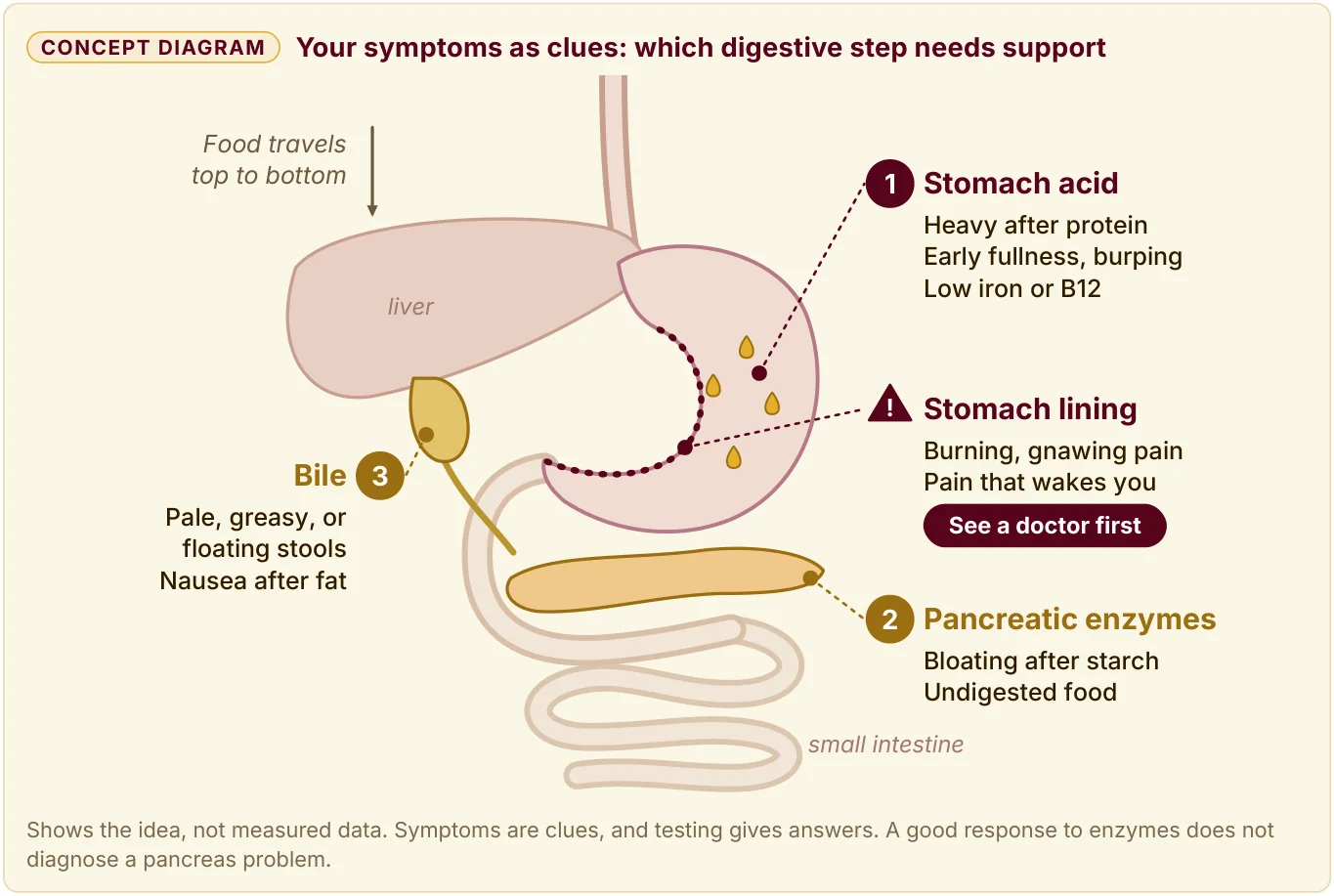
Concept diagram titled 'Your symptoms as clues: which digestive step needs support'. A drawing of the liver, stomach, gallbladder, pancreas, and small intestine, with a note that food travels top to bottom. Step 1, Stomach acid: heavy after protein; early fullness, burping; low iron or B12. Stomach lining, marked with a warning sign: burning, gnawing pain; pain that wakes you. The label reads 'See a doctor first'. Step 2, Pancreatic enzymes: bloating after starch; undigested food. Step 3, Bile: pale, greasy, or floating stools; nausea after fat. Footer note: 'Shows the idea, not measured data. Symptoms are clues, and testing gives answers. A good response to enzymes does not diagnose a pancreas problem.'
SIBO. In small intestinal bacterial overgrowth, bacteria that belong in your large intestine settle in your small intestine and ferment your meal early, making hydrogen, methane, or hydrogen sulfide gas. A flat belly in the morning that swells through the day, starting within an hour or 2 of meals, points here. Methane slows the gut, which is why methane-type overgrowth so often brings constipation. 'SIBO: The 3 Kinds, How to Test for Them, and How Each Is Treated' goes deeper.
IBS. Irritable bowel syndrome is a disorder of gut-brain interaction, and the pain, bloating, and urgency are fully real. Through a Functional Medicine lens, IBS often has findable drivers underneath it: SIBO, food reactions, low stomach acid, a slow thyroid, and a Nervous System stuck in alarm.
An IBS label is a starting point for better questions. 'Leaky Gut, IBS, IBD, and SIBO' in 'The Gut, In Depth' goes deeper.
Food sensitivities and celiac disease. Bloating after specific foods points toward a food sensitivity, and gluten, dairy, and soy are common ones. Celiac disease travels with Hashimoto's and can be called IBS for years. High-FODMAP foods such as garlic, onions, mushrooms, celery, apples, and pears can bloat a sensitive gut, which is exactly what happened to me. 'The Autoimmune Protocol' is built to reveal your own reactions.
Motility and your thyroid. Between meals, a cleansing wave called the Migrating Motor Complex sweeps your small intestine clean, and grazing all day never lets that cycle finish a single pass. A slow thyroid slows that wave and the whole digestive tract. In a 2007 study of people with hypothyroidism, about half had SIBO, compared with about 5 percent of healthy controls.
'Give Your Gut Time to Rest Between Meals' in 'The Gut, In Depth' and 'Your Thyroid, In Depth' go deeper.
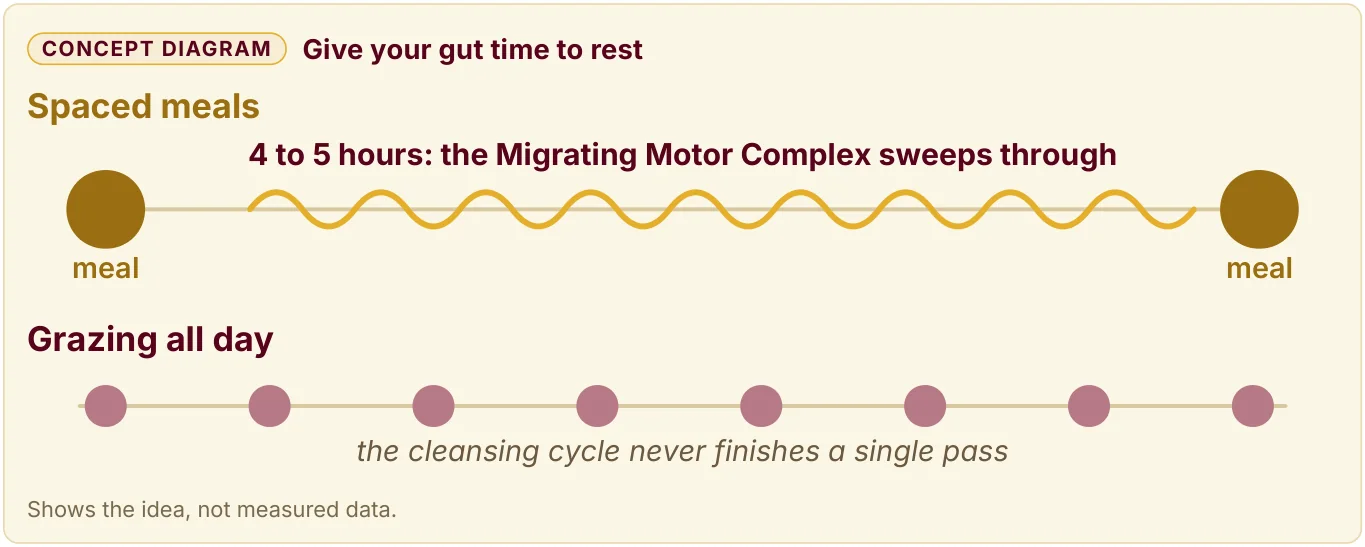
Concept diagram titled 'Give your gut time to rest'. Spaced meals: a meal, then 4 to 5 hours during which the Migrating Motor Complex sweeps through, then the next meal. Grazing all day: a row of 8 small dots for eating at short intervals, with the note 'the cleansing cycle never finishes a single pass'. Footer note: 'Shows the idea, not measured data.'
Progesterone and your cycle. Progesterone relaxes the smooth muscle of your intestines, which is part of why bloating and constipation build before your period. In Perimenopause, when progesterone lurches and drops, bowel patterns can swing from sluggish to loose without warning. 'How It All Connects' goes deeper.
Estrogen and fluid. Progesterone gently counters aldosterone, the hormone that holds on to salt and water. When progesterone falls and estrogen runs high relative to it, bloating and water retention can build in the week or 2 before your period and ease once it arrives.
Mild fluid retention is also a common early effect of starting hormone therapy, and it usually settles. 'What Is Actually Happening in Your Midlife Body' and 'Hormone Therapy 101' go deeper.
Estrogen and your microbiome. Estrogen helps keep your gut lining sealed and supports a diverse microbiome, and after Menopause many Women's gut bacteria become less diverse. A gut that handled wine, bread, and late dinners at 30 may protest at 48. 'The Gut, In Depth' goes deeper.
Stress. About a third of the acid released with a meal is triggered by your brain through the vagus nerve, and that signal works best in rest-and-digest. A meal eaten in fight or flight starts with less of that first wave, and stress hormones also open the gut. 'Stress: The Load Women Stop Noticing' goes deeper.
Constipation. Low thyroid, low magnesium, and too little water, fiber, or movement all slow your bowels, and a backed-up colon bloats. 'Your Liver, Your Kidneys, and Your Gut' goes deeper.
Medications, antibiotics, sugar, and alcohol. Long-term PPI use has been linked to about twice the odds of SIBO. Every course of antibiotics touches your microbiome, and sugar and alcohol loosen the gut barrier. 'Why the Gut Gets Harder in Midlife' in 'The Gut, In Depth' goes deeper, and any change to a prescribed medication stays with your prescriber.
Overgrowth and parasites. Candida and other overgrowth, and for some Women parasites, add to the gas. 'Root Causes: Parasites, Heavy Metals, Mold, and Environmental Toxins' goes deeper.
Your stool test and your breath test decide the plan. Treat the order as carefully as the tools: thyroid first, then SIBO, a lesson my own body keeps teaching me.
A backed-up colon is 1 of the most common reasons a belly swells, and it deserves its own plan. The Hashimoto 411 educators sort their approach into daily habits, short-term helps, and a few things to use with care, and I teach it the same way.
Constipation that is new, comes with blood, weight loss, or pain, or will not respond to these steps is a reason to see your doctor promptly.
Daily habits:
Looking upstream:
Short-term helps:
Use with care:
The gentlest fix is the 1 that answers your own root cause. 'Your Pelvic Floor and Bladder' shows how straining affects your pelvic floor, and 'How It All Connects' shows how daily bowel movements help you clear estrogen.
This article is a section of The Midlife Bible: The Essential Guide to the Women's Midlife Journey, by Daniela Hess, MSEd. It is the book's own text, so where it says 'this book' or points to another part, that means the Bible. The book has the full chapters, charts, and the Lab Wish List.
Educational content, not medical advice. Please work with your own practitioner before you change a medication or a supplement.
These 3 connect to what you just read.
'I eat well and I am still depleted.' If that sounds like you, your stomach may be part of the story. Here is what stomach acid does for your protein, iron, and B12, why acid can fall with Autoimmune gastritis, H. pylori, or stress, why you cannot tell too much acid from too little by the burn, and when a PPI is the right medication.
Read this article →Your gut and digestion'My belly is flat at breakfast and 5 months pregnant by dinner.' If eating clean has not touched your bloating, SIBO may be part of the picture. Here is why it comes in 3 kinds, how hydrogen, methane, and hydrogen sulfide each bring different symptoms, and which root causes help explain why it keeps coming back.
Read this article →Your gut and digestion'My bloating and my thyroid symptoms got treated as separate problems.' Your gut lining is 1 cell thick, and Midlife stacks several changes on it in the same decade. Here is how the lining works, what loosens it, why estrogen, stress, and medications matter, and which foods and habits feed its repair.
Read this article →FAQ
New bloating that persists, nearly every day, needs a prompt visit, especially with pelvic or belly pain, feeling full quickly, trouble eating, or needing to urinate urgently or often. These can be early signs of ovarian cancer, and the American Cancer Society advises seeing your doctor if you have them more than 12 times a month.
Also call before any protocol or elimination diet for blood in your stool, black stools, weight loss you did not try for, belly pain that wakes you at night, or a lasting change in bowel habits, especially after 45. Colon cancer screening now begins at 45 for adults at average risk.
A flat belly in the morning that swells through the day, starting within an hour or 2 of meals, points toward SIBO. Bacteria that belong in your large intestine settle in your small intestine and ferment your meal early, making hydrogen, methane, or hydrogen sulfide gas. Methane slows the gut, which is why methane-type overgrowth so often brings constipation.
Grazing all day plays a part too, because it never lets your Migrating Motor Complex finish a single pass. A breath test can show which gases are present. SIBO in Midlife explains the 3 kinds.
Yes. Food that sits like a stone, early fullness, burping, and reflux point toward your stomach. Autoimmune gastritis, H. pylori, long-term acid-blocking medication, and meals eaten in fight or flight can all lower stomach acid. Bloating after starchy meals, with food that passes undigested, can point toward pancreatic enzymes, and bloating or nausea after fatty meals, with pale or floating stools, points toward bile.
Long-term PPI use has been linked to about twice the odds of SIBO. Ask your prescriber whether your PPI is still needed, and never stop it suddenly, since rebound acid is common. Low Stomach Acid and Heartburn goes deeper.
Progesterone relaxes the smooth muscle of your intestines, which is part of why bloating and constipation build before your period. It also gently counters aldosterone, the hormone that holds on to salt and water. When progesterone falls and estrogen runs high relative to it, bloating and water retention can build in the week or 2 before your period and ease once it arrives.
In Perimenopause, when progesterone lurches and drops, bowel patterns can swing from sluggish to loose without warning. Progesterone and Estrogen Dominance in Perimenopause goes deeper.
Eat in rest-and-digest: sit down, take 1 breath first, inhale deep, exhale long, and chew until the texture is gone. Leave 4 to 5 hours between meals if you can, so your small intestine gets swept clean. Let your body and your prescriber outrank this rhythm when needed. Choose cooked vegetables while you heal, and aim for 6 to 15 different kinds a day.
Your stool test and your breath test decide the plan, so bring a record to your practitioner. For 2 weeks, log what you ate, when the bloating began, your cycle day, and your stool type on the Bristol stool chart.

A 75-page PDF guide plus the 1 hour 43 minute talk, The Entire Midlife Journey.
Send me the guideYour thyroid, your gut, your hormones, and your labs.
Get The Midlife Bible3 hours with Daniela Hess and Kim Beekman, recorded live. The Midlife Bible is included.
See the workshop60 to 90 minutes one-on-one. Send a request to work with Daniela.
Work with Daniela