Free guide
Free
The Midlife Essentials and the talk
A 75-page PDF guide plus the 1 hour 43 minute talk, The Entire Midlife Journey.
Send me the guide
By Daniela Hess, MSEd13 min readOctober 2026
Heart disease takes roughly 7 times as many Women's lives as breast cancer, and Menopause changes your cholesterol, your blood vessels, and your body fat. Here is how a heart attack can look in a Woman, which tests to ask about, and what protects your heart every day.
Most Women I meet can tell me the date of their next mammogram. Far fewer can tell me their ApoB, their Lp(a), or whether anyone has ever checked their thyroid alongside their cholesterol. The organ most likely to end a Woman's life is the 1 she is least often taught to watch.
The Estrogen section and 'Heart: What the Evidence Shows' in Hormone Therapy 101 laid the groundwork, and the High Cholesterol section of 'The Mimics', later in this guide, returns to it. This chapter goes deeper: what each number on your lipid panel means, which tests see your arteries directly, how to think about statins with clear eyes, and what protects your heart every day.
The heart and cholesterol go hand in hand with the thyroid. In an Autoimmune body, those 3 belong in the same conversation.
Heart disease builds quietly for decades before it announces itself. The blood sugar, blood pressure, and cholesterol patterns of your 20's and 30's travel with you into your 40's and 50's, and how you tend them in your 40's and 50's shapes the heart you live with at 60 and beyond.
According to the CDC, heart disease killed 304,970 Women in the United States in 2023. That is about 1 in every 5 female deaths. Heart disease is the leading cause of death for Women in this country.
Breast cancer deserves every bit of the attention it receives. The CDC reports that 43,402 Women died of breast cancer in 2024. Set those 2 numbers side by side, 1 from 2023 and 1 from 2024, and heart disease takes roughly 7 times as many Women's lives in a year.
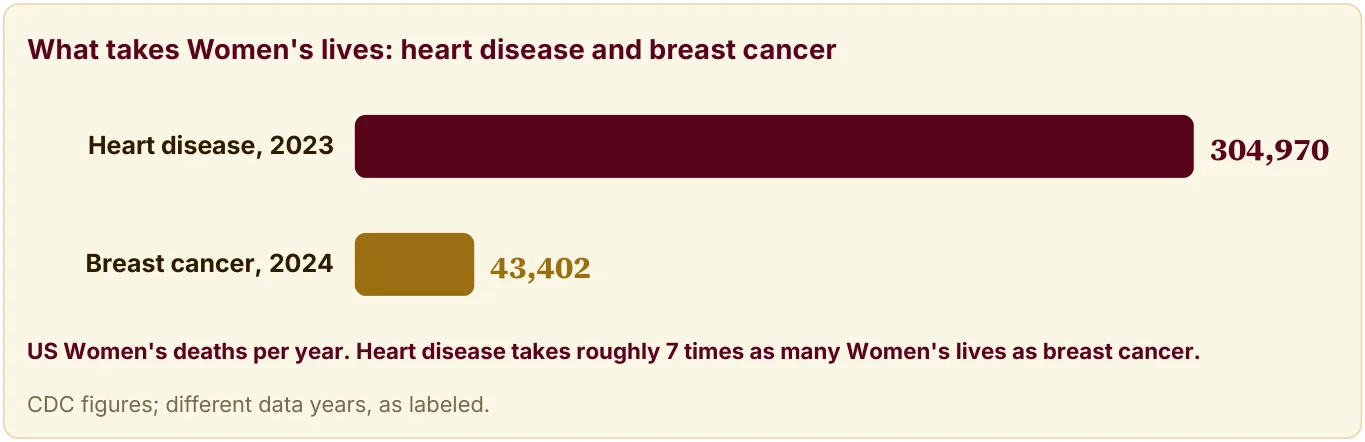
Bar chart titled 'What takes Women's lives: heart disease and breast cancer'. US Women's deaths per year: heart disease, 2023, 304,970; breast cancer, 2024, 43,402. Heart disease takes roughly 7 times as many Women's lives as breast cancer. CDC figures; different data years, as labeled.
Over 60 million US Women, about 44 percent, live with some form of heart disease, according to the CDC, and only 56 percent of Women recognize heart disease as their number 1 killer. Nearly half of Women may be watching for the wrong danger.
Chest pain is the most common heart attack symptom in Women. In the VIRGO study of heart attack patients aged 18 to 55, 87.0 percent of the Women and 89.5 percent of the men had chest pain, meaning pain, pressure, tightness, or discomfort.
The difference lies in what comes with it. In VIRGO, 61.9 percent of Women had 3 or more additional symptoms, compared with 54.8 percent of men. Women with the most serious type of heart attack were also more likely than men to arrive with no chest pain at all.
The CDC and the VIRGO study point to these signs for Women:
In VIRGO, Women were almost twice as likely as men to read their own symptoms as stress or anxiety, 20.9 percent compared with 11.8 percent. Nearly 3 in 10 Women had sought care for similar symptoms before the heart attack, and 53 percent of those Women said their provider did not think the symptoms were heart-related, compared with 37 percent of men. Many Women talk themselves out of calling for help.
If you have symptoms like these, especially several at once or with a sense that something is deeply wrong, call 911. You never have to be certain before you call.
Estrogen quietly supported your heart for decades. As it declines, several things shift at once.
Your cholesterol climbs, in a specific window. The Study of Women's Health Across the Nation, SWAN, followed Women year by year through the transition. Of all the heart risk factors measured, only total cholesterol, LDL cholesterol, and apolipoprotein B jumped substantially in the year before and the year after the final period.
Blood sugar, blood pressure, and inflammation rose at the pace of ordinary aging. Cholesterol rose with the ovaries. The researchers concluded that monitoring lipids in Perimenopausal Women should strengthen prevention.
Triglycerides and Lp(a) rise too. A 2020 scientific statement from the American Heart Association reported that triglycerides and lipoprotein(a) peaked in late Perimenopause and early postmenopause.
HDL changes its character. Before Menopause, higher HDL was linked to less plaque in the neck arteries. After Menopause, in the same research, higher HDL was linked to more.
After Menopause, a high HDL on your panel may no longer mean what it used to.
Fat moves. In SWAN, at the start of the transition the rate of fat gain doubled and lean muscle began to decline, and both trends continued until about 2 years after the final period. Weight itself rose at a steady pace, which is how a Woman can weigh what she always has and still find her body changing shape.
Your blood vessel lining loses flexibility. Your artery lining, the endothelium, lets each vessel widen when blood flow increases, and an ultrasound test called flow-mediated dilation measures it.
In 1 study of 132 healthy Women, it measured 9.9 percent before Menopause, 8.2 percent in early Perimenopause, 6.5 percent in late Perimenopause, 5.5 percent in early postmenopause, and 4.7 percent in late postmenopause. The decline began in Perimenopause, years before the last period. The AHA statement also reports that Women with hot flashes tended to have stiffer vessel responses and more calcium in the aorta, independent of their other risk factors.
Blood pressure rises with age. The AHA statement found that Menopause itself did not raise blood pressure beyond what age would predict. It also named high blood pressure as the most prominent risk factor Women can change that increases with age.
The timing of your Menopause counts. The 2026 cholesterol guideline from the American College of Cardiology and the American Heart Association lists premature Menopause, before 40, and early Menopause, before 45, as factors that raise heart risk. So do preeclampsia, high blood pressure or diabetes during pregnancy, preterm delivery, and polycystic ovary syndrome.
The 2023 international guideline asks that every Woman with PMOS, formerly called PCOS, have her lipids checked at diagnosis and her blood pressure checked every year, and 'PCOS, Now Called PMOS' explains why the metabolic risks can build just as the cycles calm down in Midlife.
Your reproductive history is heart history.
As I teach in the Autoimmune Recovery Method, chronic inflammation wears on arterial walls and adds to cardiovascular risk independent of your cholesterol numbers. The Inflammation chapter walks through the CANTOS trial, in which calming inflammation alone modestly reduced repeat heart attacks and strokes.
Heart guidelines agree. The 2018 cholesterol guideline listed chronic inflammatory conditions such as rheumatoid arthritis and psoriasis as factors that raise heart risk, along with an hs-CRP of 2.0 mg/L or higher. For a Woman with Autoimmunity, cooling inflammation is heart care.
Cholesterol is a waxy fat your body needs. It cannot travel through your watery blood on its own, so your liver packs it into carriers called lipoproteins.
Think of lipoproteins as boats, and cholesterol as the cargo. Most of what your lab reports is the cargo, while the risk to your arteries comes mostly from the number of boats.
What each number on your panel means:
ApoB, the boat count. Every boat that can damage your arteries, including LDL, VLDL, and Lp(a), carries exactly 1 molecule of apolipoprotein B. So your ApoB is a direct count of those boats.
Cardiologist Dr. Allan Sniderman and colleagues describe it this way: cholesterol can only enter the artery wall inside an ApoB particle, and the number of particles decides how much gets trapped. 2 Women can have the same LDL and very different numbers of boats.
The 2018 guideline treated an ApoB of 130 mg/dL or higher as a risk factor, and the 2026 guideline says ApoB can be useful to find risk that remains once LDL is at goal.
Particle number and particle size. An advanced lipid test, often called NMR, counts LDL particles directly, as LDL-P, and reports their size. Smaller, denser particles get trapped in the artery wall more easily, and many Functional Medicine practitioners watch size closely.
Mainstream lipid research holds that the number of particles carries most of the risk. Count first, then size.
Lp(a), once in your lifetime. Lipoprotein(a), said 'L-P-little-a', is an LDL-like boat with an extra sticky protein attached. The American Heart Association reports that about 1 in 5 people worldwide have high Lp(a), that your level is mostly inherited, and that lifestyle changes do not lower it.
It may rise with Menopause. The 2026 guideline recommends measuring it at least once in adulthood. A level of 125 nmol/L (50 mg/dL) or higher is linked to about 1.4 times the risk, and 250 nmol/L or higher to at least double.
You cannot feel it, you cannot diet it away, and you only need to test it once. A high result is a reason to work every other risk factor harder, and a reason for your children and siblings to test theirs.
The TG to HDL ratio, a clue about insulin. Divide your triglycerides by your HDL, both in mg/dL. In a 2003 study of overweight adults, a ratio of 3.0 or higher helped identify insulin resistance, correctly flagging about 2 in 3 people.
A Woman with triglycerides of 150 and an HDL of 45 has a ratio of about 3.3. This ratio is free, it is already on your lab report, and it can hint at insulin resistance before your fasting glucose rises.
Many Functional Medicine practitioners aim for 2 or below. Treat it as a clue that points you toward fasting insulin and HbA1c.
Your cells build their membranes with cholesterol. Your liver turns it into bile to digest fat, and your skin uses a close relative of it to make vitamin D in sunlight.
Every sex hormone you have begins as cholesterol. As the Pregnenolone section explains, your adrenal glands, your ovaries, and your brain snip cholesterol into pregnenolone, which becomes progesterone, DHEA, cortisol, testosterone, and estrogen.
Cholesterol is the first link in the chain that makes your hormones. That is 1 reason many Functional Medicine practitioners read a cholesterol number as part of the whole Woman.
'The Mimics' explained the mechanism: your liver pulls LDL out of your blood through receptors, and T3 tells your liver to build them. When thyroid hormone runs low, fewer receptors are built and LDL lingers. A slow thyroid can raise your LDL on its own.
This is standard care on paper. A 2014 research letter in JAMA Internal Medicine summarized it: guidelines from the National Cholesterol Education Program, the American Association of Clinical Endocrinologists, and the American Thyroid Association recommend screening for hypothyroidism in people with newly diagnosed high cholesterol before starting a cholesterol-lowering medication. Earlier studies found hypothyroidism in about 4 to 13 percent of people with high cholesterol.
In practice, it is often skipped. At the Boston medical center the researchers studied, only about half of patients with newly diagnosed high cholesterol had their thyroid checked. Among those whose low thyroid was then treated, 75 percent did not start a cholesterol medication within the next year.
Half of the patients in that study never had the thyroid question asked. That was 1 center, looking backward, and it shows a clear gap.
A second reason to check first: the FDA label for atorvastatin, a common statin, lists uncontrolled hypothyroidism among the risk factors for muscle damage from the medication. An untreated thyroid can raise your LDL and also make a statin harder on your muscles.
Ask for your full thyroid panel before or alongside any conversation about cholesterol medication. If you already take thyroid medication, bring your latest panel, since a dose that runs low can show up in your lipids too.
My own cholesterol moved with my thyroid. As my thyroid became more optimized, my cholesterol decreased. That is the mechanism above, showing up in 1 Woman's labs.
The American Heart Association's Life's Essential 8 names food, movement, no nicotine, sleep, a healthy weight, cholesterol, blood sugar, and blood pressure. Sleep was added in 2022, as a full member of that list.
Lift something heavy. A 2022 analysis of 16 studies found that muscle-strengthening activity was linked to about 10 to 17 percent lower risk of death, heart disease, cancer, and diabetes, with the greatest benefit at about 30 to 60 minutes a week.
The Bones chapter explains how to lift safely. 2 or 3 sessions a week is enough to matter.
Walk, and count it. In a study of 16,741 Women with an average age of 72, those who took about 4,400 steps a day had a 41 percent lower death rate than those who took about 2,700.
The benefit kept growing until about 7,500 steps a day, then leveled. Pace mattered less than total steps. Every walk counts, even the walk to the mailbox.
Steady your blood sugar. Insulin resistance raises triglycerides and lowers HDL. The Sugar chapter covers the steady plate, and your TG to HDL ratio will show you whether it is working.
Protect your sleep. 7 to 9 hours, on a regular schedule. If you snore, wake gasping, or wake unrefreshed, ask about sleep apnea.
Tend your Nervous System. Chronic stress raises cortisol, blood pressure, and blood sugar, as the Stress chapter explains. Diaphragmatic belly breathing regulates the Nervous System: inhale deep, exhale long, a few minutes at a time, several times a day.
Consider the sauna. In a Finnish study of 1,688 men and Women with an average age of 63, followed for 15 years, those who used a sauna 4 to 7 times a week had about 77 percent lower risk of dying from heart disease than those who went once a week, after accounting for other risk factors. This observational research cannot prove the sauna itself did the work.
If you have low blood pressure or unstable heart disease, or are pregnant, ask your practitioner first, and skip alcohol before a sauna.
Most of the famous sauna research comes from Finnish men. 'Fasting, Saunas, and Cold: What Helps a Woman's Body, and When It Backfires' compares infrared, Finnish, steam, and blankets, shows what the research found once Women were included, and describes how I use my own sauna.
Eat your omega-3s. The American Heart Association recommends 1 to 2 seafood meals a week, especially when fish replaces less healthy foods. Wild salmon, sardines, mackerel, herring, and anchovies are rich in EPA and DHA and low in mercury.
Eat your fiber. Aim for 6 to 15 different kinds of vegetables a day, more vegetables than fruit. Soluble fiber binds cholesterol-rich bile in your gut and carries it out, and cooked vegetables are gentler while you heal your gut.
What protects my own heart, every day.
After my recovery period, I returned to work I love: helping Women as a Midlife Mentor, Autoimmune Educator, and Functional Wellness Consultant, offering grief coaching and spiritual direction, and teaching Qigong with my husband, Christopher. I can handle stress now because my Nervous System is regulated, and it is regulated because my body became resourced.
This article is a section of The Midlife Bible: The Essential Guide to the Women's Midlife Journey, by Daniela Hess, MSEd. It is the book's own text, so where it says 'this book' or points to another part, that means the Bible. The book has the full chapters, charts, and the Lab Wish List.
Educational content, not medical advice. Please work with your own practitioner before you change a medication or a supplement.
These 3 connect to what you just read.
Hormone therapy is 1 of the most effective tools for the Midlife years and 1 of the most misunderstood. Here is what happened in 2002, what changed in 2025, and what the evidence shows on timing, bones, heart, and breast cancer.
Read this article →Your heart, bones, brain, and breastsBone loss in Midlife makes no sound, and in SWAN, the Study of Women's Health Across the Nation, it ran fastest from 1 year before the final period to 2 years after. This article covers how osteopenia differs from osteoporosis, what the LIFTMOR trial found about lifting heavy, and why I teach calcium from food first.
Read this article →Your inner life and your careNormal lab ranges ask if you are sick enough to treat. Optimal ranges ask where your numbers need to be for you to thrive. Here is how to walk into the appointment, what to say to the most common pushback, and your routes if the answer is still no.
Read this article →FAQ
Chest pain is still the most common symptom. In the VIRGO study of heart attack patients aged 18 to 55, 87.0 percent of the Women had it. The difference lies in what comes with it: 61.9 percent of Women had 3 or more additional symptoms, compared with 54.8 percent of men. Look for pain in the neck, jaw, throat, upper abdomen, or upper back, indigestion or nausea, shortness of breath or dizziness, extreme fatigue that will not go away, and palpitations.
If you have symptoms like these, especially several at once or with a sense that something is deeply wrong, call 911. You never have to be certain before you call.
Your cholesterol climbs in a specific window. In SWAN, which followed Women year by year through the transition, only total cholesterol, LDL cholesterol, and apolipoprotein B jumped substantially in the year before and the year after the final period. Blood sugar, blood pressure, and inflammation rose at the pace of ordinary aging. Triglycerides and Lp(a) peaked in late Perimenopause and in the early years after Menopause.
Your artery lining loses flexibility too. In 1 study of 132 healthy Women, an ultrasound measure of how well each vessel widens fell from 9.9 percent before Menopause to 4.7 percent in the late years after Menopause, and the decline began in Perimenopause. Hormone Therapy 101 covers what hormones can do for your heart, and that decision belongs to you and your prescriber.
Ask for your ApoB. Every particle that can damage your arteries carries exactly 1 molecule of it, so ApoB is a direct count. The 2026 guideline says it can help find risk that remains once LDL is at goal. Ask for Lp(a) once in your lifetime too: your level is mostly inherited, and the 2026 guideline recommends measuring it at least once in adulthood.
Check your triglyceride to HDL ratio as well. It is free and already on your lab report, and in a 2003 study of overweight adults a ratio of 3.0 or higher helped identify insulin resistance. Bring your results to Normal vs Optimal Labs.
Yes. Your liver pulls LDL out of your blood through receptors, and T3 tells your liver to build them. When thyroid hormone runs low, fewer receptors are built and LDL lingers. A slow thyroid can raise your LDL on its own.
Guidelines recommend screening for hypothyroidism in people with newly diagnosed high cholesterol before starting a cholesterol-lowering medication, and at the Boston center a 2014 research letter studied, only about half had their thyroid checked. Ask for your full thyroid panel before or alongside any conversation about cholesterol medication. Hypothyroidism vs Hashimoto's goes deeper.
The American Heart Association's Life's Essential 8 names food, movement, no nicotine, sleep, a healthy weight, cholesterol, blood sugar, and blood pressure. Lift something heavy: a 2022 analysis of 16 studies linked muscle-strengthening activity to about 10 to 17 percent lower risk of death, heart disease, cancer, and diabetes, and I teach that 2 or 3 sessions a week is enough to matter. Movement in Midlife shows how.
Walk, and count it. In a study of 16,741 Women with an average age of 72, those who took about 4,400 steps a day had a 41 percent lower death rate than those who took about 2,700, and the benefit kept growing until about 7,500 steps.

A 75-page PDF guide plus the 1 hour 43 minute talk, The Entire Midlife Journey.
Send me the guideYour thyroid, your gut, your hormones, and your labs.
Get The Midlife Bible3 hours with Daniela Hess and Kim Beekman, recorded live. The Midlife Bible is included.
See the workshop60 to 90 minutes one-on-one. Send a request to work with Daniela.
Work with Daniela