Free guide
Free
The Midlife Essentials and the talk
A 75-page PDF guide plus the 1 hour 43 minute talk, The Entire Midlife Journey.
Send me the guide
By Daniela Hess, MSEd13 min readOctober 2026
'I sneeze and cross my legs. I map every restroom and wake at 2 AM to pee.' Leaking, urgency, and a bladder that runs your schedule are common in Midlife, and they are treatable. Here is how your pelvic floor works, how to do a Kegel correctly and when to skip it, and what the 2025 guideline says about vaginal estrogen.
You sneeze in the grocery store and cross your legs. You map every restroom between home and the trailhead. You wake at 2 AM and again at 4 AM to pee, and you may call it age.
Leaking, urgency, and a bladder that runs your schedule are common in Midlife, and they are treatable. The Sex, Intimacy, and Your Vagina chapter covers genitourinary syndrome of Menopause, vaginal estrogen, painful sex, and a first look at pelvic floor physical therapy. This chapter goes further in: the muscles themselves, the bladder, the bowels, prolapse, and recurrent urinary tract infections.
This is education. Every medication, procedure, and dose decision stays with your practitioner. What I can give you is the map, and the words to ask for the care you deserve.
Your pelvic floor is a bowl of muscle, ligament, and connective tissue that closes the bottom of your pelvis. It stretches from your pubic bone to your tailbone, and from sit bone to sit bone.
It has 4 main jobs:
A healthy pelvic floor is strong, and it is also supple. Trouble can come from a floor that is too weak, too tight, or poorly timed, and the care differs for each.
Then there is the silence. In SWAN, 61 percent of Women who leaked had never sought treatment. 73 percent said it was not bad enough, 53 percent believed it was a normal part of aging, and 55 percent said no health care provider had ever asked.
Common is different from normal. Leaking is a signal worth answering.
Functional Medicine asks why. A root cause is the upstream driver, the thing that set the problem in motion, rather than the symptom you notice downstream.
The leak is downstream. Upstream, there is usually a combination of these.
Childbirth. In NHANES, pelvic floor disorders affected 12.8 percent of Women who had never given birth, 18.4 percent after 1 delivery, 24.6 percent after 2, and 32.4 percent after 3 or more. In 1 ultrasound study, the main pelvic floor muscle, the levator ani, was torn from its attachment in 20.9 percent of first-time mothers after a normal vaginal birth and 60 percent after a forceps birth. Changes from a birth long ago can stay quiet for years, and then surface in Midlife as estrogen falls.
Estrogen loss. Your urethra, bladder neck, vagina, and pelvic floor tissues carry estrogen receptors. As estrogen falls, those tissues thin and lose elasticity and blood flow, as the Sex, Intimacy, and Your Vagina chapter describes.
Chronic constipation and straining. Every hard push on the toilet presses down on the pelvic floor. In 1 small study, 61 percent of Women with prolapse had strained at stool as young adults, before any symptoms, compared with 4 percent of Women without pelvic floor problems. Constipation is 1 of the most overlooked root causes of prolapse and leaking.
Chronic cough. A cough from smoking, asthma, allergies, or reflux drives pressure down onto the floor again and again. In SWAN, current smoking was linked with more severe leaking.
Heavy lifting with a held breath. Among Danish assistant nurses, who lift patients all day, the odds of prolapse surgery were 1.6 times those of other Women. Strength training is still 1 of the best things you can do for your bones and your metabolism, as the Bones chapter explains. The skill to learn is breathing out as you lift.
Weight and blood sugar. In NHANES, 30.4 percent of Women with obesity had a pelvic floor disorder, compared with 15.1 percent at a lower weight. In the PRIDE trial, Women with an average age of 53 who lost about 8 percent of their body weight cut their leaking episodes by 47 percent, compared with 28 percent in the comparison group. In SWAN, diabetes was linked with more severe leaking.
These build slowly, and this is 1 of my deepest convictions:
We can't stress enough how what you do in your 20s and 30s creates the situations you have in your 40s and 50s, and how you treat yourself in your 40s and 50s will determine 60 and up.
You do not have much room for error in Midlife, and you do have room for repair. The pelvic floor is muscle, and muscle responds to training at any age.
In NHANES data from 2017 to 2018, among Women aged 40 to 59, 27.9 percent reported urge leaking and 15.9 percent mixed, and urge leaking has been rising.
The International Continence Society defines nocturia as waking to pass urine during your main sleep period. In a Finnish study of 6,000 people, waking 2 or more times a night was linked with a measurably lower quality of life.
Nocturia has many possible roots:
Ask whether your bladder wakes you, or you wake and then notice your bladder. A bladder diary answers it.
In a 2018 Cochrane review, Women with stress incontinence who did pelvic floor muscle training were 8 times as likely to report cure, 56 percent compared with 6 percent. 74 percent reported cure or improvement, compared with 11 percent.
The catch is technique. In a classic study, after brief verbal instructions, only 49 percent of Women did an ideal Kegel, and 25 percent pushed down instead of lifting, a pattern that could make leaking worse.
How to find the right muscles:
A program usually pairs longer holds, building toward about 10 seconds, with quick flicks and full rest between. A pelvic floor physical therapist can set your numbers.
The Knack. In a small study of older Women with stress incontinence, squeezing just before and during a cough cut the leak by 98.2 percent with a medium cough and 73.3 percent with a deep cough, after 1 week of practice. Squeeze before you sneeze.
When not to do Kegels. If you have pelvic pain, pain with sex, bladder pain, or a tight floor, strengthening can add tension to muscles that need to let go. The American Urological Association guideline on bladder pain syndrome says pelvic floor strengthening exercises such as Kegels should be avoided in Women with pelvic floor tenderness, and recommends hands-on physical therapy instead. If Kegels make your symptoms worse, stop, and see a pelvic floor physical therapist.
A pelvic floor physical therapist has advanced training in the muscles, nerves, and connective tissue of the pelvis. For many Women, this 1 referral changes everything.
A first visit often includes:
Where to look:
The bladder and urethra share estrogen receptors with the vagina, which is why GSM includes urinary symptoms. The Sex, Intimacy, and Your Vagina chapter covers the tissue and the landmark UTI trial.
For your bladder, the route of estrogen matters. In a 2012 Cochrane review, oral hormone therapy, mostly conjugated equine estrogen in older trials, made leaking worse than placebo. Vaginal estrogen improved leaking, with about 1 to 2 fewer bathroom trips a day and less urgency.
Vaginal estrogen comes as a cream, a vaginal insert or suppository, a tablet, or a ring. I use the cream, 3 times a week. Your prescriber will choose the form and the rhythm with you.
My own pelvic floor is great and strong. Vaginal estrogen has been really good for my bladder, and I count it among the best protections against bladder infections, which the 2025 guideline in the next section backs.
Recurrent UTIs usually means 2 or more infections in 6 months, or 3 or more in a year. After Menopause, recurrent UTIs have root causes, and each deserves a look.
The 2025 update of the American Urological Association guideline on recurrent UTIs lays out this plan:
What I suggest to Women with recurrent UTIs, alongside their practitioner: keep using your vaginal estrogen, and consider D-mannose and uva ursi after sex. Many Functional Medicine practitioners suggest taking D-mannose after sex, a timing no trial has tested.
Uva ursi, carefully. Uva ursi, or bearberry leaf, is a traditional herb for mild bladder infections. Its arbutin is converted in the body to hydroquinone, which acts against bacteria in the urine.
The European Medicines Agency's 2018 herbal monograph limits uva ursi to adult Women, for no more than 1 week at a time. It advises against it in pregnancy, while breastfeeding, with kidney disorders, for men, and for anyone under 18, and notes it can turn urine greenish-brown. Its limits are written for short courses, so ask your practitioner whether, and how often, after-sex use is safe for you.
See your practitioner if symptoms last more than 4 days, or if you have fever, back pain, or blood in your urine.
Peeing after sex is harmless and reassuring. In a study of 796 young Women, waiting to pee after sex did not raise UTI risk, while recent sex and a diaphragm with spermicide did.
See your practitioner promptly for fever, chills, back or side pain, nausea, blood in your urine, or symptoms that do not ease within a day or 2 of treatment.
The Hormone Therapy 101 chapter introduces vaginal estrogen as 1 of the greatest protectors we can give Women. Here is the evidence behind the bladder part of that sentence.
The landmark trial. In 1993, Drs. Raz and Stamm randomly assigned 93 postmenopausal Women with recurrent UTIs to a vaginal estriol cream or a placebo for 8 months.
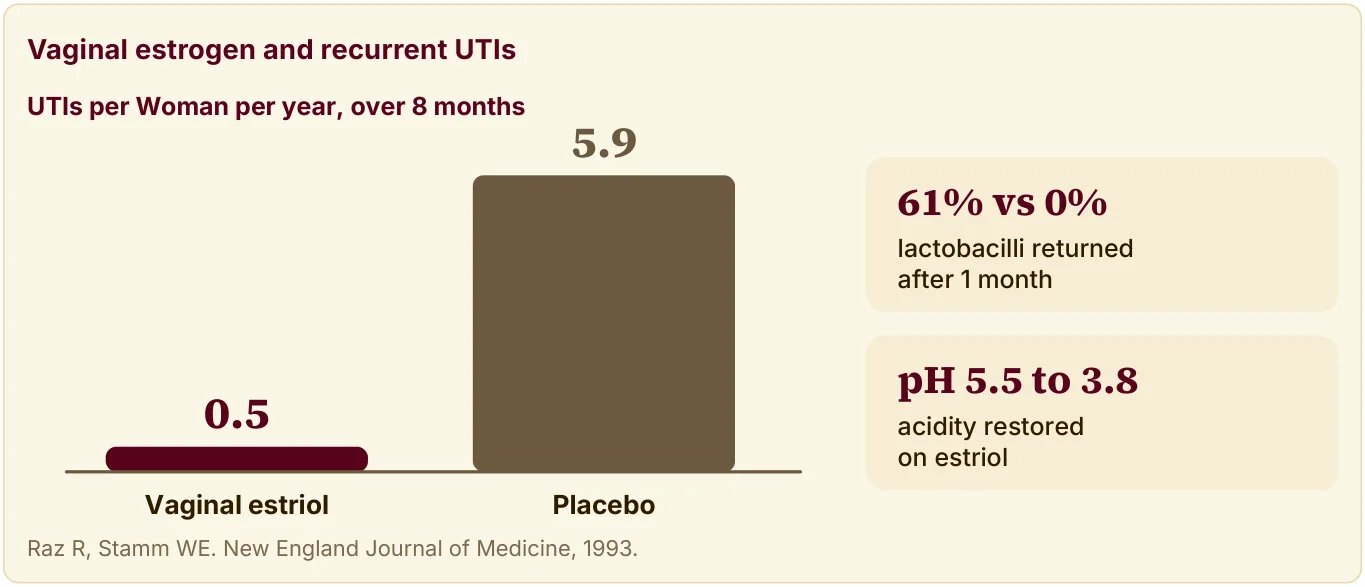
Title: Vaginal estrogen and recurrent UTIs. The bar chart shows UTIs per Woman per year, over 8 months. Vaginal estriol: 0.5. Placebo: 5.9. Beside the bars are 2 notes. First: 61% vs 0%, lactobacilli returned after 1 month (on estriol versus placebo). Second: pH 5.5 to 3.8, acidity restored on estriol. Source: Raz R, Stamm WE. New England Journal of Medicine, 1993.
The route matters. A Cochrane review found that estrogen taken by mouth did not reduce UTIs, while vaginal estrogen did in 2 small trials. The protection comes from rebuilding the local tissue.
The guideline. The American Urological Association's guideline on recurrent UTIs, first published in 2019 and updated in 2022, was amended in 2025 to strengthen its recommendation and extend it to Women in Perimenopause. It now says clinicians should recommend vaginal estrogen to Women in Perimenopause and after Menopause who have recurrent UTIs, if there is no contraindication. The 2025 AUA guideline on GSM says the same.
How it is usually used. The Menopause Society describes a starting phase of daily use for 2 weeks, then creams 2 to 3 times a week, tablets or inserts twice a week, and a ring changed every 3 months.
How much reaches your blood. With low-dose vaginal products, blood estradiol stays within the postmenopausal range, about 3 to 11 pg/mL with tablets and 5 to 10 pg/mL with the ring. The 2025 AUA guideline states that low-dose vaginal estrogen does not increase the risk of endometrial hyperplasia with atypia or endometrial cancer.
The label. In November 2025 the FDA began removing the boxed warnings on cardiovascular disease, breast cancer, and dementia from menopausal hormone therapy, including vaginal estrogen, and approved the first revised labels in February 2026. The Estring vaginal ring was among the first. Labels change product by product, so the insert in your box may still show the older warning for a while.
My conviction is that almost every Woman in this season should ask about vaginal estrogen. It is small, local, and deeply protective of both your comfort and your bladder.
2 conversations come first for some Women. If you have had breast cancer, talk with your prescriber and your oncologist together; ACOG's guidance supports low-dose vaginal estrogen for many survivors through that shared decision. And any unexplained vaginal bleeding needs to be checked by your prescriber before you start.
This article is a section of The Midlife Bible: The Essential Guide to the Women's Midlife Journey, by Daniela Hess, MSEd. It is the book's own text, so where it says 'this book' or points to another part, that means the Bible. The book has the full chapters, charts, and the Lab Wish List.
Educational content, not medical advice. Please work with your own practitioner before you change a medication or a supplement.
These 3 connect to what you just read.
Hormone therapy is 1 of the most effective tools for the Midlife years and 1 of the most misunderstood. Here is what happened in 2002, what changed in 2025, and what the evidence shows on timing, bones, heart, and breast cancer.
Read this article →Your hormones and your thyroidPerimenopause can begin as early as 35 and run up to 17 years. Here are the 3 stages, how a trained practitioner reads where you are, and why 5 hormones never work alone.
Read this article →What you may be feelingIf your sex drive has tanked and you wonder whether you will ever want it back, this one is for you. Here is what the numbers say about low desire in Midlife, which hormones and body systems sit behind it, where testosterone stands in the United States as of September 2026, and why orgasm and sensitivity can come back.
Read this article →FAQ
Common is different from normal, and leaking is a signal worth answering. In the SWAN study of 3,302 Women with an average age of 46, 57 percent reported some incontinence, and 25 percent wore protection or changed their underwear several days a week. Women in early Perimenopause were 1.34 times as likely, and in late Perimenopause 1.52 times as likely, to start leaking monthly or more.
Then there is the silence. 61 percent of Women who leaked had never sought treatment, and 55 percent said no health care provider had ever asked. You can raise it first.
Usually a combination of root causes. In NHANES, pelvic floor disorders affected 12.8 percent of Women who had never given birth and 32.4 percent after 3 or more deliveries, and changes from a birth long ago can stay quiet for years, then surface in Midlife as estrogen falls. Chronic constipation and straining, chronic cough, heavy lifting with a held breath, extra weight, and high blood sugar add to it.
Your pelvic floor tissues carry estrogen receptors, so they thin as estrogen falls. Perimenopause, Menopause, and Your Hormones covers that shift. The pelvic floor is muscle, and muscle responds to training at any age.
Imagine stopping gas and stopping urine at the same time, then gently lift those muscles up and in. Keep your buttocks, inner thighs, and belly soft, keep breathing, and let go completely after each squeeze. Many pelvic floor physical therapists advise against practicing by stopping your stream, because repeated stopping can interfere with full emptying.
Technique matters: in a classic study, only 49 percent of Women did an ideal Kegel after brief verbal instructions, and 25 percent pushed down instead of lifting. With pelvic pain, pain with sex, bladder pain, or a tight floor, Kegels can add tension. If Kegels make your symptoms worse, stop, and see a pelvic floor physical therapist.
Recurrent UTIs usually means 2 or more infections in 6 months, or 3 or more in a year. Ask about the 2025 American Urological Association guideline: a urine culture with every infection, before antibiotics, vaginal estrogen in Perimenopause and after Menopause, cranberry, and more water if you drink less than about 1.5 liters a day. Ask whether leaking, urine left in the bladder after voiding, or high blood sugar could be root causes.
See your practitioner promptly for fever, chills, back or side pain, nausea, blood in your urine, or symptoms that do not ease within a day or 2 of treatment.
In the 1993 trial by Drs. Raz and Stamm, 93 Women after Menopause with recurrent UTIs used a vaginal estriol cream or a placebo for 8 months. Infections fell to 0.5 per year with the cream, compared with 5.9 on placebo. The 2025 AUA guideline states that low-dose vaginal estrogen does not increase the risk of endometrial hyperplasia with atypia or endometrial cancer. Hormone Therapy 101 covers the wider picture.
2 conversations come first for some Women. If you have had breast cancer, talk with your prescriber and your oncologist together. Any unexplained vaginal bleeding needs to be checked by your prescriber before you start.

A 75-page PDF guide plus the 1 hour 43 minute talk, The Entire Midlife Journey.
Send me the guideYour thyroid, your gut, your hormones, and your labs.
Get The Midlife Bible3 hours with Daniela Hess and Kim Beekman, recorded live. The Midlife Bible is included.
See the workshop60 to 90 minutes one-on-one. Send a request to work with Daniela.
Work with Daniela