Free guide
Free
The Midlife Essentials and the talk
A 75-page PDF guide plus the 1 hour 43 minute talk, The Entire Midlife Journey.
Send me the guide
By Daniela Hess, MSEd14 min readOctober 2026
The workouts that carried you at 30 may be too little in some ways and too much in others at 50. Here is why lifting comes first, what the walking research says about 7,000 steps, how to protect your pelvic floor while you train, and the signs that exercise has become another stress, with a weekly shape you can adjust to your own labs and energy.
Movement is the 1 practice that feeds every system in this book at once. Your muscles soak up blood sugar, your bones answer load, your heart and lungs grow stronger, your brain grows new connections, and your Nervous System settles.
Midlife changes the kind of movement your body asks for. The workouts that carried you at 30 may be too little in some ways and too much in others at 50.
This chapter gathers the pieces: strength, walking, your heart and lungs, balance and power, your pelvic floor, and the signs that exercise has tipped from medicine into another stress. The Bones chapter and the Joints chapter hold the full strength training detail, and this chapter points you there.
Before my diagnosis, I lived with gripping fatigue and all of my symptoms, and I could not do any conscious exercise.
To get out of my slump, I went on the Camino with some dear sister friends. And I came back unbelievably sick, and that, at least, is what helped me to get diagnosed.
I did not get my Autoimmune as a result of the Camino. The long walk cleared my system enough that I could finally feel it: something is really not right.
So I know both sides of this chapter. I know what it is to have no energy to move, and to push a depleted body farther than it could go. I also know what it feels like when movement becomes nourishment again, once the body underneath is resourced.
Today I move every day:
That is a lot of walking, and it is built for 1 body, mine, after years of rebuilding. It is what I call 'one size fits one'. Your week will look like yours, shaped by your labs, your energy, and your joy.
Muscle. In the SWAN study, Women began losing lean mass about 2 years before their final period, while the rate of fat gain nearly doubled, and both continued until about 1.5 years after it. Worldwide, about 10 to 27 percent of adults over 60 have sarcopenia, the loss of muscle mass and strength, depending on how it is defined.
Bone. Bone loss speeds up about 1 year before the final period and runs about 2 percent a year for several years, more in the spine. Estrogen once protected your bone and muscle on its own, and now your training has to send the signal.
Heart and lungs. Your fitness, measured as VO2 max, the most oxygen your body can use, declines with age, and it is 1 of the strongest predictors of how long and how well you live, as the section on your heart below explains.
Recovery. Broken sleep, shifting hormones, and a stress system working overtime can all slow how fast you recover from a hard session. The same workout can land differently in a body with less recovery to spend.
If you do 1 thing from this chapter, lift. Muscle carries your blood sugar, your bones, your balance, and your independence into your 70's and 80's.
The National Strength and Conditioning Association recommends that older adults train 2 to 3 days a week, with 1 to 3 sets of 6 to 12 repetitions at about 70 to 85 percent of the most they can lift once, adding load over time, along with power training. Dr. Stacy Sims urges Women in Perimenopause and after to lift heavy, with fewer repetitions and a real challenge in the last few, and to add short jump training.
How much is enough. In an analysis of cohort studies, 30 to 60 minutes a week of muscle-strengthening activity was linked to about 10 to 20 percent lower risk of dying from any cause, heart disease, and cancer, with no clear added benefit beyond about an hour. Combined with aerobic activity, the lowest risk was about 40 percent lower. That research is observational, and it tells you that 2 or 3 focused sessions a week carry most of the benefit.
The detail lives in 2 places:
Feed the muscle you train. 25 to 30 grams of protein at each meal, and protein soon after training, as 'Eating for Midlife' explains. Dr. Sims also advises eating before morning training, and she recommends against fasted training.
A good old-fashioned walk without a phone call or music is simply the invitation for 30 days, and consecutive days, if possible, because it works like a medicine.
Count your steps once, and you will know where you stand. In a study of 16,741 Women with an average age of 72, those who took about 4,400 steps a day had a 41 percent lower death rate than those who took about 2,700. The benefit kept growing until about 7,500 steps a day, then leveled, and pace mattered less than total steps.
A 2025 analysis of 57 studies found that 7,000 steps a day, compared with 2,000, was linked to about 47 percent lower risk of death and about 38 percent lower risk of dementia, with fewer heart problems, less depression, and fewer falls, and most benefits leveled off around 7,000. An earlier analysis of 15 cohorts found the benefit leveled off at about 6,000 to 8,000 steps for adults 60 and over.
10,000 steps began as a 1960s pedometer marketing number. 7,000 is a realistic, research-backed target, and more is welcome if your body loves it.
Walk after meals. In a review of 7 short trials, a light walk after eating lowered the rise in blood sugar by about 17 percent compared with sitting, and walks of just 2 to 30 minutes helped. Working muscles act like a sponge, soaking up glucose from your blood.
Make it a hill. An incline turns an easy walk into real work for your heart, your glutes, and your calves, with less pounding than running. My treadmill incline and my afternoon hill are where my heart does much of its training.
Swim. I swim for 30 minutes every day. Water carries your weight, so swimming is gentle on your joints and wonderful for your heart and lungs. Because the water unloads your skeleton, pair swimming with strength training and impact for your bones, as the Bones chapter explains.
Walking is not enough for your spine on its own. As the Bones chapter explains, a review of 10 trials found walking had no significant effect on bone density at the lower spine in Women in and after Perimenopause. Keep walking for your heart, your mood, and your blood sugar, and add lifting and jumping for your bones.
Fitness is 1 of the strongest numbers you can change. In 122,007 adults who had treadmill tests, the least fit had about 5 times the risk of death of the most fit, a gap the researchers found comparable to or larger than smoking, diabetes, or heart disease, and they found no upper limit to the benefit. In 5,721 Women, an exercise capacity below 85 percent of what is expected for their age doubled the risk of death.
Zone 2. Zone 2 is steady, easy-to-moderate effort, the pace where you can still speak in full sentences. It has become famous as the key to longevity and to building mitochondria, the energy factories in your cells.
A 2025 review in Sports Medicine concluded that current evidence does not show Zone 2 is the best intensity for building mitochondria or fat-burning capacity, and that higher intensities produce equal or greater gains in people who are new to training. Zone 2 is still valuable as easy volume, a base you can recover from, and a gentle option for a body with flat cortisol. My walks are mostly this pace.
Intervals. Short bursts of hard effort with recovery between them build VO2 max efficiently. In the Generation 100 trial, about 1,500 Norwegians aged 70 to 77, about half of them Women, were followed for 5 years. The group that did twice-weekly intervals, 4 rounds of 4 minutes hard, had the lowest death rate, about 3 percent, compared with about 6 percent in the moderate exercise group, a difference that was not statistically significant, and they reported better quality of life.
Dr. Sims' sprints. Dr. Sims recommends that Midlife Women favor short sprint intervals and heavy lifting over long, moderate cardio. Her format, with sprints of 30 seconds or less and full recovery between them, is in 'Recovery and Sleep', in the Joints chapter. Rest fully between sprints, so the next 1 can be just as hard.
How to begin. Build a walking base for several weeks first. Then add 1 short interval session a week, such as a few hard bursts up a hill or on a bike, and keep it only if your sleep and your energy the next day stay steady.
'Your Heart: Cholesterol, Your Thyroid, and Why Heart Disease Is the Number 1 Risk for Women' shows how movement fits beside your cholesterol, blood pressure, and blood sugar.
Balance prevents falls. A Cochrane review found that exercise reduced the rate of falls in older adults living at home by about 23 percent. Balance and functional exercise had the strongest evidence, programs that combined balance, function, and resistance training did better still, and tai chi also helped. A fall that breaks a hip can change a life, and balance is a skill you can train.
Power fades first. Power is strength with speed: how fast you can rise from a chair, catch yourself on a stair, or step out of the way. Research shows power declines earlier and faster than strength with age, and predicts function and falls better than strength alone.
The floor test. In adults aged 51 to 80, a low score on getting down to the floor and back up without using hands was linked to a much higher risk of death, and a 2025 follow-up confirmed it in men and Women. Practice getting down to the floor and back up, every day, with a hand on a chair if you need it.
Mobility. A few minutes each morning moving your shoulders, hips, and ankles through their range keeps your joints supple, as 'Movement That Soothes: Qigong, Walking, and Mobility', in the Joints chapter, explains.
Lifting and jumping protect your bones, and they also ask a great deal of your pelvic floor. In a 2025 review of 5 studies, 41 to 49 percent of Women powerlifters and 37 to 54 percent of Women weightlifters reported leaking urine, most often during deadlifts and squats, and more with age, births, higher body weight, heavier loads, and competition.
Those were competitive athletes, and the lesson is to train your pelvic floor alongside your lifting.
'Your Pelvic Floor and Bladder: Leaks, Urgency, UTIs, and Prolapse' holds the full picture, including 'Kegels, Done Correctly, and When Not to Do Them' and 'Your Breath, Your Diaphragm, and Your Posture'.
Qigong is the practice I teach with my husband, Christopher, and I do it myself. Slow, rooted, flowing movement, done with the breath, helps joints move and the Nervous System settle at the same time.
Great Energy Qigong itself has not been studied in a trial. Tai chi, its cousin, has strong evidence for knee osteoarthritis and may help prevent falls, as the Joints chapter and the Cochrane review above show.
On the days your body has little to give, Qigong is movement that gives back. It can be done standing or seated.
Exercise is a stress your body grows stronger from, when it can recover. When the stress outruns the recovery, the same workout starts taking more than it gives.
Overtraining. A European and American sports medicine consensus describes a spectrum. At 1 end, short overreaching recovers in days to weeks. At the other, overtraining syndrome can take months to recover from.
No single blood test diagnoses it, and the signs include falling performance, fatigue, mood changes, poor sleep, and frequent illness.
Low energy availability. The International Olympic Committee's 2023 consensus names Relative Energy Deficiency in Sport, RED-S: too little fuel for the training load, harming hormones, bone, metabolism, immunity, mood, and performance, in any sex and at any level. Most of the research is in young athletes. After Menopause, a lost period can no longer serve as the warning sign, and practitioners describe low energy availability in Midlife Women who train hard and eat lightly, a group research has barely studied.
Cortisol and intensity. In a small study of 12 men, exercise at about 60 and 80 percent of maximum effort raised cortisol, while 40 percent did not. If your cortisol curve is flat, easy movement builds you, and hard sessions may dig the hole deeper. 'Blood Sugar, Light, Sleep, and Saying No', in 'Burnout and Fatigue', explains how this looked in my own recovery.
Autoimmune conditions. A 20-year review found that regular exercise has anti-inflammatory effects across Autoimmune diseases. In Autoimmune thyroid disease, moderate recreational activity was linked to lower TPO antibodies in 2 studies, while heavy physical work was linked to worse thyroid Autoimmunity, and the authors noted the data are not yet strong enough for guidelines.
Moderate and steady helps, and too much, too fast can flare. 'When Inflammation Is High, Start Low and Build', in the Joints chapter, shows how intense exercise raises inflammatory messengers, and how to build safely.
Signs your exercise has become too much:
If even modest activity leaves you wiped out for a day or more, tell your practitioner. That pattern, called post-exertional malaise, calls for careful pacing, as the Joints chapter explains.
What helps recovery. Sleep first, as 'Recovery and Sleep', in the Joints chapter, explains. Then protein at every meal, enough carbohydrate around harder sessions, an easy day after every hard 1, and, as many coaches suggest, a lighter week every 4 to 6 weeks.
The World Health Organization recommends 150 to 300 minutes of moderate activity or 75 to 150 minutes of vigorous activity a week, muscle strengthening on 2 or more days, and, from 65 on, varied balance and strength work on 3 or more days, with less time sitting.
Here is 1 shape a week can take, as education. Let your trainer, physical therapist, or practitioner adjust it to your body.
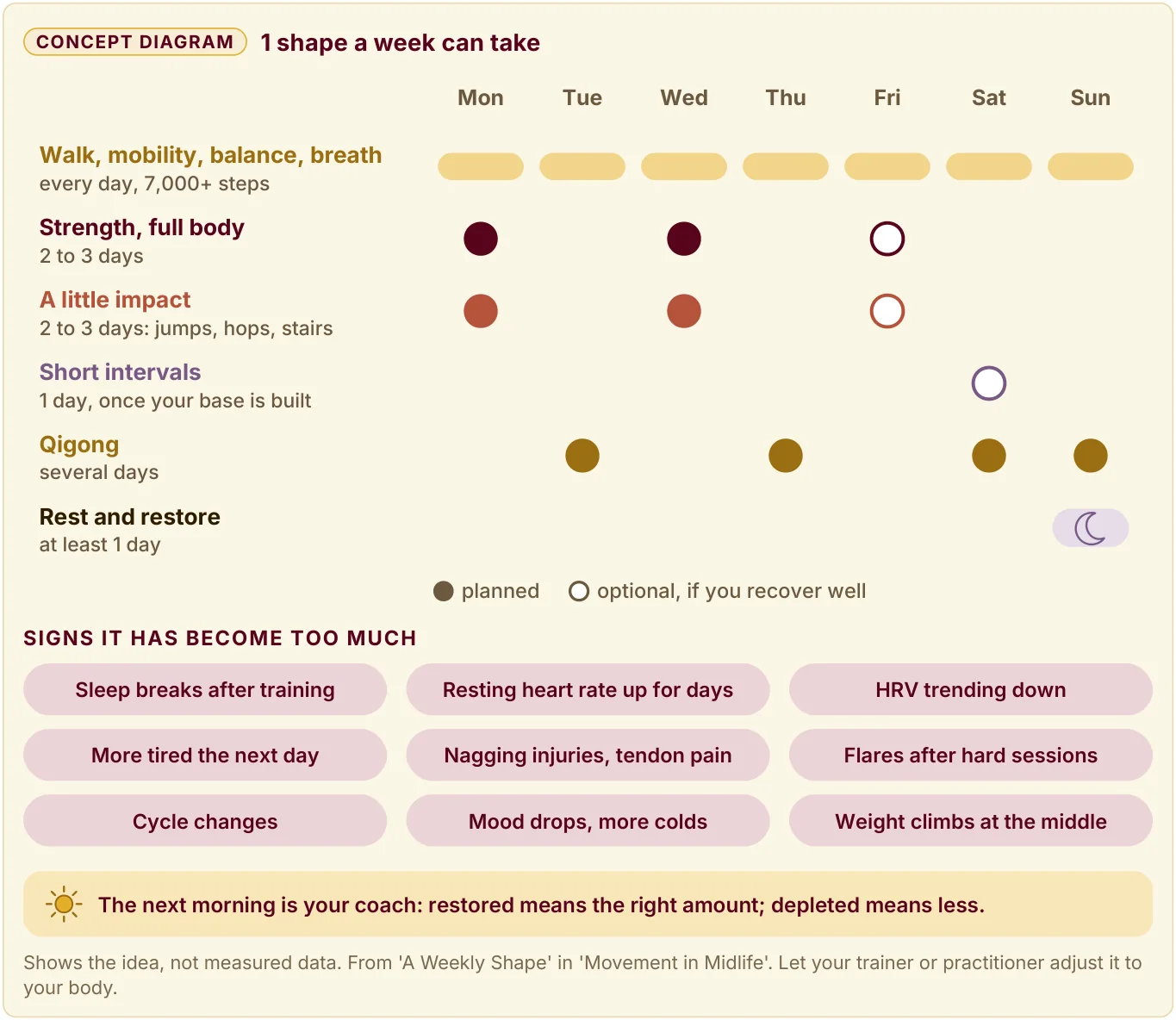
A concept diagram titled '1 shape a week can take', with the days Mon to Sun. Walk, mobility, balance, breath: every day, 7,000+ steps. Strength, full body, 2 to 3 days: planned Mon and Wed, optional Fri. A little impact, 2 to 3 days (jumps, hops, stairs): planned Mon and Wed, optional Fri. Short intervals, 1 day, once your base is built: optional Sat. Qigong, several days: planned Tue, Thu, Sat, and Sun. Rest and restore, at least 1 day: Sun. A filled dot means planned, and an open dot means optional, if you recover well. Signs it has become too much: sleep breaks after training; resting heart rate up for days; HRV trending down; more tired the next day; nagging injuries, tendon pain; flares after hard sessions; cycle changes; mood drops, more colds; weight climbs at the middle. The next morning is your coach: restored means the right amount; depleted means less. Shows the idea, not measured data. From 'A Weekly Shape' in 'Movement in Midlife'. Let your trainer or practitioner adjust it to your body.
If your cortisol is flat or your Autoimmune condition is flaring, the shape gets gentler:
The full sample week, with strength and impact days laid out, is in 'Strength Training: The Command Your Bones Are Waiting For', in the Bones chapter.
Your energy the next day is your most honest coach. If you wake restored, you gave your body the right amount. If you wake depleted, it asked for less.
This article is a section of The Midlife Bible: The Essential Guide to the Women's Midlife Journey, by Daniela Hess, MSEd. It is the book's own text, so where it says 'this book' or points to another part, that means the Bible. The book has the full chapters, charts, and the Lab Wish List.
Educational content, not medical advice. Please work with your own practitioner before you change a medication or a supplement.
These 3 connect to what you just read.
Bone loss in Midlife makes no sound, and in SWAN, the Study of Women's Health Across the Nation, it ran fastest from 1 year before the final period to 2 years after. This article covers how osteopenia differs from osteoporosis, what the LIFTMOR trial found about lifting heavy, and why I teach calcium from food first.
Read this article →Food, movement, and breath'You don't have room for error in Midlife.' That can sound like pressure, and I mean it as good news: when the buffer thins, every nourishing meal counts for more. Here is how protein at each meal, 6 to 15 kinds of vegetables a day, meals spaced 4 to 5 hours apart, and a clear look at alcohol fit together.
Read this article →Food, movement, and breathPodcasts promise autophagy, brown fat, and a longer life from fasting, saunas, and cold, and many of those promises rest on studies of young men. Here is how your cycle, cortisol, and thyroid change your answer to fasting, heat, and cold, what the sauna research shows, and for whom each practice can backfire.
Read this article →FAQ
Start with 2 or 3 focused sessions a week. In an analysis of cohort studies, 30 to 60 minutes a week of muscle-strengthening activity was linked to about 10 to 20 percent lower risk of dying from any cause, heart disease, and cancer, with no clear added benefit beyond about an hour. Combined with aerobic activity, the lowest risk was about 40 percent lower. That research is observational.
Muscle carries your blood sugar, your bones, and your balance into your 70's and 80's. Osteopenia and Osteoporosis in Midlife covers loading with low bone density.
A realistic, research-backed target is 7,000 steps a day, and more is welcome if your body loves it. A 2025 analysis of 57 studies linked 7,000 steps, compared with 2,000, to about 47 percent lower risk of death and about 38 percent lower risk of dementia, and most benefits leveled off around 7,000. In 16,741 Women with an average age of 72, pace mattered less than total steps.
The 10,000 steps figure began as a 1960s pedometer marketing number. A light walk after eating lowered the rise in blood sugar by about 17 percent compared with sitting, in a review of 7 short trials.
Walking is wonderful for your heart, your mood, and your blood sugar, and it is not enough for your spine on its own. A review of 10 trials found walking had no significant effect on bone density at the lower spine in Women in and after Perimenopause.
Estrogen once protected your bone and muscle on its own, and now your training has to send the signal. Add lifting and jumping. Swimming is gentle on your joints, and because the water unloads your skeleton, pair it with strength training and impact. Osteopenia and Osteoporosis in Midlife has the details.
Your body answers the next day. Signs include sleep that breaks or wakes you early after training days, a resting heart rate that stays several beats above your usual for several days, fatigue that is worse the day after a workout, nagging injuries, joint pain or Autoimmune symptoms flaring after hard sessions, and a changing cycle. After Menopause, a lost period can no longer serve as the warning sign.
If even modest activity leaves you wiped out for a day or more, tell your practitioner. If your cortisol curve is flat, easy movement builds you, and hard sessions may dig the hole deeper. That rests on a small study of 12 men.
Lifting and jumping protect your bones, and they also ask a great deal of your pelvic floor. In a 2025 review of 5 studies, 41 to 49 percent of Women powerlifters and 37 to 54 percent of Women weightlifters reported leaking urine, most often during deadlifts and squats. Those were competitive athletes, and the lesson is to train your pelvic floor alongside your lifting.
Breathe out as you lift, rise, or land. A pelvic floor physical therapist can teach you what your floor needs, and some Women need to release before they strengthen. Bladder Leaks, Urgency, and UTIs in Midlife holds the full picture.

A 75-page PDF guide plus the 1 hour 43 minute talk, The Entire Midlife Journey.
Send me the guideYour thyroid, your gut, your hormones, and your labs.
Get The Midlife Bible3 hours with Daniela Hess and Kim Beekman, recorded live. The Midlife Bible is included.
See the workshop60 to 90 minutes one-on-one. Send a request to work with Daniela.
Work with Daniela