Free guide
Free
The Midlife Essentials and the talk
A 75-page PDF guide plus the 1 hour 43 minute talk, The Entire Midlife Journey.
Send me the guide
By Daniela Hess, MSEd11 min readOctober 2026
If your sex drive has tanked and you wonder whether you will ever want it back, this one is for you. Here is what the numbers say about low desire in Midlife, which hormones and body systems sit behind it, where testosterone stands in the United States as of September 2026, and why orgasm and sensitivity can come back.
'My sex drive has completely tanked, and honestly, I don't know if I care if I ever have sex again.'
If you have said that sentence, out loud or only to yourself, this chapter is for you.
What it can feel like. Desire that used to arrive on its own and now has to be summoned. No longer initiating touch, then no longer responding to it, then quietly dreading it. Dryness, burning, or sex that hurts. Sensation that feels muted, and orgasm that is harder to reach.
The Menopause Society estimates that the genitourinary syndrome of Menopause, the genital and urinary changes that follow falling estrogen, affects roughly 27 to 84 percent of postmenopausal Women.
Pattern clues.
What to track. For 4 weeks, note any moment desire surfaced on its own, your cycle day, how you slept, and any dryness or pain.
Many marriages go quiet in Midlife, and many Women have no idea their hormones are part of the reason.
That last number surprises people, because popular articles quote much higher figures for 'sexless marriages.' Those figures use a looser definition, usually sex fewer than about 10 times a year. The fully sexless marriage is a minority, and the marriage where desire has slowly drained away is common.
Then there is the silence. In a national study of adults aged 57 to 85, only 22 percent of Women had discussed sex with a physician since turning 50. In the REVIVE survey of postmenopausal Women living with vaginal symptoms, only 24 percent connected those symptoms to Menopause.
So a great many Women may be living with hormones that have gone nearly flat, and nobody has told them. Many assume the fading is age, or the marriage, or something wrong with them.
I said it this way in my Midlife talk:
When your testosterone drops, your libido drops. And a woman really oftentimes has no idea why. Oftentimes women assume something has gone wrong with her or her marriage or partnership. It can happen at such a slow decline. You just think, well, my drive is slowing down because that's what getting older does.
I am in an extremely loving and healthy marriage with my husband, Christopher. I share this part of our story because I suspect many Women will recognize themselves in it.
For years I thought, well, maybe I'm just one of those people for whom sex doesn't really matter. Now, I had a healthy, intimate relationship with my husband, because I'm devoted to our relationship. I'm devoted to him. Intimacy is important to cultivate. It's something sacred that the two of you in a monogamous relationship get to share together.
I had to consciously rally intimacy. It never felt like I was forcing myself, and it was always a wonderful experience. And the desire wasn't there. I chose to consciously summon it.
At the same time, my zest for life was going. My enthusiasm was fading, and my brain fog was thickening. The Hormones chapter describes what that flatness felt like from the inside: 'A or B? I don't care.'
When I finally worked with practitioners who knew Women's hormones, my labs showed what my body had been telling me. I was deficient in testosterone.
Once I started my hormone replacement therapy, oh my gosh, especially the testosterone. I started at 5 milligrams topical daily, and now I use 6, which is still quite low. All of a sudden, my drive came back online, my brain fog cleared, my mental sharpness came back, my wellspring of joy felt effortless to connect with again. And it completely helped with intimacy.
For context, the ISSWSH clinical practice guideline lists 5 mg a day as the starting dose, adjusted up to 10 mg as needed, for a 1 percent testosterone cream made for Women in Australia. A Woman's dose is a small fraction of a man's.
The devotion was always there. What came back was the desire itself, arriving on its own, with no rallying required. Intimacy that I had been choosing with my whole heart became intimacy my body wanted too.
My full protocol is topical testosterone at a very low dose, topical estrogen, and oral progesterone, built for my body by my practitioners. It is not a prescription for you.
Desire is a whole-body event. It draws on hormones, blood flow, sleep, energy, and how at home you feel in your own skin. When several of those run low at once, desire is often the first thing to go quiet.
Here is how each piece contributes.
Testosterone. Testosterone feeds the wanting itself. The Hormones chapter covers its role in motivation and zest. For intimacy specifically, the ISSWSH guideline describes androgen receptors in the clitoris, the vagina, the labia, and the vestibule, the entrance to the vagina. Androgens help maintain the smooth muscle in the clitoris's blood vessels, which matters for arousal and sensation. Testosterone declines slowly from your 20's onward, so the loss hides.
Yes, testosterone has to do with your libido, but let's think about libido more like your oomph. Your enthusiasm. Your... passion for your Aliveness, your zest. It's much more than desire.
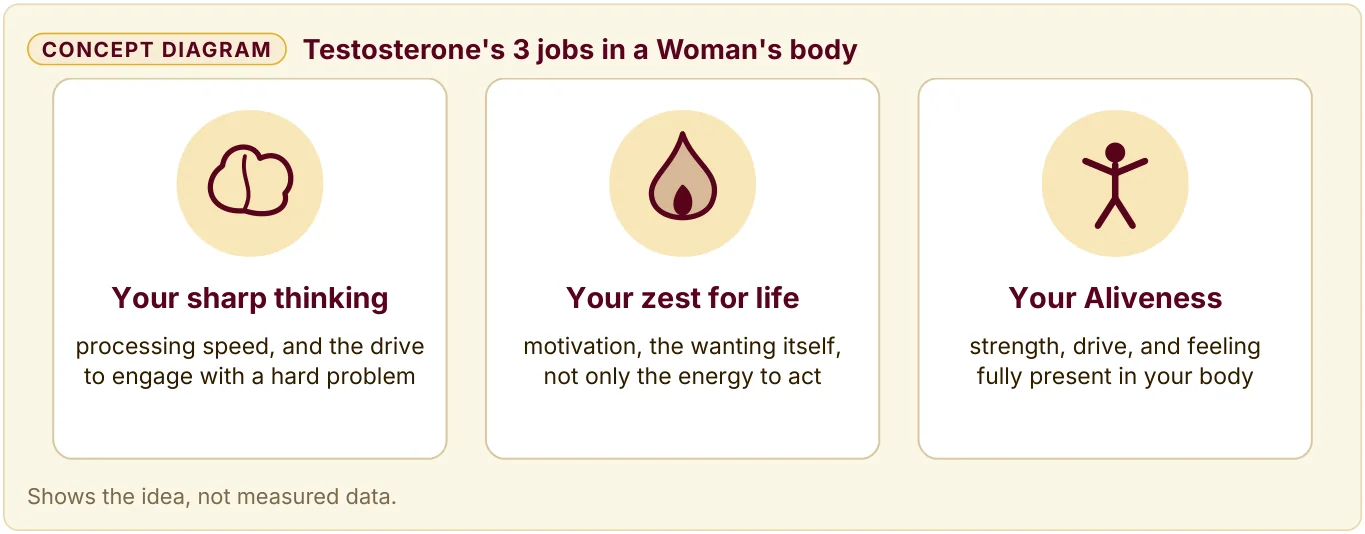
Testosterone's 3 jobs in a Woman's body: your sharp thinking (processing speed, and the drive to engage with a hard problem), your zest for life (motivation, the wanting itself, not only the energy to act), and your Aliveness (strength, drive, and feeling fully present in your body).
Estrogen. Estradiol helps regulate blood flow to the genitals, the density of collagen in the vaginal wall, and the relaxation of the clitoris's blood vessels during arousal. Vaginal lubrication is a combination of mucus the tissue makes at rest and fluid that seeps through the vaginal wall when blood flow rises, and sex steroids regulate both. When estrogen falls, lubrication, comfort, and arousal can all fall with it. In a 2023 Cochrane review, estrogen alone slightly improved sexual function scores in Women with symptoms or in early Menopause, mainly lubrication, pain, and satisfaction.
Progesterone. Progesterone's gift to your intimate life runs through sleep and calm. In a small trial of postmenopausal Women, 300 mg of oral progesterone at bedtime cut wake time during disrupted nights by 53 percent. Research has not shown that progesterone itself raises desire, and a Woman who is finally sleeping has more of herself to bring to anyone, including her partner.
Thyroid. A low thyroid slows the whole system, and low libido appears on the Thyroid chapter's list of hypothyroid symptoms. Thyroid hormone also raises SHBG, which holds testosterone out of use, so a thyroid dose that is too high can lower your free testosterone.
Ferritin. Iron is how your blood carries oxygen to every tissue. A Woman running on an empty ferritin is often too tired to want anything extra, and desire is extra.
Cortisol. Cortisol and your sex hormones share raw material and regulatory pathways. The Pregnenolone section of the Hormones chapter explains how years of high cortisol demand can shortchange the rest.
Then add what Midlife often layers on top.
If you are exhausted by 8 PM, intimacy can start to feel like 1 more thing on the list. If your weight has shifted to your middle with no change in how you eat, you may not feel at home in your own body, and it is hard to open to pleasure in a body that feels like a stranger's.
Put it all together, and you have a Woman whose hormones have gone quiet, who is tired to the bone, and who avoids the mirror. For many Women, that combination can completely tank an intimate life.
The Relational Layer chapter describes how this unfolds inside a home: she stops initiating touch, then starts dreading it, then feels guilty and says nothing. Her partner may read it as rejection, and she may read it as a verdict on herself. Often, both of them are looking at physiology nobody has checked.
There is no single hormone plan that fits every Woman. As I say in my talks, it is 'one size fits one,' built from both your labs and your symptoms.
Please do not start hormone therapy based on symptoms alone. Symptoms overlap. Your tiredness could have several roots. Your anxiousness could be low progesterone, and it could also be low ferritin. A Woman who treats the wrong cause can spend months wondering why nothing changed.
Hormone therapy was 1 of the biggest turning points in my own recovery. It came from very small, precise amounts of exactly what my labs showed my body needed, and more was never the goal.
Your labs show where you are. Your symptoms show how you are living there. Skillful care reads both.
The 2019 Global Consensus on testosterone for Women found 1 evidence-based use: low desire that causes distress, after Menopause. In the trials behind it, Women on testosterone gained, on average, about 1 additional satisfying sexual experience a month over placebo, along with improvements in desire, arousal, orgasm, pleasure, and responsiveness, and less distress about sex.
1 more satisfying experience a month may sound modest. For a Woman who has had none in a year, and for the partner beside her, it can be a real turning point for both of them.
The consensus found too little evidence to recommend testosterone for Women before Menopause. Many practitioners prescribe it in Perimenopause based on labs and clinical experience, and that belongs in a careful conversation with your prescriber.
Where testosterone stands in the United States, as of September 2026:
Testosterone on the clitoris. Some prescribers direct a tiny amount of a Woman's prescribed testosterone cream onto the clitoris or vulva. This is off-label, and it should only be done as your prescriber directs. The direct evidence is limited: I could find no randomized trial of testosterone applied specifically to the clitoris. The closest research:
Put together, the biology is sound, and the specific practice of applying it to the clitoris rests on clinical experience more than on trials. Ask your prescriber whether it makes sense for you, how much, and how often.
What to watch at any dose: acne, oily skin, and new facial hair. At doses that keep your level in a premenopausal Woman's range, the Global Consensus found mild increases in acne and hair growth in some Women, and no hair loss, clitoral enlargement, or voice changes.
Losing orgasm, or feeling it grow faint, is 1 of the quietest losses of Midlife. Many Women never mention it to anyone.
The research points in a hopeful direction. Orgasm and responsiveness improved with testosterone in the trials behind the Global Consensus, orgasm scores rose with vaginal testosterone in the trial described above, and clitoral blood flow rose with testosterone through the skin.
Many Women report that with the right hormone care, sensitivity returns, arousal comes more easily, and orgasm is available again. I have experienced it myself. Sensation depends on blood flow and healthy tissue, and both can respond to care.
Give it time. Tissue rebuilds over about 3 months with vaginal estrogen, and testosterone often takes several weeks to a few months to show its effect on desire.
This article is a section of The Midlife Bible: The Essential Guide to the Women's Midlife Journey, by Daniela Hess, MSEd. It is the book's own text, so where it says 'this book' or points to another part, that means the Bible. The book has the full chapters, charts, and the Lab Wish List.
Educational content, not medical advice. Please work with your own practitioner before you change a medication or a supplement.
These 3 connect to what you just read.
'I just don't care the way I used to anymore.' If that sounds like you, the cause may sit in your hormones, your thyroid, your ferritin, or your testosterone, and real depression is common in Midlife too. Here is how to tell the look-alikes apart, what testosterone does in a Woman's body, and where to look first.
Read this article →Your hormones and your thyroidHormone therapy is 1 of the most effective tools for the Midlife years and 1 of the most misunderstood. Here is what happened in 2002, what changed in 2025, and what the evidence shows on timing, bones, heart, and breast cancer.
Read this article →Your hormones and your thyroidPerimenopause can begin as early as 35 and run up to 17 years. Here are the 3 stages, how a trained practitioner reads where you are, and why 5 hormones never work alone.
Read this article →FAQ
Desire is a whole-body event. It draws on hormones, blood flow, sleep, energy, and how at home you feel in your own skin. When several of those run low at once, desire is often the first thing to go quiet. Testosterone feeds the wanting itself and declines slowly from your 20's, so the loss hides. Falling estrogen affects blood flow, lubrication, and comfort. A low thyroid slows the whole system, low ferritin leaves you too tired to want anything extra, and years of high cortisol demand can shortchange your sex hormones.
Many Women assume the fading is age, or the marriage, or something wrong with them. Often, both partners are looking at physiology nobody has checked.
Very common. In PRESIDE, a survey of 31,581 US Women, 38.7 percent reported low desire, more than reported trouble with arousal or orgasm. Low desire that caused real distress affected 12.3 percent of Women aged 45 to 64, compared with 8.9 percent of Women 18 to 44 and 7.4 percent of Women 65 and older.
Then there is the silence. In a national study of adults aged 57 to 85, only 22 percent of Women had discussed sex with a physician since turning 50.
The 2019 Global Consensus on testosterone for Women found 1 evidence-based use: low desire that causes distress, after Menopause. In the trials behind it, Women on testosterone gained about 1 additional satisfying sexual experience a month over placebo, along with improvements in desire, arousal, orgasm, pleasure, and responsiveness. It found too little evidence to recommend testosterone before Menopause.
As of September 2026, no testosterone product is FDA-approved for Women in the United States, and it is approved for low desire after Menopause in Australia, New Zealand, the United Kingdom, and South Africa. On September 17, 2026, the FDA held a public workshop on testosterone therapy for Women in Menopause. Please do not start hormone therapy based on symptoms alone, and bring the decision to a prescriber who reads your labs and your symptoms together. Anxiety, Depression, and Lost Zest in Midlife covers testosterone's other jobs.
Desire that is still there, with dryness, pain, or UTIs that keep returning, points toward falling estrogen and the genitourinary syndrome of Menopause, which The Menopause Society estimates affects roughly 27 to 84 percent of Women after Menopause. Estradiol helps regulate blood flow to the genitals, the density of collagen in the vaginal wall, and lubrication. In a 2023 Cochrane review, estrogen alone slightly improved sexual function scores in Women with symptoms or in early Menopause, mainly lubrication, pain, and satisfaction.
Give it time. Tissue rebuilds over about 3 months with vaginal estrogen. The treatment decision is yours and your prescriber's.
The research points in a hopeful direction. Orgasm and responsiveness improved with testosterone in the trials behind the Global Consensus, orgasm scores rose with vaginal testosterone in a trial of 80 Women after Menopause, and clitoral blood flow rose with testosterone through the skin in a study of 81 Women. Many Women report that with the right hormone care, sensitivity returns, arousal comes more easily, and orgasm is available again. I have experienced it myself.
Sensation depends on blood flow and healthy tissue, and both can respond to care. Testosterone often takes several weeks to a few months to show its effect on desire.

A 75-page PDF guide plus the 1 hour 43 minute talk, The Entire Midlife Journey.
Send me the guideYour thyroid, your gut, your hormones, and your labs.
Get The Midlife Bible3 hours with Daniela Hess and Kim Beekman, recorded live. The Midlife Bible is included.
See the workshop60 to 90 minutes one-on-one. Send a request to work with Daniela.
Work with Daniela