Free guide
Free
The Midlife Essentials and the talk
A 75-page PDF guide plus the 1 hour 43 minute talk, The Entire Midlife Journey.
Send me the guide
By Daniela Hess, MSEd15 min readOctober 2026
'My bloating and my thyroid symptoms got treated as separate problems.' Your gut lining is 1 cell thick, and Midlife stacks several changes on it in the same decade. Here is how the lining works, what loosens it, why estrogen, stress, and medications matter, and which foods and habits feed its repair.
I came to my own diagnosis after almost 20 years as a vegan. A Master's in Health Education. Ayurvedic training. By every measure I had been taught to trust, I was doing everything right. And I was still, in a very real sense, starving at the level of my cells.
Food matters. And the terrain underneath the food, your gut lining, your stomach acid, your microbiome, matters just as much, sometimes more. You can eat what you would call a very healthy diet and still be deeply undernourished, because if your gut lining is inflamed and your digestion is weak, you stop absorbing what you eat well. That includes iron. That includes B12. That includes everything.
That phrase matters: nourished on paper, and starving at the level of my cells. It is the reason this guide spends as much time on your gut as it does on your plate. Your gut is also where a great deal of inflammation starts, and where much of it can be calmed.
When I finally sat across from a Functional Medicine practitioner, the testing found Hashimoto's, small intestinal bacterial overgrowth, and low stomach acid, all in the same body, all at the same time. The gut was sitting underneath all of it.
You may have described your bloating and your thyroid symptoms in the same appointment and heard them treated as 2 separate complaints. They belong in the same conversation. The gate in your gut and the calm of your immune system are linked, and the link is physical.
What that practitioner understood, and what I teach now, is that the state of your gut sits at the beginning and the end of so much of what a Woman feels physically in Midlife. The bloating. The fatigue that sleep does not touch. The iron that will not climb. The brain fog.
This chapter goes all the way down: the lining itself, the digestion that happens above it, the bacteria that live along it, how to test it, and what rebuilds it. The Autoimmune Protocol chapter, right after the Liver chapter, turns all of it into a 90-day plan.
The Stomach chapter, just before this one, goes deep on stomach acid, digestive enzymes, and how to test them, so this chapter touches them only briefly.
The inside of your small intestine is lined with a single layer of cells. Folded into ridges and tiny finger-like villi, the lining of your whole digestive tract covers roughly 32 square meters, about half the floor of a badminton court, tucked inside your abdomen.
Everything you absorb crosses that 1 layer. Everything you should not absorb is supposed to be turned away at it.
Everything hinges on the health of that 1 little, 1 cell layer wall. It's just astounding. We're such a powerful, fragile system.
The cells are stitched together by protein seams called tight junctions. They open and close in response to signals, letting digested nutrients through and keeping everything else inside the gut where it belongs. The word that matters is 'selectively'. A healthy gut wall is a discerning door, opening just enough, for just the right things.
When those junctions stay open longer than they should, larger particles slip through:
Right behind that wall sits a large share of your immune system, often described as about 70 percent of it. It meets these particles in a place they were never meant to be, and it does its job. It responds. This is the right response in the wrong location, and when it repeats day after day, it becomes chronic inflammation.
For some Women, a food protein that crosses this way resembles a piece of their own tissue closely enough to confuse the immune system. That is molecular mimicry, and 'Gluten, Molecular Mimicry, and Your Thyroid' in the thyroid chapter walks through it step by step.
The biology has a hopeful half too. The cells of your gut lining are among the fastest-renewing cells in your body, replaced roughly every 3 to 5 days. This is why gut healing is possible at all. Give the lining fewer irritants and more raw materials, and it rebuilds itself, week after week.
The immune system behind the wall calms more slowly than the lining renews. That is part of why the protocol in the Autoimmune Protocol chapter asks for 90 days.
What tends to loosen the tight junctions:
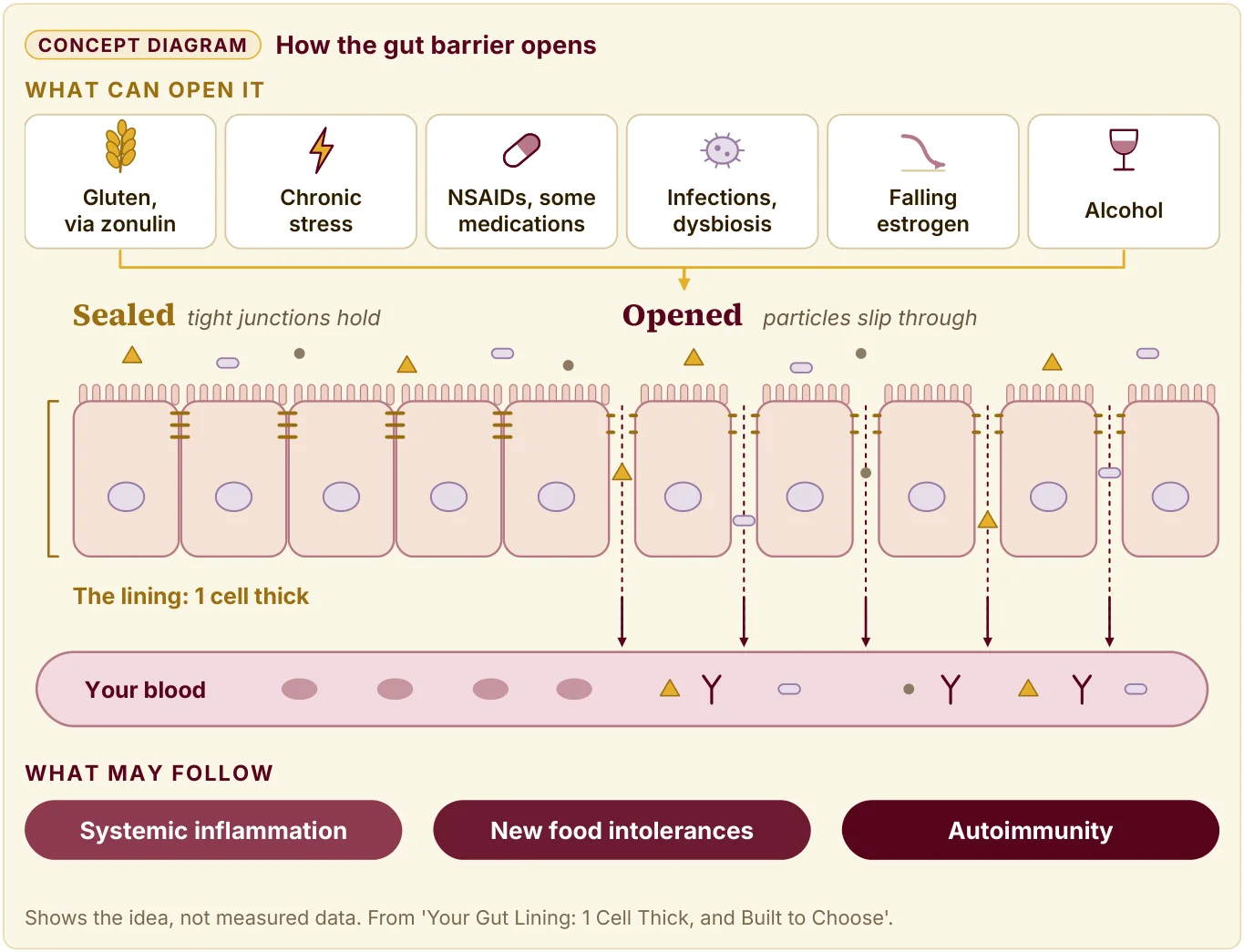
Diagram titled 'How the gut barrier opens.' What can open it, 6 things: Gluten, via zonulin; Chronic stress; NSAIDs, some medications; Infections, dysbiosis; Falling estrogen; Alcohol. Below them, the gut lining is 1 cell thick. On the left it is sealed, and the tight junctions hold. On the right it is opened, and particles slip through into your blood. What may follow, 3 things: Systemic inflammation; New food intolerances; Autoimmunity. The chart shows the idea, not measured data, and comes from 'Your Gut Lining: 1 Cell Thick, and Built to Choose'.
The blood-brain barrier is built from similar tight junction proteins. Many Women notice their brain fog lift as their gut heals, and while the research on that connection is still growing, it matches what I hear again and again from the Women I work with.
Zonulin is a protein your own gut makes to open the tight junctions on purpose. Opening them is sometimes useful. It is 1 of the ways the gut flushes out unwanted bacteria.
The trouble comes when the key keeps turning. Gliadin, a protein in gluten, triggers zonulin release. In laboratory studies, gliadin raised zonulin and loosened the barrier in intestinal tissue from people with celiac disease and from people without it.
In most bodies, the door closes again. In a gut that is already inflamed, or in a body with the genetic susceptibility for Autoimmunity, it can stay propped open far longer than it should.
Certain bacteria in the small intestine also trigger zonulin release. That is 1 more reason an overgrowth in the wrong place, like SIBO, matters so much to the gut barrier.
Some stool tests report zonulin. Researchers have raised real questions about what some commercial zonulin tests actually measure, so read a zonulin number as 1 clue among several, alongside your other markers and how you actually feel.
Zonulin reaches beyond the gut. Dr. Alessio Fasano, whose team discovered it, describes zonulin as a regulator of tight junctions in other barriers too, and in laboratory cell models zonulin loosened a model of the blood-brain barrier as well as the gut lining. In a small human study, blood zonulin and blood-brain barrier leakiness did not track together, so this link is still being worked out.
When the gate in your gut stays open, what slips through travels. Medications such as NSAIDs, unfriendly bacteria, stress, toxins, and undigested food particles can all loosen the junctions between the cells of your lining. Fragments then pass into your bloodstream and your lymphatic system, which carry them everywhere.
What researchers and practitioners watch for next falls into 3 groups: systemic inflammation, new food intolerances, and Autoimmunity.
The Hashimoto 411 educators teach leaky gut as a whole-body picture, and it is 1 of my favorite ways to see it. A permeable gut has been linked with conditions in nearly every system. Linked means found together in research, and for most of these, scientists are still working out which comes first.
Each system on this list has its own chapter in this book, and the gut sits underneath all of them. Healing the lining is 1 step that touches every system on the list at once.
Right beneath your gut lining sits the largest concentration of immune tissue in your body, called gut-associated lymphoid tissue. Specialized immune cells there, called dendritic cells, sample what arrives and help teach the rest of your immune system what to accept as food and friend. Researchers call this lesson oral tolerance.
When the barrier stays open, that classroom gets noisy. More undigested fragments reach it, the immune system flags more of them, and the list of foods a Woman reacts to can keep growing. That is 1 reason a food you ate for decades can start to cause trouble in Midlife.
The lesson can run in reverse. Healing the barrier is how you quiet the classroom, so your immune system can relearn the difference between a meal and a threat. 'Why You Might Get More Sensitive as You Heal', later in this chapter, explains why a reaction can sharpen for a season before your food map grows.
Many Women tell me some version of the same story. For decades, digestion was something they never had to think about. Then, somewhere in their 40's, the bloating arrived and stayed, foods they had always eaten began to push back, and their bowels stopped keeping a schedule.
Several changes stack up in the same decade, and each 1 asks more of the same lining, 1 cell thick. Most of them can be tested, and many of them can be tended.
Any change to a prescribed medication, a PPI included, belongs with your prescriber. Many of these medications are necessary, and some, like PPIs, cause a rebound when they are stopped suddenly. What you can do is ask whether each 1 is still needed, and what might support your gut while you take it.
Put these together, and the Midlife gut starts to make sense. A gut that handled everything at 30 is now working with less hormonal support, fewer bacterial allies, weaker digestion, and a heavier load, all in the same years. Every factor on this list is also a place to begin.
For a whole book on this decade and your gut, read Cynthia Thurlow's The Menopause Gut: Balance Your Microbiome to Reclaim Your Health in Midlife and Beyond (Avery, 2026). Thurlow is a nurse practitioner, and her book explores how your gut and your microbiome change alongside your hormones in Perimenopause and Menopause, with practical nutrition and lifestyle strategies.
It is the book I recommend most on the Midlife gut. Read it beside this chapter, and find it in the Resource Directory.
William Davis, MD, the cardiologist behind Wheat Belly, wrote an excellent book on rebuilding what your gut has lost, Super Gut (2022). His signature idea is bringing back microbes that modern life has thinned out, such as Lactobacillus reuteri, through a homemade yogurt fermented for about 36 hours, and on AIP any version of it needs a dairy-free base. It is a brilliant, practical guide to restoring what modern life has taken from your gut, and the human research on his yogurt method is still early. Look for it in the Resource Directory.
Alcohol is a direct driver of intestinal permeability. It loosens the tight junctions in your gut lining, lets more undigested material into your bloodstream, and shifts your microbiome toward the organisms we are trying to calm down. I say this with no judgment on the glass of wine that got you through a hard year. This is simply what is happening in the body while that repair work is trying to happen too.
This is part of why every Woman in Midlife is served by eating in a more anti-inflammatory way, whether she drinks or not. Many Midlife guts carry some degree of chronic, low-grade inflammation, loud enough to notice or not.
Alcohol and acetaldehyde, the compound your body turns it into, both loosen the seams between gut cells. More LPS, those inflammatory bacterial fragments, then reaches your liver and your bloodstream.
Your liver, meanwhile, is asked to clear the alcohol, the LPS, and your used estrogen all at once. And alcohol fragments sleep in the second half of the night, which is exactly when so many Midlife Women already wake at 3 AM.
The second glass of wine asks more of your gut than the first. On AIP, alcohol comes out for the full 90 days, and many Women tell me how much better they sleep within the first couple of weeks.
If the evening glass has been your ritual for decoupling from the day, keep the ritual and change what is in the glass. Sparkling water with lime and a sprig of mint, in your favorite wine glass, on the porch, still marks the end of the workday.
Vegetables do real, structural work on your plate, well beyond filling the space around the protein. Their fiber feeds the beneficial bacteria in your gut, and those bacteria produce short chain fatty acids, butyrate especially, which is the primary fuel your own gut lining cells run on.
Liver gives you retinol, the form of vitamin A your body can use directly, plus B12 and copper in amounts that are almost impossible to get anywhere else. Bone broth gives you collagen, gelatin, glycine, and glutamine, the literal building blocks your gut lining uses to knit itself back together.
The full repair kit, and where each piece comes from:
Gut-healing supplements such as L-glutamine and collagen can support repair. They cannot outrun a food that keeps injuring the lining. Stopping the harm and feeding the repair are 2 different jobs, and your gut needs both.
And some of the repair kit is not food at all. Sitting down to eat. Chewing well. Space between meals. Sleep. Movement. A Nervous System that gets to rest. The lining heals in a body that feels safe enough to digest.
Ask yourself honestly, were you truly a picture of health before, or had your body simply adapted, learning to quietly tolerate a low simmer of inflammation because that was the only option it had? A body under chronic strain becomes remarkably good at compensating without telling you. Once the gut lining actually heals, that compensation is no longer required, and your immune system is finally free to respond honestly to what is truly reactive for you. Becoming more sensitive after gut healing is your body finally telling you the truth it could not afford to tell you before.
This is why reintroduction, the careful testing of foods 1 at a time after 90 days, gives you such clear answers. You may notice a reaction to a food you ate daily for years without a second thought.
Sensitivity is also rarely fixed. As the lining heals and the immune system calms, many of the reactions that show up in early reintroduction fade with time. Your food map tends to grow.
This article is a section of The Midlife Bible: The Essential Guide to the Women's Midlife Journey, by Daniela Hess, MSEd. It is the book's own text, so where it says 'this book' or points to another part, that means the Bible. The book has the full chapters, charts, and the Lab Wish List.
Educational content, not medical advice. Please work with your own practitioner before you change a medication or a supplement.
These 3 connect to what you just read.
'I'm bloated by the end of every day, no matter what I eat.' Bloating usually has a findable cause. This article starts with the red flags that need a doctor promptly, then maps the drivers, including stomach acid, SIBO, your thyroid, and progesterone, and shares what helps, from how you eat to a plan for constipation.
Read this article →The roots underneath'My body was telling me for years something was not right, and nobody would listen.' Every Autoimmune condition needs 3 factors to line up: genetic susceptibility, a loosened gut barrier, and triggers. Here is how your immune system tells self from non-self, what the years before a diagnosis look like, and why about 80 percent of Autoimmune conditions occur in Women.
Read this article →The roots underneathInflammation is your immune system's repair response, and the trouble is the kind that never switches off. Here is where it hides, where it comes from, the damage it does, and a plan to cool it.
Read this article →FAQ
The inside of your small intestine is lined with a single layer of cells, stitched together by protein seams called tight junctions. When those junctions stay open longer than they should, partly digested food proteins, bacterial fragments called LPS, and toxins slip through. Right behind that wall sits a large share of your immune system, often described as about 70 percent of it, and it responds.
That is the right response in the wrong location, and when it repeats day after day, it becomes chronic inflammation. Gluten, alcohol, regular NSAID use, chronic stress, infections, a microbiome short on fiber, and falling estrogen can each loosen the junctions.
Several changes stack up in the same decade, and each asks more of the same lining. Estrogen helps keep the tight junctions sealed, and it swings and then falls in Perimenopause. Progesterone drops unpredictably, so bowel patterns can swing from sluggish to loose. Stress runs high, stomach acid can run lower, and a slow thyroid slows the gut. In a 2022 study of 2,300 adults, Women after Menopause trended toward lower gut microbial diversity than before Menopause.
Medications and antibiotic courses add up too. Every factor here is also a place to begin. Bloating in Midlife covers the bloating that arrives and stays for many Women.
A permeable gut has been linked with conditions in nearly every system, and linked means found together in research. For most of these, scientists are still working out which comes first. A 2021 study found higher zonulin in people with Hashimoto's. In a 2018 study, blood markers of gut permeability ran higher in people with anxiety or depression. In a 2020 study, zonulin rose and the gut barrier weakened before rheumatoid arthritis appeared.
Many Women notice their brain fog lift as their gut heals, and the research on that connection is still growing.
Some stool tests report zonulin. Researchers have raised real questions about what some commercial zonulin tests measure, so read a zonulin number as 1 clue among several, alongside your other markers and how you feel. A slow thyroid, Autoimmune gastritis, H. pylori, and long seasons of stress can all lower stomach acid, and that can be tested too.
The Midlife Bible compares comprehensive stool testing with the leaky gut blood panel. If you take a PPI or an NSAID, ask your prescriber whether it is still needed and what might support your gut while you take it. Any change to a prescribed medication belongs with your prescriber.
The cells of your gut lining are replaced roughly every 3 to 5 days, so with fewer irritants and more raw materials, it rebuilds itself. The immune system behind the wall calms more slowly, which is part of why the Autoimmune Protocol asks for 90 days. Vegetable fiber feeds the bacteria that make butyrate, the primary fuel for your lining cells, and bone broth gives you collagen, glycine, and glutamine.
Supplements such as L-glutamine and collagen can support repair, and they cannot outrun a food that keeps injuring the lining. Sitting down to eat, chewing well, sleep, and a Nervous System that gets to rest belong in the repair kit too.

A 75-page PDF guide plus the 1 hour 43 minute talk, The Entire Midlife Journey.
Send me the guideYour thyroid, your gut, your hormones, and your labs.
Get The Midlife Bible3 hours with Daniela Hess and Kim Beekman, recorded live. The Midlife Bible is included.
See the workshop60 to 90 minutes one-on-one. Send a request to work with Daniela.
Work with Daniela