Free guide
Free
The Midlife Essentials and the talk
A 75-page PDF guide plus the 1 hour 43 minute talk, The Entire Midlife Journey.
Send me the guide
By Daniela Hess, MSEd13 min readOctober 2026
'My belly is flat at breakfast and 5 months pregnant by dinner.' If eating clean has not touched your bloating, SIBO may be part of the picture. Here is why it comes in 3 kinds, how hydrogen, methane, and hydrogen sulfide each bring different symptoms, and which root causes help explain why it keeps coming back.
When I share my story at summits and workshops, I list what my testing found, and then I add 1 more.
So that was me. One more thing on top of it, SIBO, small intestinal bacteria overgrowth. Yay! Okay, so this is when bacteria proliferate where they shouldn't be, further damaging the gut lining, creating bloating, fog, more inflammation.
Many Women live some version of it: the belly that is flat at breakfast and 5 months pregnant by dinner, the 'healthy' vegetables that make it worse, the bloating that no amount of eating clean seems to touch.
'SIBO and Your Thyroid' in the Gut chapter introduced SIBO, and 'Leaky Gut, IBS, IBD, and SIBO' set it beside the conditions it is most often confused with. This chapter goes further, because SIBO turns out to be at least 3 different overgrowths, each with its own gas, its own symptoms, and its own treatment.
Which kind do I have? Did my test even look for all 3?
What treats each 1? And why does it keep coming back?
Your small intestine is where most of your nourishment is absorbed, and it is meant to hold very few bacteria. In healthy people, a sample of fluid from the upper small intestine grows fewer than 1,000 bacteria per milliliter. Your large intestine, further along, holds most of the roughly 38 trillion bacteria in your body.
That quiet is actively kept. The American College of Gastroenterology's 2020 SIBO guideline lists the guards that hold the line:
SIBO takes hold where 1 or more of these guards has gone quiet. The guideline notes that in almost every case, SIBO is related to something else, usually a condition that lets contents sit still in the small intestine. That sentence is the Functional Medicine case for finding the root cause.
The ACG guideline defines SIBO as too many bacteria in the small intestine, causing gut symptoms. When a gastroenterologist samples fluid from the small intestine during an endoscopy, 1,000 or more bacteria per milliliter counts as SIBO.
The most common symptom is bloating. Pain, gas, distension, and diarrhea are close behind, along with constipation in some Women, and some people describe fatigue and poor concentration too. No single symptom proves SIBO, which is why the test matters so much.
The name itself is changing. Methane, 1 of the gases measured on a breath test, is made by microbes called archaea, which are a separate branch of life from bacteria. They can overgrow in the large intestine as well as the small.
So in 2020, the ACG proposed a new name for the methane pattern: intestinal methanogen overgrowth, or IMO.
Newer research has refined the picture further. The Gut chapter describes SIBO as bacteria from the large intestine moving up. Recent sequencing studies from Cedars-Sinai suggest the overgrowth is often dominated by just a few species, mainly strains of E. coli and Klebsiella.
The same group now describes 3 overgrowth patterns: SIBO, IMO, and intestinal sulfide overproduction, or ISO.
Most practitioners still call all 3 'SIBO', and so do I, naming the type whenever it changes the treatment.
Your body cannot make hydrogen or methane. When those gases show up in your breath, microbes in your gut made them, and the gas tells you who is doing the fermenting.
Hydrogen-dominant SIBO. Bacteria ferment your food and release hydrogen. This is the classic SIBO pattern.
In a 2026 study of 3,004 people who took a 3-gas breath test at home, higher hydrogen went with more severe diarrhea. Bloating, gas, and loose stools are the typical picture.
Methane-dominant, or IMO. The methane makers, mainly 1 species called Methanobrevibacter smithii, feed on the hydrogen other microbes produce and turn it into methane. Methane slows the gut.
In the research behind the ACG guideline, a positive methane test was linked to constipation, and the higher the methane, the worse the constipation tended to be. Bloating with hard, slow stools is the typical picture.
Hydrogen sulfide, or ISO. Some bacteria use hydrogen to make hydrogen sulfide, the gas that smells like rotten eggs.
In the same 2026 study, higher hydrogen sulfide went with more severe diarrhea, more urgency, and more belly pain. Gas with a sulfur smell, urgent loose stools, and pain are the typical picture.
The 3 gases compete for the same hydrogen. When methane makers or sulfide makers use it up, the hydrogen line on a breath test can look low or flat even while a great deal of fermentation is happening. Some practitioners read a flat hydrogen line in a Woman with obvious symptoms as a clue to hydrogen sulfide, and researchers have described how these gases trade hydrogen back and forth.
It remains an interpretation, and a 3-gas test gives a direct answer.
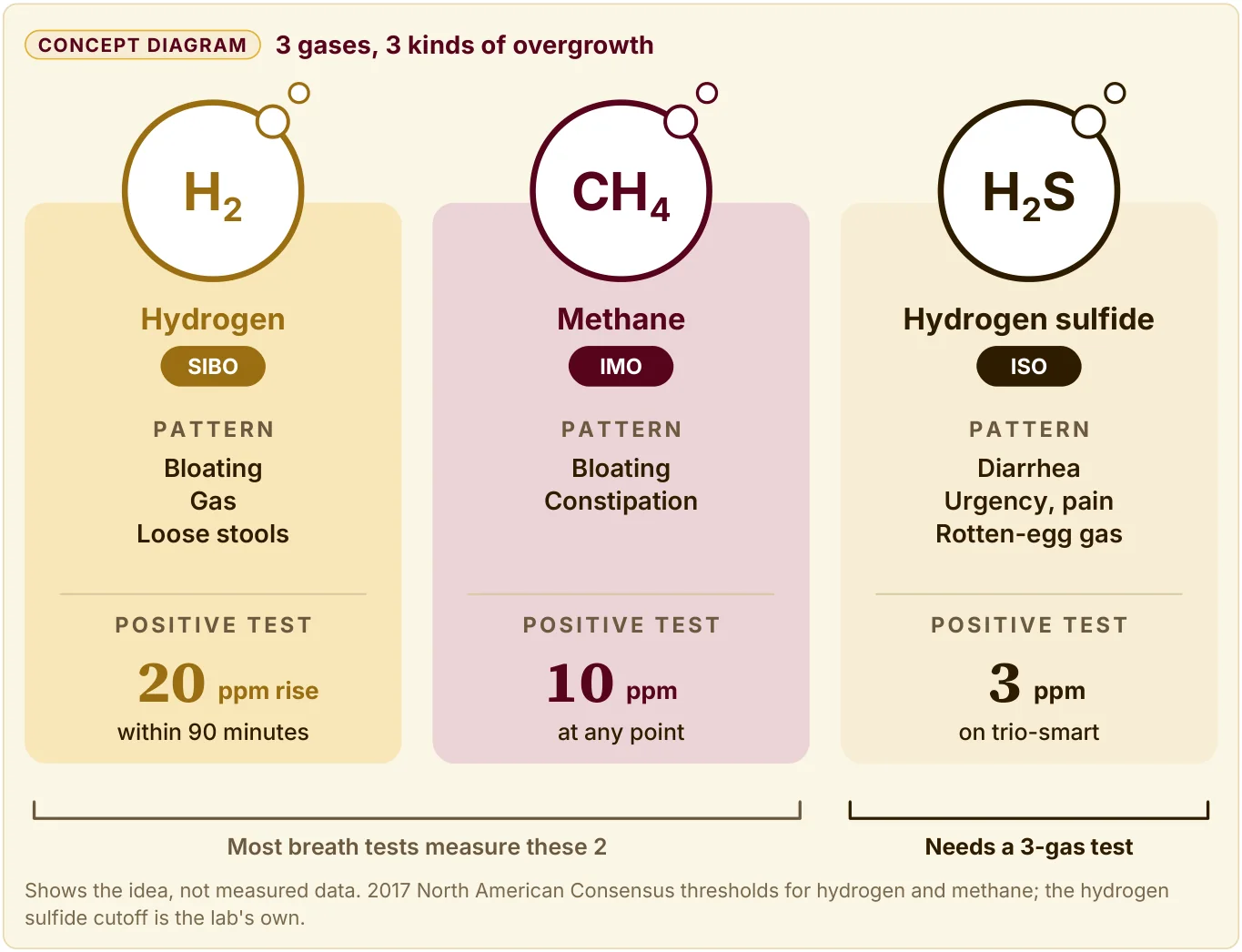
Diagram titled '3 gases, 3 kinds of overgrowth.' Hydrogen, H2, SIBO. Pattern: bloating, gas, loose stools. Positive test: 20 ppm rise within 90 minutes. Methane, CH4, IMO. Pattern: bloating, constipation. Positive test: 10 ppm at any point. Hydrogen sulfide, H2S, ISO. Pattern: diarrhea, urgency, pain, rotten-egg gas. Positive test: 3 ppm on trio-smart. A bracket under hydrogen and methane says most breath tests measure these 2. A bracket under hydrogen sulfide says it needs a 3-gas test. The chart shows the idea, not measured data. The 2017 North American Consensus sets the thresholds for hydrogen and methane, and the hydrogen sulfide cutoff is the lab's own.
Some Women can name the day their gut changed: a bout of food poisoning, a stomach bug on vacation, traveler's diarrhea that never quite resolved. That pattern is called post-infectious IBS.
In a 2017 analysis of 45 studies and more than 21,000 people, about 10 percent developed IBS within a year of a gut infection. Women had about 2 times the odds of men. After infections caused by parasites or protozoa, the rate was about 42 percent.
Dr. Mark Pimentel's group at Cedars-Sinai proposed a mechanism. Bacteria that cause food poisoning make a toxin called cytolethal distending toxin B, or CdtB. The antibodies your body makes against CdtB can also react with vinculin, a protein your own gut uses, and in animal research this cross-reaction produced IBS-like changes, including shifts in the bacteria of the small intestine.
Their blood test, now sold by Gemelli Biotech as ibs-smart, measures anti-CdtB and anti-vinculin antibodies. In their 2015 study of 2,375 people with diarrhea-type IBS, a high anti-CdtB result was quite specific, 91.6 percent, and it caught fewer than half the cases, 43.7 percent. An Australian research team found the antibodies did not separate IBS from health well in their community sample.
Read it as 1 more clue. A positive result can help explain why your SIBO keeps returning, and it points the plan toward protecting your gut's motility after treatment.
In Functional Medicine, the question underneath every symptom is 'why?' A root cause is the upstream driver, the reason the overgrowth could take hold, rather than the overgrowth itself. Antimicrobials clear the bacteria. The root cause decides whether they return.
And they often do. In a 2008 Italian study of 80 people whose SIBO had cleared with rifaximin, it returned in 12.6 percent by 3 months, 27.5 percent by 6 months, and 43.7 percent by 9 months. Older age, a past appendectomy, and long-term PPI use each raised the odds of a return.
The root causes worth looking for:
Age and being a Woman also raise the odds, the ACG notes, possibly because food moves more slowly. That makes the root-cause work especially important in Midlife.
Once the overgrowth has cleared, prevention comes back to the cleaning wave that 'Give Your Gut Time to Rest Between Meals' in the Gut chapter describes.
Space your meals. The wave runs only when your gut is empty, and food stops it. Leave 4 to 5 hours between meals, with nothing in between but water.
For a Woman prone to SIBO, grazing hands the bacteria a steady supply of food and takes away the wave that would have swept them along.
Let your Nervous System rest. Stress quiets the wave, so the breathing, sleep, and Connection practices in this book are part of SIBO prevention. Inhale deep, exhale long.
Ask about a prokinetic. A prokinetic is a medication or herb that encourages the gut to move. Many practitioners suggest 1 after SIBO treatment, especially when methane, a slow thyroid, or a post-infectious pattern is in the picture.
Keep treating the root causes you found. Supporting stomach acid when testing shows it is low, caring for your thyroid, and steadying your blood sugar all protect the small intestine long after the antimicrobials are done.
1 of the Hashimoto 411 educators teaches 3 habits to keep long after treatment: a prokinetic, support for low stomach acid, and care for a healthy microbiome. In her experience, the prokinetic is the habit most worth protecting. As thyroid and gut health improve, many Women can lower their betaine HCl dose with their practitioner.
She suggests taking a prokinetic at night, on an empty stomach that will stay empty for hours, since the cleaning wave runs only in a fasting gut. Where blood sugar and adrenals allow, she favors long gaps between meals, a long overnight fast, and a kitchen closed 2 to 4 hours before bed.
She is just as clear that spacing bends to the body in front of you. A Woman with low blood sugar may need to eat every few hours, and a Woman with adrenal issues may need breakfast within 30 minutes of waking and a small protein and fat snack at bedtime. Space your meals as far as your blood sugar and your adrenals allow.
SIBO can show up well beyond the gut, in places Women do not expect.
Histamine belongs on this list too. Some of the bacteria that overgrow in the gut make histamine, and an inflamed lining makes less of DAO, the enzyme that clears food histamine. If you flush, itch, or get headaches after fermented foods or wine, read 'Histamine Intolerance and MCAS: When Your Body Overreacts'.
Before I knew I had SIBO, healthy food made me miserable. Within 10 minutes of eating garlic, onions, celery, mushrooms, or certain fruits, I was so bloated, and it would not go down.
Those foods share a thread. Monash University's FODMAP research lists garlic and onions as rich in fructans, mushrooms and celery as rich in mannitol, and fruits such as apples, pears, and mango as high in excess fructose or sorbitol.
Because eating made me so uncomfortable, I began to eat less. That calorie restriction deepened the nutrient deficiencies I already had.
Thank goodness I did the trio-smart breath test, which measures all 3 gases. My methane came back at extreme levels, the pattern this chapter calls IMO.
On that first test, my methane measured about 75 ppm. The North American Consensus on breath testing treats 10 ppm or more at any point in the test as positive.
I followed an antimicrobial protocol from Dr. Allison Siebecker, a naturopathic doctor who has focused on SIBO since 2011. First came her methane protocol for 6 weeks, then a slower, longer round for 8 weeks, with a biofilm disruptor and low FODMAP eating alongside.
The tools I name, as education to bring to your practitioner:
Dr. Siebecker's site lists berberine with allicin, berberine with Atrantil, neem with allicin, and oregano with allicin among her combinations for methane, usually in rounds of 4 to 6 weeks, and many Women need more than 1 round. Every product, amount, and length of treatment belongs with your practitioner, and none of these herbs has been tested on its own in a human SIBO trial.
And the order mattered as much as any herb. Thyroid first, then SIBO. When you have a list of things to treat, a skillful Functional Medicine practitioner helps you understand the proper order.
About 7 months later, after treatment, my methane read 23 ppm on FoodMarble, a handheld breath device I use at home. A home device and a lab breath test are different tools, so I read that number as a trend.
About 10 months after that, my methane climbed again, to 52 ppm on FoodMarble. I understand why: my thyroid was not yet optimized. A slow thyroid slows the gut, and a slow gut gives the methane makers time to settle back in.
As my thyroid has come closer to optimal, my antimicrobials have worked much better, and my results are holding. Thyroid first, then SIBO, is a lesson my own body keeps teaching me.
These are my own results, reached with my practitioners, and 1 Woman's numbers are not a promise for yours.
This article is a section of The Midlife Bible: The Essential Guide to the Women's Midlife Journey, by Daniela Hess, MSEd. It is the book's own text, so where it says 'this book' or points to another part, that means the Bible. The book has the full chapters, charts, and the Lab Wish List.
Educational content, not medical advice. Please work with your own practitioner before you change a medication or a supplement.
These 3 connect to what you just read.
'I'm bloated by the end of every day, no matter what I eat.' Bloating usually has a findable cause. This article starts with the red flags that need a doctor promptly, then maps the drivers, including stomach acid, SIBO, your thyroid, and progesterone, and shares what helps, from how you eat to a plan for constipation.
Read this article →Your gut and digestion'I eat well and I am still depleted.' If that sounds like you, your stomach may be part of the story. Here is what stomach acid does for your protein, iron, and B12, why acid can fall with Autoimmune gastritis, H. pylori, or stress, why you cannot tell too much acid from too little by the burn, and when a PPI is the right medication.
Read this article →Your gut and digestion'My bloating and my thyroid symptoms got treated as separate problems.' Your gut lining is 1 cell thick, and Midlife stacks several changes on it in the same decade. Here is how the lining works, what loosens it, why estrogen, stress, and medications matter, and which foods and habits feed its repair.
Read this article →FAQ
Each kind is named for its gas. Hydrogen-dominant SIBO is the classic pattern, with bloating, gas, and loose stools. Methane-dominant SIBO, called IMO, is made by microbes called archaea, and methane slows the gut, so bloating comes with hard, slow stools. Hydrogen sulfide overgrowth, called ISO, makes the rotten-egg gas, and brings gas with a sulfur smell, urgent loose stools, and pain.
In a 2026 study of 3,004 people who took a 3-gas breath test at home, higher hydrogen and higher hydrogen sulfide each went with more severe diarrhea. Most practitioners still call all 3 'SIBO', and I name the type whenever it changes the treatment.
No single symptom proves SIBO, which is why the test matters so much. Ask your practitioner which kind you have and whether your test looked for all 3 gases. A breath test that measures hydrogen, methane, and hydrogen sulfide gives a direct answer. The 3 gases compete for the same hydrogen, so when methane or sulfide makers use it up, the hydrogen line can look low or flat even while a great deal of fermentation is happening.
I did the trio-smart breath test, which measures all 3 gases, and my methane came back at about 75 ppm. The North American Consensus on breath testing treats 10 ppm or more at any point in the test as positive.
Antimicrobials clear the bacteria, and the root cause decides whether they return. In a 2008 Italian study of 80 people whose SIBO had cleared with rifaximin, it returned in 12.6 percent by 3 months, 27.5 percent by 6 months, and 43.7 percent by 9 months. Older age, a past appendectomy, and long-term PPI use each raised the odds of a return.
Root causes worth looking for include low stomach acid, a Migrating Motor Complex that has gone quiet, stress, a slow thyroid, a weak ileocecal valve, past abdominal surgery, certain medications, and diabetes. Low Stomach Acid and Heartburn covers the first.
Some Women can name the day their gut changed, after food poisoning or traveler's diarrhea that never quite resolved. That pattern is called post-infectious IBS. In a 2017 analysis of 45 studies and more than 21,000 people, about 10 percent developed IBS within a year of a gut infection, and Women had about 2 times the odds of men. A past gut infection is also linked to SIBO.
A blood test measures antibodies against the food poisoning toxin CdtB and the gut protein vinculin. Read it as 1 more clue, since an Australian research team found the antibodies did not separate IBS from health well in their community sample. A positive result can help explain why your SIBO keeps returning.
Keep your gut's cleaning wave running. The Migrating Motor Complex sweeps the small intestine only when your gut is empty, so leave 4 to 5 hours between meals with only water in between. Stress quiets the wave, so let your Nervous System rest. Space your meals as far as your blood sugar and your adrenals allow.
Ask your practitioner about a prokinetic, a medication or herb that encourages the gut to move. My own methane climbed again while my thyroid was not yet optimized, and I learned thyroid first, then SIBO. Every change stays with your prescriber. Hypothyroidism vs Hashimoto's covers the thyroid.

A 75-page PDF guide plus the 1 hour 43 minute talk, The Entire Midlife Journey.
Send me the guideYour thyroid, your gut, your hormones, and your labs.
Get The Midlife Bible3 hours with Daniela Hess and Kim Beekman, recorded live. The Midlife Bible is included.
See the workshop60 to 90 minutes one-on-one. Send a request to work with Daniela.
Work with Daniela