Free guide
Free
The Midlife Essentials and the talk
A 75-page PDF guide plus the 1 hour 43 minute talk, The Entire Midlife Journey.
Send me the guide
By Daniela Hess, MSEd14 min readOctober 2026
If your breath sits high in your chest and your jaw stays tight all day, this article gives you practices to follow at your kitchen table. It covers belly breathing, the long exhale, the cyclic sigh, and humming, what the research does and does not show, why your labs still matter, and when breathlessness needs a doctor.
Put 1 hand on your chest and 1 hand on your belly, right now, and breathe the way you were breathing before you read this sentence. Do not fix anything yet. Just notice which hand moves more.
For most of us, in the middle of a busy day, it is the hand on the chest. That high, quick chest breath is the breath of fight or flight, and many Women in Midlife live in it from morning to night.
We cannot tell our heart to slow down. We cannot tell our gut to start digesting. What we can do is slow our exhale, and the exhale is a door into the whole Nervous System that is always within reach.
This chapter gathers the breath practices my husband, Christopher, and I teach in Great Energy Qigong and in my Autoimmune Recovery Method classes, with the steps written out so you can follow them at your kitchen table. Next to each 1, you will find the physiology underneath it and what the research does and does not show.
'Stress: The Load Women Stop Noticing' lays the foundation in its sections 'Inhale Deep, Exhale Long' and 'More Ways to Tone the Vagus Nerve'. Read this chapter as the practice room that goes with them.
Emotional regulation is knowing how to come back to our breathing, and to consciously choose to welcome a neutral space. Neutrality is your greatest immunity.
I love these practices, and I want you to have an honest picture of where they fit.
We cannot meditate our way to higher ferritin. We can't breathwork our way into replenished hormones, and we can't somatic our way into a functioning thyroid.
When ferritin sits in the teens, progesterone has gone quiet, or cortisol is pouring glucose into your blood from the inside, the breath helps in the moment, and the anxiousness returns once the practice ends. That is what I call a treading-water practice, and 'The Spiritual Layer: Why You Cannot Pour From an Empty Vessel' tells the story of my own years of it.
When the body is resourced, the same breath lands in a body that can finally hold the calm it gives you. So keep breathing, and get your labs. 'Your Lab Wish List for Midlife' shows you which ones.
Your autonomic Nervous System runs without your permission, and it has 2 main modes. In the sympathetic mode, fight or flight, your heart speeds up, your breath rises high and fast into your chest, your digestion pauses, and your muscles get ready to move.
In the parasympathetic mode, rest and digest, your heart slows, your breath drops down into your belly, your digestion switches back on, and your body does its repair work. Both modes are good designs, and trouble begins when the switch stays on and your body can no longer tell a real threat from an ordinary Tuesday.
It can feel like a jaw that stays tight, thoughts that race at 2 AM, or an exhale that never quite finishes.
The main nerve of rest and digest is the vagus nerve. Vagus comes from the Latin word for wandering, and it is the longest of your cranial nerves.
I teach it as a nerve with 3 centers:
Head, heart, and Hara, all wired together by 1 nerve. About 80 percent of the vagus nerve's fibers carry messages up from your body to your brain, as the Stress chapter explains. When you slow your breath and soften your belly, you send a message up that chain of command: the danger has passed.
The vagus nerve also carries a calming signal to the immune system, a pathway researchers call the inflammatory reflex. In an early study, an implanted device that stimulated the vagus nerve in people with rheumatoid arthritis brought inflammation down. I will not claim that any particular breath flips that same switch, because that link has not been established.
What is well established is simpler. When you breathe in, your heart rate rises a little, and when you breathe out, your heart rate slows a little, and the vagus nerve drives that slowing. A long, slow exhale gives the nerve more time to work.
This is the first practice I give every new student, and it takes no time at all.
Whenever you notice yourself listening to others, you're not talking, maybe you're on a phone call, or you're talking with someone, just kind of casually put a hand on your belly. Check if your hand expands when you breathe. Where am I? Where's my breath? My chest or my belly?
You cannot change a breath you have never noticed. The belly check turns an automatic habit into information, the same way a symptom diary turns a vague feeling into a pattern.
Diaphragmatic breathing, or belly breathing, moves your diaphragm fully, and your diaphragm is the very muscle your vagus nerve passes through. Christopher opens our live classes with this sequence.
Throughout a Qigong practice, when you notice the breath has climbed back into your chest, you simply bring it back down. Each time you notice and return, you are doing the practice.
When I want to relax, I make my exhale longer than my inhale and let my Nervous System settle a little before I go on. In class I teach it with numbers.
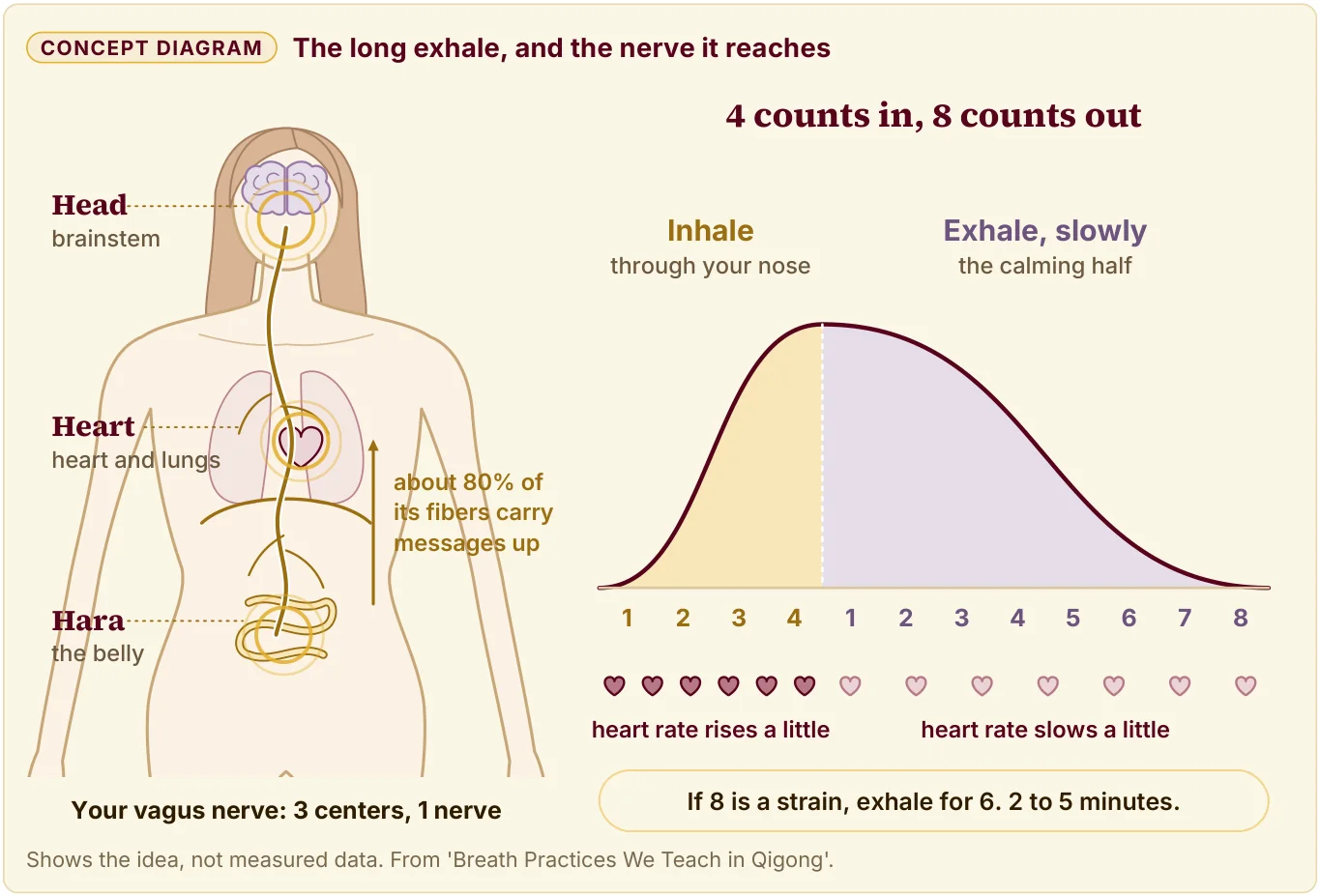
Illustration of the vagus nerve, 3 centers and 1 nerve, running from the brainstem in the head, to the heart and lungs, to the belly (the hara). About 80 percent of its fibers carry messages up. Beside it, a breath pattern of 4 counts in through your nose and 8 counts out slowly: heart rate rises a little on the inhale and slows a little on the exhale. If 8 is a strain, exhale for 6, for 2 to 5 minutes.
This is the breath the rest of this book calls 'inhale deep, exhale long.' You can use it in a waiting room, in the car before you walk into the house, or awake at 2 AM. The long exhale is the 1 practice in this chapter to carry everywhere.
In the yoga world, a slow exhale with a soft sound at the back of the throat is called ujjayi, the victorious breath. I teach it with an imaginary mirror, so your body understands it right away.
The slight narrowing at your throat slows the air on its way out, which lengthens the exhale almost by itself. You can also hear the breath, and hearing it gives a restless mind something gentle to follow. This is 1 of the quickest ways I know to bring calm to the Nervous System.
Research on ujjayi as a separate technique is small. What it reliably does is the part with the evidence behind it: it slows you down and stretches the exhale.
Tension is sneaky. We can get so used to it that we stop noticing it, the same way we stop noticing the chronic stress we have adapted to. This is a small practice I use myself.
Relaxing the face gives the whole Nervous System the command to relax. When I relax, I can bring the breath in much more fully, and that fuller breath brings more space into the lungs and into the heart.
A sigh is the body's own reset button. You already sigh without trying, about every 5 minutes, roughly 12 times an hour, and in 2016 researchers at UCLA and Stanford mapped the brainstem circuit behind it in mice. Those spontaneous sighs reopen the tiny air sacs in your lungs that slowly collapse with ordinary shallow breathing.
In Great Energy classes, the sigh shows up again and again. We open with a deep breath in and let it out with a sigh, and the Emotional layer chapter suggests 3 big, audible sighs to let a feeling move.
There is also a well-studied general practice called the cyclic sigh. It comes from the research world, and I include it because the evidence behind it is good.
In a 2023 Stanford trial led by Melis Yilmaz Balban and published in Cell Reports Medicine, 108 adults practiced 5 minutes a day for 28 days. Cyclic sighing brought a larger lift in positive mood than mindfulness meditation, and the largest drop in breathing rate of the techniques tested.
I teach 3 little mantras for the moments when your mind grabs a stressful story: 'So what?', 'Why not?', and 'Hmm, interesting.'
So what? Why not? Hmm, interesting. Each one buys you a breath between what happens and what happens next.
The third 1 has a vagus nerve stimulator built in. When you hum, you can feel the 'mmm' move down from your head into your chest and down into your belly, through all 3 of the vagus nerve's centers.
Humming does something measurable in your nose, too. In a 2002 study of 10 healthy men, published in the American Journal of Respiratory and Critical Care Medicine, humming raised nasal nitric oxide about 15-fold compared with a quiet exhale, because the vibration ventilates the sinuses, where nitric oxide is made. Nitric oxide helps defend the airways and relax blood vessels.
Christopher adds sound to movement. During the shaking warm-up in our classes, he invites a sound from high to low on any vowel you like, 'Ahhh,' as the body shakes.
A long, sounded exhale is a long exhale you can hear, and the sound itself lets held energy move. The Kharrazian practices in the Stress chapter, singing loudly and humming until you feel it in your chest, belong in this same family.
Box breathing, also called square breathing, gives a busy mind a shape to hold. Christopher teaches it as the short entry into meditation, right after throwing away the trash.
You decide how long your 4 is. If holding the breath out for 4 feels like a strain, count a little faster, so the holds feel doable and even.
There is something to explore at that last corner of the box, where you really want to breathe in and, for a moment, you do not. That gentle urge is carbon dioxide rising, and resting with it calmly is how your body grows more at ease with it. In the 2023 Stanford trial, box breathing also lifted mood over the month, though cyclic sighing lifted it most.
Keep the holds gentle and short. Box breathing is the 1 practice in this chapter with breath holds, so it is the 1 to skip or shorten if your practitioner has asked you to avoid them.
This is the breath Christopher uses inside Effortless Meditation, the method I describe in 'The Mental Layer'.
Breathwork works like watering soil, as the Stress chapter says: a little every day changes where your whole system rests. Each practice has its place in the day.
Sometimes the breath is telling you something about your Physical layer, and the practices above are not the answer. Breathlessness on the stairs can be a sign of low ferritin, and a struggling thyroid, low B12, or your heart can do the same.
Get emergency care now for sudden shortness of breath, chest pain or pressure, or pain and swelling in 1 leg with breathlessness, which can be a blood clot.
Make an appointment soon if you notice:
'The Mimics: What Else These Midlife Symptoms Could Actually Be' and 'Anxiety and Mood: When You No Longer Feel Like Yourself' go deeper.
These practices grow stronger in company. Great Energy Qigong is taught live online, and practicing alongside other people is part of what makes it steadying. We are not designed to heal in isolation, and that includes learning to breathe again.
This article is a section of The Midlife Bible: The Essential Guide to the Women's Midlife Journey, by Daniela Hess, MSEd. It is the book's own text, so where it says 'this book' or points to another part, that means the Bible. The book has the full chapters, charts, and the Lab Wish List.
Educational content, not medical advice. Please work with your own practitioner before you change a medication or a supplement.
These 3 connect to what you just read.
'I'm fine, just busy.' If that is your sentence, your body may be carrying a load you stopped feeling a long time ago. This article walks through what stress does inside you, step by step, how it loosens the gut lining, why the load adds up across Midlife, and how a longer exhale gives your Nervous System a signal of safety.
Read this article →What you may be feelingBefore any supplement, before any lab intervention, before any diet refinement: sleep. Here is how I take apart the 3 AM wake-up, the apnea Women miss, restless legs and ferritin, and a wind-down routine.
Read this article →Your inner life and your careYou still know the teachings and can still say the words, and the felt experience keeps getting further away. If your practice has gone theoretical, the cause may sit in a depleted body, and shame has no place in it. Here is how ferritin, thyroid, and cortisol shape your felt connection, what treading-water practices can and cannot do, and the Soul questions Midlife asks.
Read this article →FAQ
Try the belly check. When you are listening rather than speaking, rest 1 hand on your belly and breathe normally. Notice whether your hand moves out as you inhale and back in as you exhale. If the movement lives in your chest, let the next few breaths drop down under your hand.
Belly breathing moves your diaphragm fully, and your diaphragm is the very muscle your vagus nerve passes through. You cannot change a breath you have never noticed, so the belly check turns an automatic habit into information.
When you breathe in, your heart rate rises a little, and when you breathe out, it slows a little, and the vagus nerve drives that slowing. A long exhale gives the nerve more time to work. To try it, inhale through your nose for a count of about 4 and exhale for about 8. If 8 feels like a strain, exhale for 6.
In an early study, an implanted device that stimulated the vagus nerve in people with rheumatoid arthritis brought inflammation down. I will not claim that any particular breath flips that same switch, because that link has not been established.
In a 2023 Stanford trial led by Melis Yilmaz Balban, 108 adults practiced for 28 days. Cyclic sighing brought a larger lift in positive mood than mindfulness meditation, and the largest drop in breathing rate of the techniques tested. Box breathing also lifted mood, though cyclic sighing lifted it most.
Box breathing is the 1 practice in this article with breath holds. Ask first about breath holds if you are pregnant, or have a heart or lung condition, uncontrolled blood pressure, or a history of fainting or seizures.
They help you meet the wave with less panic. In 2 randomized trials, paced breathing did not reduce how often hot flashes came, and The Menopause Society's 2023 nonhormone statement does not recommend it as a treatment for them.
When a hot flash begins, inhale deep, exhale long, and fog the mirror: breathe out slowly with your mouth closed, with a gentle rumble at the back of your throat. Hot Flashes and Night Sweats gives you the treatments that change the wave itself.
Get emergency care now for sudden shortness of breath, chest pain or pressure, or pain and swelling in 1 leg with breathlessness, which can be a blood clot. Make an appointment soon for new breathlessness with ordinary activity, a racing heart that will not settle, snoring or gasping in your sleep, or a cough, wheeze, or tightness that has lasted for weeks.
Breathlessness on the stairs can be a sign of low ferritin, and a struggling thyroid, low B12, or your heart can do the same. Ask your doctor to look at those.

A 75-page PDF guide plus the 1 hour 43 minute talk, The Entire Midlife Journey.
Send me the guideYour thyroid, your gut, your hormones, and your labs.
Get The Midlife Bible3 hours with Daniela Hess and Kim Beekman, recorded live. The Midlife Bible is included.
See the workshop60 to 90 minutes one-on-one. Send a request to work with Daniela.
Work with Daniela