Free guide
Free
The Midlife Essentials and the talk
A 75-page PDF guide plus the 1 hour 43 minute talk, The Entire Midlife Journey.
Send me the guide
By Daniela Hess, MSEd14 min readOctober 2026
If you are having thoughts of harming yourself or ending your life, please reach out today. In the US and Canada, call or text 988, 24 hours a day. Elsewhere, findahelpline.com lists the line for your country. If you are in immediate danger, call your local emergency number.
'I just don't care the way I used to anymore.' If that sounds like you, the cause may sit in your hormones, your thyroid, your ferritin, or your testosterone, and real depression is common in Midlife too. Here is how to tell the look-alikes apart, what testosterone does in a Woman's body, and where to look first.
'I feel anxious about things that never used to bother me.' 'I snap at the people I love, and I don't even recognize myself in the moment.'
So many Women say some version of these words to me.
A low hum of dread with no clear cause. Wide awake at 3 in the morning with what I call moon-pie eyes, the mind already racing through tomorrow.
A short fuse, rage that comes out of nowhere, and guilt right after. You may snap at someone you love, cry at a commercial, and wonder who that was.
I know the edge from the inside. A voice in me said, 'Everyone in the world is tired. Buck up. Don't be a baby.' That voice kept me pushing through 7 years of symptoms, dressed up as discipline.
I also know how fast the edge can arrive. During the prep for my first SIBO breath test, a single day without anything sugary left me shocked at how irritable and mean I felt. That was chemistry, and it taught me to look underneath the feeling.
I teach anxiety as an alert, and I prefer the phrase 'the sensations of anxiousness', because it describes what the body actually experiences. The sensations of anxiousness are asking you to pause, get curious, and investigate. This chapter is your map for that investigation.
If you are having thoughts of harming yourself or ending your life, please reach out today. In the US and Canada, call or text 988, 24 hours a day. Elsewhere, findahelpline.com lists the line for your country. If you are in immediate danger, call your local emergency number. Both lines are listed in the Resource Directory, and nothing in this book is a reason to wait.
In Midlife, several of these usually pull on each other at once. When they do, I call it a chemical storm, and a Woman inside that storm can feel like she is losing her mind. Each piece is testable, and each piece becomes workable once someone looks.
Instead of asking how do I calm down, we ask, what is in the way of my calm right now. Is it biology, neurology, or lifestyle?
Low progesterone, the hormone of calm. Your brain turns some of your progesterone into allopregnanolone, which acts on GABA receptors, the same calming receptors many sleep and anti-anxiety medications target. Progesterone is often the first hormone to fall, sometimes in your late 30's, as more cycles pass without ovulation.
When anxiety arrives in your 40's with no reason you can name, your hormones deserve a look before your personality does. 'What Is Actually Happening in Your Midlife Body' goes deeper.
Anxiety that tracks your cycle. Anxiety or rage that builds in the week or 2 before your period and lifts when you bleed points toward low progesterone, PMS, or PMDD, which often worsen in Perimenopause. The Progesterone section of 'What Is Actually Happening in Your Midlife Body' and 'Anxiety, Irritability, and Rage' in 'The Mimics' go deeper.
Estrogen swings. Estrogen supports serotonin and dopamine, the brain chemicals behind mood and reward. In Perimenopause, estrogen can surge and dip on top of an overall decline, so your mood can change from week to week. 'What Is Actually Happening in Your Midlife Body' and 'Hormone Therapy 101' go deeper.
Blood sugar and adrenaline. A blood sugar crash, a third coffee, or the rebound the morning after wine each release adrenaline, which brings a racing heart, shaky hands, and a dread that can feel exactly like panic. If the anxiety eases after a few bites of food, blood sugar is the likely sender of that message. 'Sugar, and the Addiction Nobody Names' goes deeper, and 'Sleep' covers the 3 AM version.
Your thyroid. An overactive thyroid, a dose set too high, or the swings of Hashimoto's, when a thyroid under attack spills stored hormone for days or weeks, can bring anxiety, palpitations, and rage that seem to come from nowhere. A 2018 review in JAMA Psychiatry found people with Autoimmune thyroiditis about 3.5 times as likely to have depression and about 2.3 times as likely to have an anxiety disorder. 'Your Thyroid, In Depth' goes deeper.
Iron and ferritin. Low ferritin looks and acts like depression, and your brain needs iron to make dopamine. Heavy bleeding from low progesterone drains iron month after month, so low progesterone and low ferritin often travel together, and both feel like exhaustion and anxiety. The section on low ferritin in 'Supplements: Test, Don't Guess' goes deeper.
Sleep. Night sweats and the 3 AM wake-up can fragment sleep for years, and a brain running on less sleep has less buffer between a thought and a reaction. 'Sleep: Why It Breaks in Midlife' goes deeper.
Cortisol and your adrenals. A cortisol curve running high can leave you wired, anxious, and unable to wind down, and a curve that has gone flat leaves you tired and wired at the same time. 'Cortisol and Midlife Burnout' and 'Burnout and Fatigue' go deeper.
Stress, and nutrients. Years of carrying a workplace, a household, teenagers, and aging parents in the same week keep your Nervous System braced, and low magnesium, B12, and vitamin D add to the load. 'Stress: The Load Women Stop Noticing' and 'Supplements: Test, Don't Guess' go deeper.
Your gut. When your gut lining is inflamed, the upward signals carry inflammatory information to your brain, and inflammation shows up in the brain as brain fog, anxiousness, low mood, and racing, worried thoughts. 'The Gut, In Depth' and 'Inflammation: The Fire Under Everything' go deeper.
Testosterone and flatness. Low testosterone looks like the 'I just don't care anymore' feeling, and it can quietly turn down the wanting itself. 'What Is Actually Happening in Your Midlife Body' goes deeper, and 'Loss of Zest' in 'The Mimics' gives the pattern clues.
Caffeine and alcohol. Caffeine's average half-life is about 5 hours, and anxiety that peaks the morning after drinking points toward alcohol rebound. 'Sugar, and the Addiction Nobody Names' covers both.
The Emotional Layer. Midlife arrives for many Women as an identity quake, often alongside grief that rarely gets called grief. When emotion has nowhere to go, the body holds it for you, and for many Women that held energy is part of what they feel as anxiety. Jump ahead to 'The Emotional Layer: When Midlife Feels Like an Identity Quake'.
The Mental Layer. Anxious thoughts fall into familiar families: worry, concern, upset, complaint, and criticism. Each time you believe the same stressful thought, your body runs the whole cascade again. Jump ahead to 'The Mental Layer: Your Memory and Your Clear Thinking'.
Depression and anxiety in their own right. In SWAN, Women were 2 to 4 times more likely to have an episode of major depression during Perimenopause and early post-Menopause than in the years before it. Flatness with hopelessness, guilt, changes in sleep and appetite, and loss of pleasure in nearly everything for 2 weeks or more points toward clinical depression, which deserves prompt care. 'The Mimics' walks through each look-alike.
Medication, and the order of operations. 1 in 5 Women aged 40 to 59 took an antidepressant in the last 30 days, often before anyone checked her hormones, thyroid, or ferritin. For some Women, anti-anxiety medication and antidepressants are life-saving and life-giving, and in my view the Physical layer deserves a full look at the same time. Every decision to start, change, or stop a medication stays with your prescriber, and 'The 5 Midlife Crises No One's Talking About' goes deeper.
Why does this matter so much? Because in Midlife, several of the most common physical shortfalls look and feel exactly like depression and anxiety.
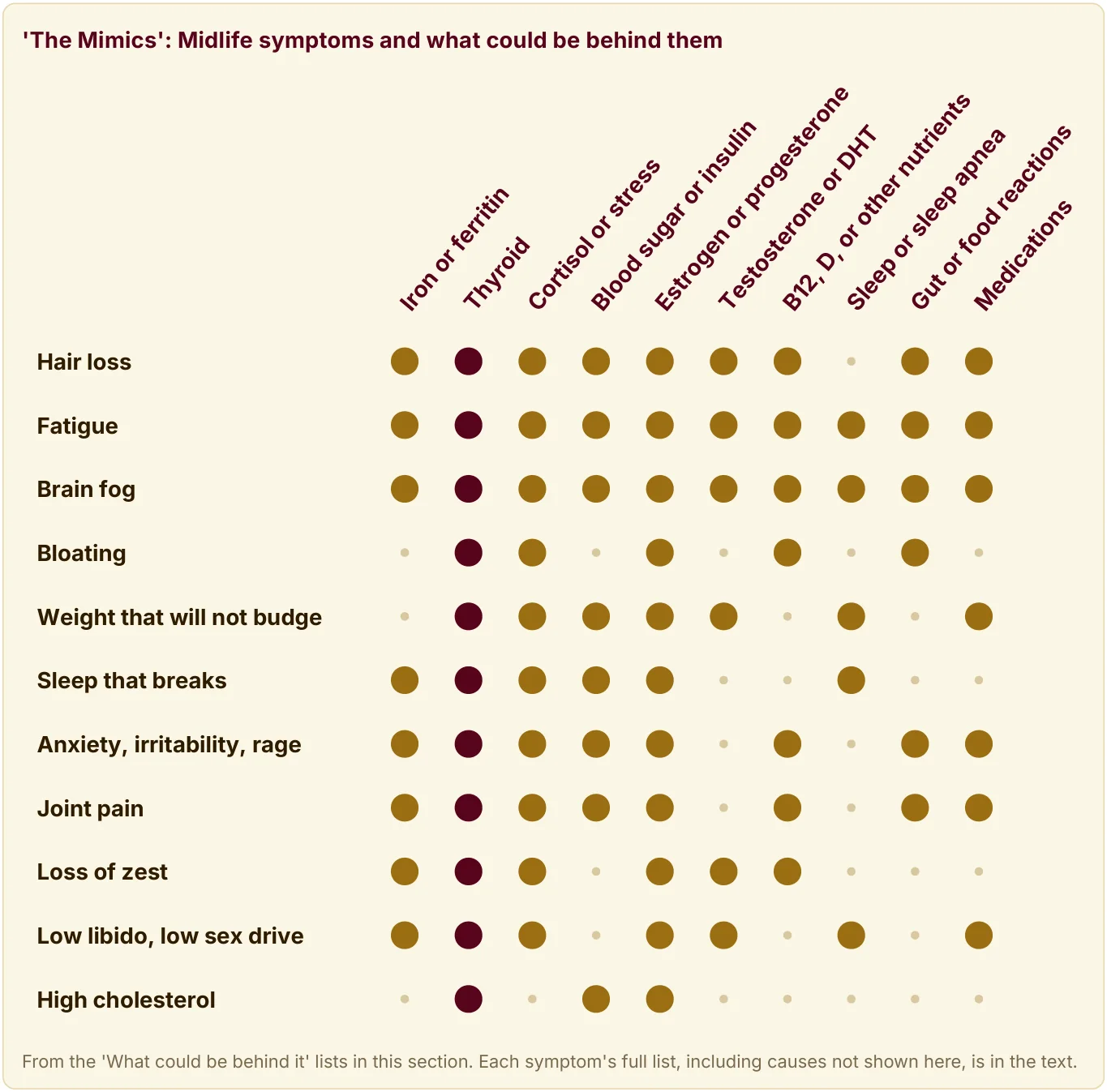
Chart linking 11 Midlife symptoms (hair loss, fatigue, brain fog, bloating, weight that will not budge, sleep that breaks, anxiety, irritability, and rage, joint pain, loss of zest, low libido, and high cholesterol) to the possible causes behind them: iron or ferritin, thyroid, cortisol or stress, blood sugar or insulin, estrogen or progesterone, testosterone or DHT, B12, D, or other nutrients, sleep or sleep apnea, gut or food reactions, and medications. Dots show which causes link to which symptoms. The thyroid column is filled for all 11 symptoms.
There are good reasons a doctor may reach for an antidepressant. Real clinical depression is common in Perimenopause and deserves real treatment. Some antidepressants also calm hot flashes, and a low-dose form of paroxetine is approved for exactly that, which matters for Women who cannot take estrogen.
Now, I'm also not telling anyone, stop your antidepressants, okay? They save lives. Some Women need them, okay? What I'm saying is that a lot of Women were never given the chance to find out whether their sadness has a root cause, sitting in their blood work.
If you take an antidepressant now, keep taking it as prescribed while you investigate. Stopping suddenly can cause real withdrawal symptoms, and any change belongs with your prescriber.
When you experience anxiety, become a scientist. What might be going on in my physical body?
Pattern clues.
'I just don't feel zest and enthusiasm for life the way I used to, and that scares me.' 'I just don't care the way I used to anymore, and that concerns me.' 'I just don't feel like myself anymore.'
What it can feel like. Flatness where there used to be enthusiasm. A or B, and you do not care which. Losing interest in sex, in projects, and in people you love. Feeling like a quieter, dimmer version of yourself.
What could be behind it:
How it happens in your body. Wanting something, looking forward to it, and reaching for it all run on dopamine, your brain's reward messenger. Testosterone supports dopamine activity, and your brain needs iron to make dopamine in the first place. So low testosterone and low ferritin can each quietly turn down the wanting itself.
Estrogen supports both serotonin and dopamine, T3 sets the pace of your brain cells, and years of high cortisol can burn down to a flat curve that leaves nothing in reserve. Inflammation from the gut adds its own weight, since an inflamed brain feels flat. Many Women describe feeling quieter and smaller, and they chalk it up to getting older because nothing shows up on their conventional lab report.
Pattern clues.
What to track. Once a week, write down 1 thing you genuinely looked forward to, and notice whether that list grows or shrinks.
Testosterone circulates in a Woman's body at several times the level of estradiol. Most of us were never told it was there at all.
Your ovaries and your adrenal glands both make it, and other tissues, including fat and skin, make more of it from precursors such as DHEA. You have been making testosterone your whole life, and it has been doing essential work the whole time.
We think of it as the male hormone, so almost no Woman is ever taught to ask about her own. In your body it is doing 3 specific jobs.
Your sharp thinking. Testosterone supports mental processing speed and the drive to actually engage with a hard problem instead of drifting past it, though the research on testosterone and thinking in Women is still limited. When it drops, thinking tends to go flat, a different feeling from the fog of low estrogen. You can still think. You just do not especially want to.
Your zest for life. Testosterone appears to feed motivation, the wanting itself as well as the energy to act on it. It sits close to the same reward circuitry that makes anything feel worth reaching for.
Your Aliveness. Strength, drive, and a felt sense of being fully present in your own body all lean on it. It is a real, physical contributor to what makes a day feel worth being in.
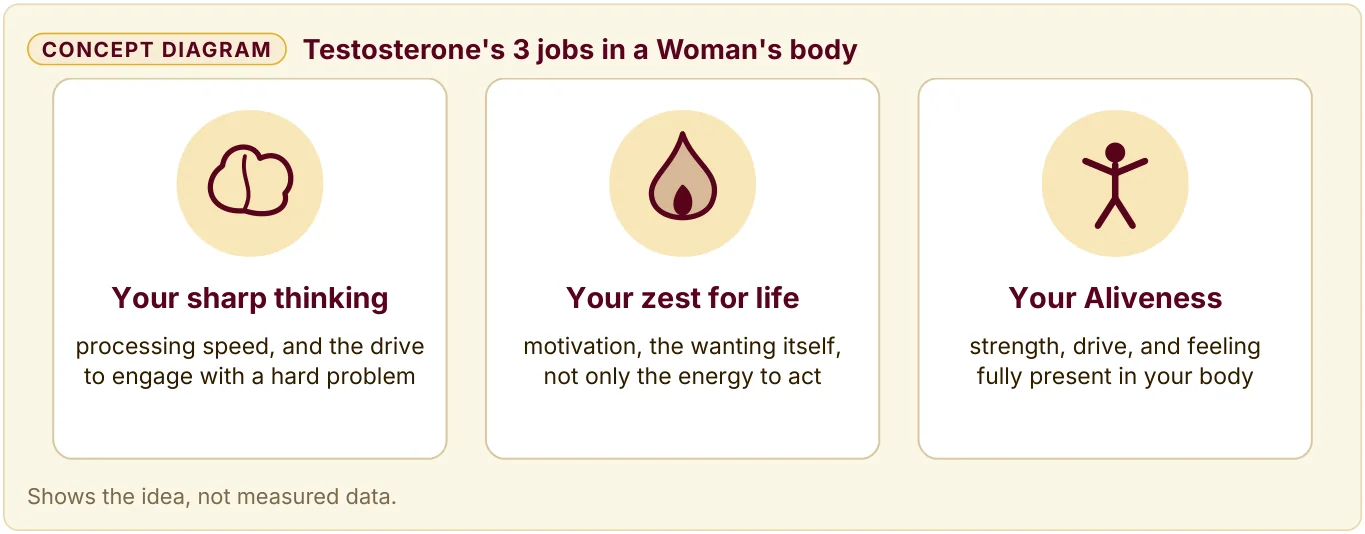
Testosterone's 3 jobs in a Woman's body: your sharp thinking (processing speed, and the drive to engage with a hard problem), your zest for life (motivation, the wanting itself, not only the energy to act), and your Aliveness (strength, drive, and feeling fully present in your body).
Testosterone also works in your muscles, where it helps you build and keep strength, and in your bones, partly by being converted into estradiol right inside bone tissue. It supports blood flow and sensation in the clitoris and vaginal tissue, which is part of arousal. Desire, strength, and drive share a common thread, and testosterone runs through all 3.
How and why it changes. Testosterone declines slowly and steadily from your 20's onward, a gentler slope than the fall of estradiol around Menopause. In 1 study measuring testosterone across a full 24 hours, Women around 40 had roughly half the level of Women around 21.
After a natural Menopause, your ovaries keep making some testosterone for years. Surgical removal of both ovaries takes away a major source all at once, which is why Women after surgical Menopause often notice the loss of desire and drive sharply.
Because the decline is so slow, it hides. For many Women, it happens so gradually that they get used to it and assume this is simply what getting older feels like.
Here is what it felt like when mine went.
I walked around thinking, I don't really care. About anything. A or B? I don't care. I had always been an enthusiast for life, and suddenly the enthusiasm was gone.
That is biochemistry, and knowing the difference between biochemistry and a spiritual crisis matters.
From the outside, it can look like depression. When I teach this, I describe what goes with it: 'Libido is only the front edge of it. What goes with it is capacity. Patience exits stage left. The wish to be really close to others will decline.' That flatness is 1 of the symptoms Midlife Women have the hardest time putting into words.
What low testosterone can look like:
My own protocol includes a very low dose of topical testosterone, built for my body by my practitioners. Alongside the rest of my care, it helped bring back my enthusiasm, my strength, and my intimacy.
In Ayurvedic terms I am a very air constitution, so fire is something I have always needed to cultivate. When I finally started a low-dose topical testosterone cream, I wept.
What made me weep was the sorrow of all the years I had gone without it, and had not known I needed it. Then, all of a sudden, it was like life was in Technicolor again.
Be a scientist with your own anxiety, and look at every layer before you decide it lives only in your head.
If the low mood includes thoughts of harming yourself or ending your life, please reach out today: call or text 988 in the US and Canada, or find your country's line at findahelpline.com.
This article is a section of The Midlife Bible: The Essential Guide to the Women's Midlife Journey, by Daniela Hess, MSEd. It is the book's own text, so where it says 'this book' or points to another part, that means the Bible. The book has the full chapters, charts, and the Lab Wish List.
Educational content, not medical advice. Please work with your own practitioner before you change a medication or a supplement.
These 3 connect to what you just read.
A low hum of dread, a short fuse, and a voice in you that says, 'Buck up.' Here is the chemical storm that can sit behind Midlife anxiety and mood changes, each piece testable, and what helps.
Read this article →What you may be feelingIf your sex drive has tanked and you wonder whether you will ever want it back, this one is for you. Here is what the numbers say about low desire in Midlife, which hormones and body systems sit behind it, where testosterone stands in the United States as of September 2026, and why orgasm and sensitivity can come back.
Read this article →Your hormones and your thyroidPerimenopause can begin as early as 35 and run up to 17 years. Here are the 3 stages, how a trained practitioner reads where you are, and why 5 hormones never work alone.
Read this article →FAQ
Yes, and the numbers are real. In SWAN, Women were 2 to 4 times more likely to have an episode of major depression during Perimenopause and the early years after Menopause than in the years before it. Estrogen supports serotonin and dopamine, the brain chemicals behind mood and reward, and in Perimenopause it can surge and dip on top of an overall decline. Your brain also turns some of your progesterone into allopregnanolone, which acts on the same calming GABA receptors many sleep and anti-anxiety medications target.
Flatness with hopelessness, guilt, changes in sleep and appetite, and loss of pleasure in nearly everything for 2 weeks or more points toward clinical depression, which deserves prompt care.
Wanting something, looking forward to it, and reaching for it all run on dopamine, your brain's reward messenger. Testosterone supports dopamine activity, and your brain needs iron to make dopamine in the first place, so low testosterone and low ferritin can each quietly turn down the wanting itself. A low thyroid, falling estrogen, years of high cortisol that have burned down to a flat pattern, and low vitamin D or B12 can add to it.
I know this one from the inside. I walked around thinking, 'A or B? I don't care.' That was biochemistry, and knowing the difference between biochemistry and a spiritual crisis matters. Many Women chalk it up to getting older because nothing shows up on their conventional lab report.
Testosterone circulates in a Woman's body at several times the level of estradiol, and most of us were never told it was there. Your ovaries and your adrenal glands both make it. It supports your sharp thinking, your zest for life, and your Aliveness, and it works in your muscles, your bones, and the blood flow and sensation that are part of arousal. The research on testosterone and thinking in Women is still limited.
It declines slowly and steadily from your 20's onward. In 1 study measuring testosterone across a full 24 hours, Women around 40 had roughly half the level of Women around 21. Surgical removal of both ovaries takes away a major source all at once, which is why Women after surgical Menopause often notice the loss sharply. Low Libido in Midlife covers where desire fits in.
No. I am not telling anyone to stop their antidepressants. They save lives, and some Women need them. What I am saying is that a lot of Women were never given the chance to find out whether their sadness has a root cause sitting in their blood work. 1 in 5 Women aged 40 to 59 took an antidepressant in the last 30 days, often before anyone checked her hormones, thyroid, or ferritin.
If you take an antidepressant now, keep taking it as prescribed while you investigate. Stopping suddenly can cause real withdrawal symptoms, and any change belongs with your prescriber.
The pattern is the clue. Flatness with low libido, weaker muscles, and less drive points toward low testosterone. Flatness with breathlessness, cold hands, and hair shedding points toward low ferritin. Flatness with feeling cold, constipated, and slowed down points toward your thyroid. Flatness that arrived with changing cycles and hot flashes points toward estrogen. Flatness with hopelessness, guilt, changes in sleep and appetite, and loss of pleasure in nearly everything for 2 weeks or more points toward clinical depression, which deserves prompt care.
Once a week, write down 1 thing you looked forward to, and notice whether that list grows or shrinks. If your low mood includes thoughts of harming yourself or ending your life, please reach out today. Call or text 988 in the US and Canada, or find your country's line at findahelpline.com.

A 75-page PDF guide plus the 1 hour 43 minute talk, The Entire Midlife Journey.
Send me the guideYour thyroid, your gut, your hormones, and your labs.
Get The Midlife Bible3 hours with Daniela Hess and Kim Beekman, recorded live. The Midlife Bible is included.
See the workshop60 to 90 minutes one-on-one. Send a request to work with Daniela.
Work with Daniela