Free guide
Free
The Midlife Essentials and the talk
A 75-page PDF guide plus the 1 hour 43 minute talk, The Entire Midlife Journey.
Send me the guide
By Daniela Hess, MSEd9 min readOctober 2026
'I fall asleep easily, then I am wide awake at 3 in the morning with my mind racing.' If anxiety, heavier periods, and tender breasts showed up in your 40's, progesterone may be falling while estrogen is still normal or even high. Here is where progesterone works in your body, why it falls first, and what estrogen dominance means in Functional Medicine.
Most of us were taught that Midlife hormones are about periods and hot flashes.
There is another body underneath the one you know. A body made of iron, thyroid hormone, cortisol, estrogen, and gut lining. It can drive much of what you may be feeling, and you cannot see it in the mirror.
Some Women sail through Midlife without a single hot flash and still lose themselves in this season. Others flash every hour and feel like themselves in every other way. The hot flash is the loudest signal, and it is rarely the whole story.
I teach this from inside it. In my mid-50's, I am still in late Perimenopause myself.
Progesterone is your steadiness. Deep sleep. The Nervous System's ability to actually settle. Laboratory research also points to a neuroprotective role, helping maintain the myelin sheath, the coating around your nerve fibers. That work is largely preclinical and I hold it loosely.
Where progesterone works, tissue by tissue. Progesterone has receptors in far more places than your uterus.
That last point matters if you live with Autoimmunity. Many Women with Hashimoto's, rheumatoid arthritis, or lupus notice their symptoms worsen in the days before their period, when progesterone falls away. As Perimenopause lowers progesterone across the whole month, that protective buffer shrinks, and many Women notice their Autoimmune symptoms running hotter with no change in anything they are doing.
Progesterone is often the first hormone to decline, sometimes in the late 30's, more than a decade before Menopause.
A Woman with low progesterone often feels anxious. Restless. Wired at night. Wide awake at 3 in the morning with what I call moon-pie eyes.
Too often, she becomes 1 of the Women handed an anti-anxiety prescription before anyone checks her progesterone. Of course she is anxious. Of course she cannot sleep. Her calming hormone is running out.
This is often the anxiety with no story attached. Nothing you can point to and say, that is why. When anxiety arrives in your 40's with no reason you can name, your hormones deserve a look before your personality does.
Why progesterone falls first. Progesterone is made mainly after you ovulate, by the small structure left behind when an egg is released. No ovulation, no real progesterone that cycle. As Perimenopause begins, more cycles pass without ovulation, so progesterone can fall while estrogen is still normal or even running high. That imbalance is why so many Women in their early 40's notice heavier periods, tender breasts, and worse PMS before anything else changes.
Even in the cycles where you do ovulate, the structure left behind can make less progesterone, and for fewer days. The stretch from ovulation to your next period is called the luteal phase. A luteal phase of 10 days or less is 1 sign that progesterone production is running short, and it can show up years before your periods become irregular.
Stress, low thyroid function, and undereating all make ovulation less likely, too. So progesterone can run low in a Woman in her 30's who is nowhere near Menopause, simply because her body does not feel safe enough to ovulate every month.
What it can feel like day to day. You may notice it first as the week before your period getting harder. You fall asleep easily, then wake at 3:12 AM with your mind already racing. The irritability arrives around day 22 and lifts when you bleed. You may snap at someone you love, cry at a commercial, and wonder who that was.
What low progesterone can look like:
How progesterone talks to the rest of your body.
2 free tools add real information between blood draws. Track your cycle, your sleep, and your mood for 2 to 3 months, and a pattern usually emerges. Charting your basal body temperature each morning shows the small rise that tells you ovulation happened, and how many days it lasted.
What supports it. Bioidentical progesterone, prescribed by a practitioner, is 1 of the most common tools in Perimenopause care. Taken by mouth at night, micronized progesterone breaks down in part into allopregnanolone, a calming compound that acts on the same GABA receptors that help your Nervous System settle. That is why many Women sleep better on it. Lowering chronic stress matters here too, for the reasons in the Pregnenolone section below.
In a sleep laboratory study of healthy postmenopausal Women, progesterone taken at night reduced time spent awake during the night. Because oral progesterone can make you drowsy, it is usually taken at bedtime. Route matters: taken by mouth, more of it becomes allopregnanolone, and through the skin, less does. The Hormone Therapy chapter covers how progesterone differs from the synthetic progestins in many older prescriptions.
The foundation underneath any prescription:
Your practices still matter. Breathwork, meditation, and Qigong calm the Nervous System, and they cannot manufacture a hormone your ovaries have stopped making. When the body is resourced, the practices land in a body that can finally receive them.
'Estrogen dominance' is a Functional Medicine term, and you will not find it as a diagnosis in a conventional medical manual. It describes a body where the effects of estrogen outweigh the balancing effects of progesterone. The label matters less than the pattern, and the pattern is very common in Perimenopause.
Why Perimenopause tips the scale. Progesterone comes almost entirely from the corpus luteum, the small structure left behind after you ovulate. As more cycles pass without ovulation, more months bring very little progesterone.
At the same time, Dr. Jerilynn Prior's research shows estrogen in early Perimenopause often running higher and swinging wider than it did in your 30's. Less progesterone and more erratic estrogen, arriving together, is the recipe.
The 2 forms.
Where the extra estrogen comes from.
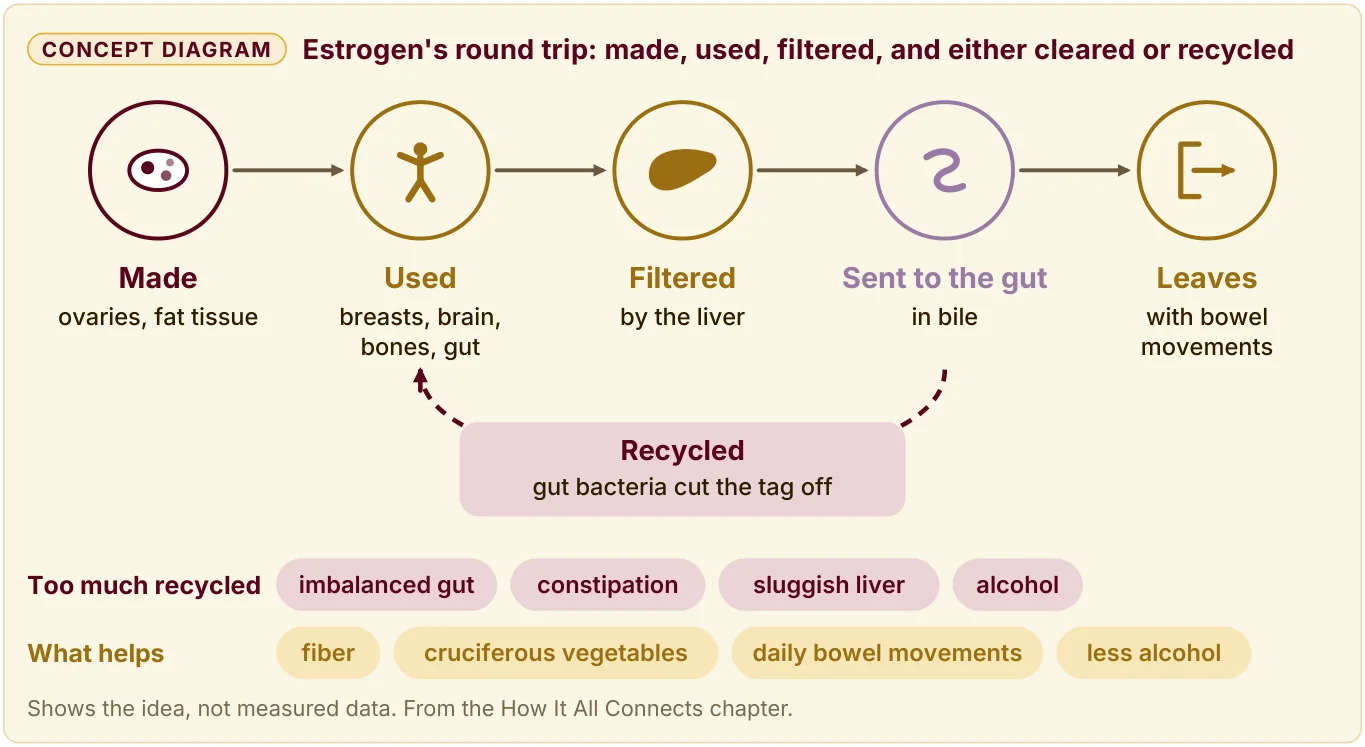
Concept diagram titled 'Estrogen's round trip: made, used, filtered, and either cleared or recycled'. 5 steps in a row. Made: ovaries, fat tissue. Used: breasts, brain, bones, gut. Filtered: by the liver. Sent to the gut: in bile. Leaves: with bowel movements. A loop runs from the gut step back to the 'Used' step. It is labeled 'Recycled: gut bacteria cut the tag off'. Too much recycled: imbalanced gut, constipation, sluggish liver, alcohol. What helps: fiber, cruciferous vegetables, daily bowel movements, less alcohol. Footer note: 'Shows the idea, not measured data. From the How It All Connects chapter.'
The timing tell. Symptoms that build in the 1 to 2 weeks before your period and ease once you bleed point toward estrogen outweighing progesterone. Tender breasts, heavy periods with clots, bloating, mood swings, and headaches around your period are the classic signs, and the full list sits in 'How It All Connects'.
What helps, starting at your table.
I lived this pattern myself. Estrogen dominance was part of my own picture, and clearing it took longer than the rest of my hormone work. My gut needed healing, and my liver and kidneys needed care.
I treated it with daily movement, with my food, and with supplements that help clear excess estrogen, including calcium D-glucarate. Bringing my levels down took a little over a year of steady care. 'The First 3 Months', in the Hormone Therapy 101 chapter, tells the rest of that season.
This article is a section of The Midlife Bible: The Essential Guide to the Women's Midlife Journey, by Daniela Hess, MSEd. It is the book's own text, so where it says 'this book' or points to another part, that means the Bible. The book has the full chapters, charts, and the Lab Wish List.
Educational content, not medical advice. Please work with your own practitioner before you change a medication or a supplement.
These 3 connect to what you just read.
Perimenopause can begin as early as 35 and run up to 17 years. Here are the 3 stages, how a trained practitioner reads where you are, and why 5 hormones never work alone.
Read this article →Your cycle, joints, and pelvic floorA cycle of 21 days, and then 45, can leave you wondering whether something is wrong. That swing is often the first sign of Perimenopause, and it has findable drivers: cycles without ovulation, low progesterone, estrogen surges, and your thyroid, and heavy bleeding drains your iron. This map shows what can sit behind it, what helps, and which signs of heavy bleeding call for your doctor promptly.
Read this article →Your hormones and your thyroidHormone therapy is 1 of the most effective tools for the Midlife years and 1 of the most misunderstood. Here is what happened in 2002, what changed in 2025, and what the evidence shows on timing, bones, heart, and breast cancer.
Read this article →FAQ
Progesterone is your steadiness, and it has receptors in far more places than your uterus. In your brain, it and its breakdown product allopregnanolone act on GABA receptors, the same calming receptors many sleep and anti-anxiety medications target. In your uterus, it matures the lining and signals it to shed cleanly, and without enough of it the lining can grow thicker than usual, 1 reason periods turn heavy.
It also balances estrogen's growth signal in your breasts, raises your resting temperature by about half a degree to 1 degree Fahrenheit after you ovulate, slows your intestines, and supports regulatory T cells, the immune cells that dampen overreaction.
Progesterone is made mainly after you ovulate, by the small structure left behind when an egg is released. No ovulation, no real progesterone that cycle. As more cycles pass without ovulation, progesterone can fall while estrogen is still normal or even running high. Dr. Jerilynn Prior's research shows estrogen in early Perimenopause often running higher and swinging wider than it did in your 30's.
A luteal phase, the stretch from ovulation to your next period, of 10 days or less is 1 sign that production is running short. Stress, low thyroid function, and undereating also make ovulation less likely, so progesterone can run low in your 30's too.
Waking between 2 and 4 in the morning and not falling back asleep. Anxiety that arrives out of nowhere, or a new short fuse. Shorter cycles, spotting before your period, or heavier bleeding. Tender breasts and more intense PMS. Headaches or migraines that cluster around your period.
The timing is a clue: irritability that arrives around day 22 and lifts when you bleed. When anxiety arrives in your 40's with no reason you can name, your hormones deserve a look before your personality does. Heavy bleeding also drains iron, and low progesterone and low ferritin often travel together. Heavy or Irregular Periods in Perimenopause goes deeper.
'Estrogen dominance' is a Functional Medicine term, and you will not find it as a diagnosis in a conventional medical manual. It describes a body where the effects of estrogen outweigh the balancing effects of progesterone. The timing tell: symptoms that build in the 1 to 2 weeks before your period and ease once you bleed.
What helps starts at your table: 6 to 15 kinds of vegetables a day, fiber and a daily bowel movement so estrogen leaves on schedule, less alcohol, and fewer xenoestrogens. In a controlled feeding study, premenopausal Women who drank about 2 drinks a day for 3 cycles had estradiol 27.5 percent higher around ovulation than in their alcohol-free cycles.
Ask whether your progesterone and estradiol can be tested, and how the draws should be timed. Ask about your thyroid and your ferritin too: low thyroid function can bring heavy periods and cycles without ovulation, and heavy bleeding drains iron. Between draws, track your cycle, sleep, and mood for 2 to 3 months, and chart your basal body temperature each morning.
Bioidentical progesterone, prescribed by a practitioner, is 1 of the most common tools in Perimenopause care, and many Women sleep better on it. Whether to use it is a decision for you and your prescriber. Hormone Therapy 101 covers how progesterone differs from synthetic progestins.

A 75-page PDF guide plus the 1 hour 43 minute talk, The Entire Midlife Journey.
Send me the guideYour thyroid, your gut, your hormones, and your labs.
Get The Midlife Bible3 hours with Daniela Hess and Kim Beekman, recorded live. The Midlife Bible is included.
See the workshop60 to 90 minutes one-on-one. Send a request to work with Daniela.
Work with Daniela