Free guide
Free
The Midlife Essentials and the talk
A 75-page PDF guide plus the 1 hour 43 minute talk, The Entire Midlife Journey.
Send me the guide
By Daniela Hess, MSEd14 min readOctober 2026
'I'm fine, just busy.' If that is your sentence, your body may be carrying a load you stopped feeling a long time ago. This article walks through what stress does inside you, step by step, how it loosens the gut lining, why the load adds up across Midlife, and how a longer exhale gives your Nervous System a signal of safety.
Stress keeps showing up in this guide. It is 1 of the triggers for Autoimmunity. It drives cortisol. It feeds inflammation. It can pull raw material away from your sex hormones. It deserves its own chapter, because the most common stress in Midlife is the kind Women no longer feel.
Stress is biology unfolding in the body, a measurable cascade that reaches your gut lining, your immune system, your thyroid, your blood sugar, and your sleep. There is no blame for you to carry here.
That is good news, because a cascade has steps, and steps can be changed. Understanding the mechanism turns stress from a character flaw into something you can work with, on purpose, with your own breath and your own choices.
'Everyone tells me to reduce stress, yet no one tells me how.' I have heard that sentence more than almost any other in well over 25 years of teaching, and it is a fair 1. 'Reduce stress', on its own, is a wish handed to a Woman who is already doing too much.
The mechanism is more useful than the instruction: what stress does inside you, step by step, and what actually moves it.
Stress adds up across the decades. The years of pushing through in your 20's and 30's can be what your cortisol, your sleep, and your gut are answering for in your 40's and 50's, and the way you learn to come back to calm now shapes the Nervous System you live inside at 60 and beyond.
In the Autoimmune Recovery Method, Calm & Resilience is a Key of its own, Key 5 of the 6 Keys of Action Toward Remission. It carries the same weight as the food on your plate.
Most of the Women I work with describe themselves as busy. Working, parenting, caring for aging parents, running a household, answering messages at 10 at night, and doing all of it well.
That pace is unnatural. Human bodies were built for short bursts of stress followed by recovery: a threat, a response, and then rest. What most of us live now is a low-grade stress response that never switches off, from the first phone check in the morning to the last email at night.
Women adapt to it remarkably well, and that is exactly the problem. When a load has been there long enough, it stops registering as a load. It becomes normal. Earlier in this guide I told you I would have said I was not under chronic stress, and I meant it. My body was telling a different story.
I only saw it when my Functional Medicine practitioner asked me directly.
I was working with my Functional Medicine practitioner. And she was like, well, did you have chronic stress in your life? I'm like, no, I don't think so. Then we went through my life story. I'm like, oh, wow, I didn't even identify as somebody with chronic stress, because we adapt!
That is the pattern I now see in so many Women.
The Women most affected by this are frequently the ones who would tell you, with total sincerity, that they handle stress okay. But their body keeps a record either way.
The adapting has a cost, and the cost comes due in Midlife, as the Inflammation chapter showed.
Chronic stress in Midlife often sounds and looks like:
If 3 or more of those sound like you, your body may be carrying stress whether or not you would call it that.
A body stuck in chronic alarm often looks like a body that cannot tell a real threat from an ordinary Tuesday: a jaw that stays tight, thoughts that race at 2 AM, an exhale that never quite finishes even when nothing is wrong. Held long enough, the bracing can start to feel like who you are.
Look again at the coffee in the morning and the wine or sugar at night. Caffeine and sugar are artificial energy, and they can carry a depleted body through years of load without the load ever registering. 'Sugar, and the Addiction Nobody Names', just before this chapter, looks at why I live caffeine-free, so I always know what my honest energy is.
Your stress response runs on 2 tracks, a fast one and a slower one. Both start in your brain, and both were designed to switch on hard and then switch off.
The sequence begins the moment something registers as a threat.
That is where the name HPA axis comes from: hypothalamus, pituitary, adrenal. The design is brilliant for a lion, a flood, or a car that swerves into your lane. It was never designed to run from 6 in the morning until midnight, every day, for years.
The Cortisol section later in this guide shows how to see your own cortisol rhythm across a day. Here the focus is what happens when the switch stops turning off.
Acute stress is short, and it is healthy. The presentation you give, the hill you climb, the cold water on your face, the deadline you meet and then celebrate. In short doses, cortisol is anti-inflammatory, and your body comes out of it stronger.
Chronic stress is the same response with no ending. The caregiving that has no finish line, the job that follows you home on your phone, the relationship that keeps you braced, the inflammation already running in your body, the sleep that keeps breaking.
Held there long enough, several things shift at once.
Your body does not separate a hard conversation from a hard meal. Datis Kharrazian, 1 of my favorite teachers, makes this point directly: isolation, chronic pessimism, toxic relationships, and purposeless living raise cortisol and inflammation much as physical stressors do. A lonely life and a physical injury can speak to your body in the same chemical language.
The cascade is fast. A stressful thought you believe true becomes an emotion within a fraction of a second, then a sensation in your body, then an action. When that runs all day, every day, your body never gets the message that the danger has passed.
This connection between stress and Autoimmunity shows up at population scale too. The Swedish JAMA study in 'The Triggers, 1 at a Time', in 'How Autoimmunity Begins: The 3 Factors and the Years Before a Diagnosis', shows it: people diagnosed with a stress-related disorder went on to develop Autoimmune disease at a higher rate than their siblings and the general population.
Chronic stress is 1 of the most overlooked ways to damage the gut barrier, the second of the 3 factors that underlie every Autoimmune condition.
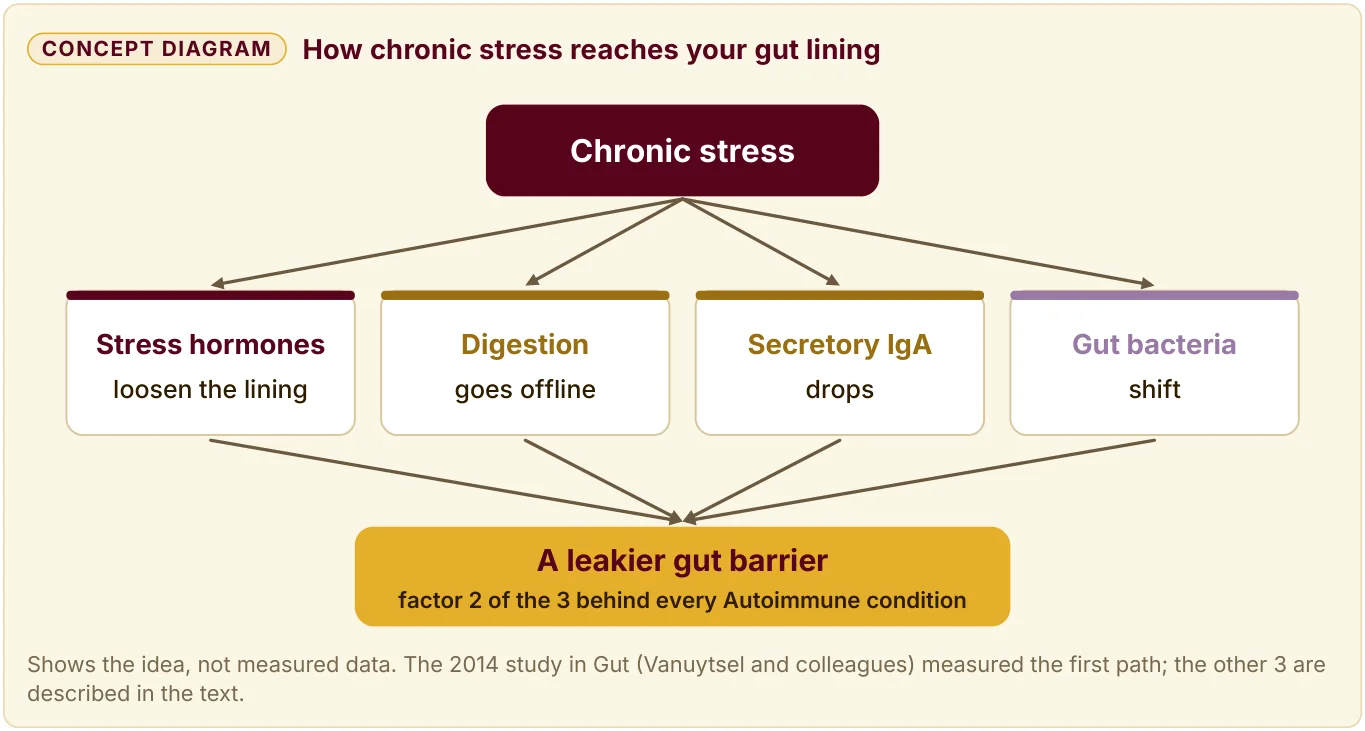
Concept diagram titled 'How chronic stress reaches your gut lining'. Chronic stress at the top, with 4 arrows to 4 boxes: stress hormones loosen the lining; digestion goes offline; secretory IgA drops; gut bacteria shift. All lead to 'A leakier gut barrier, factor 2 of the 3 behind every Autoimmune condition'. Footer note: 'Shows the idea, not measured data. The 2014 study in Gut (Vanuytsel and colleagues) measured the first path; the other 3 are described in the text.'
Put those together and you can see how a Woman eating a clean diet can still have a leaky gut. You can do everything right on your plate and still keep the lining open with the way you live.
Picture a lunch eaten at your desk while you answer emails. Your body is in fight or flight, so your stomach makes less acid, your pancreas sends fewer enzymes, and your gut slows down. The salmon and roasted vegetables you chose so carefully arrive in a gut that is not ready to receive them.
Researchers have a name for the total cost of stress over time. Bruce McEwen of Rockefeller University called it allostatic load: the wear and tear your body accumulates from adapting, again and again, to demands that never fully let up.
Allostasis means staying stable through change. Your body is constantly adjusting your heart rate, blood sugar, cortisol, and immune activity to meet whatever the day asks. That flexibility is how you survive.
The load builds in 4 ways McEwen described:
Picture a backpack. Each stressor is a stone: the teenager's crisis, the aging parent's fall, the Perimenopausal night sweats, the gluten you have not yet removed, the blood sugar crash at 3 PM, the resentment you have not voiced. Each stone alone feels light, and together they make the backpack heavy.
This is why a Woman can say, with complete honesty, 'Nothing big is wrong.' Allostatic load is usually 40 small things, carried every day, for years.
It is also why taking out stones works, even small ones. Each blood sugar crash you prevent, each night of real sleep, each 'no' to an obligation that drains you, lightens the load your body carries.
I think of these small stones as energy leaks. When I taught the practice of energy integrity to our community, I asked everyone to look at 5 places where energy either strengthens and nourishes us, or weakens and depletes us:
When emotion moves, energy restores. When emotion stays stuck, our energy leaks.
Midlife stacks stones in a particular way. More responsibility arrives in the same decade that your body's built-in buffers begin to change.
Caregiving in both directions. Many Women in their 40s and 50s are raising children or supporting grown ones while caring for parents who need more every year. A 2013 Pew Research Center survey found that nearly half of adults in their 40s and 50s had a parent 65 or older and were either raising a young child or financially supporting a grown child. Researchers call it the sandwich generation. Most Women I know call it Tuesday.
Caregiving leaves a measurable mark. In a 6-year study published in PNAS in 2003, Janice Kiecolt-Glaser and colleagues found that IL-6, an inflammatory messenger, rose about 4 times faster in older adults caring for a spouse with dementia than in adults who were not caregiving. The rise continued even after the caregiving ended.
'Work, Money, and Purpose: Finding Meaning in the Second Half' looks at the sandwich years in depth: what caregiving costs your income and your retirement, and practical ways to share the load.
Work. Many Women in Midlife are at the height of their responsibility at work, leading teams, running businesses, holding space for others. The phone means the work comes home, and the brain never quite gets the signal that the day is over.
Perimenopausal sleep loss. Sleep complaints climb across the Menopause transition. Research reviews estimate that roughly 4 in 10 Women in Perimenopause report sleep difficulties, and more after Menopause. Night sweats wake you. Falling progesterone, your calming hormone, thins your sleep. For some Women, a cortisol surge in the early hours brings the 3 AM waking.
Lost sleep is a stressor of its own, and a fast-acting one. In a 2010 study in the Journal of Clinical Endocrinology and Metabolism, a single night of only 4 hours of sleep made healthy adults measurably more insulin resistant the next day. Short sleep raises the next day's stress load before the day has even begun.
Your buffers are changing. Progesterone is your primary calming buffer, and it is often the first hormone to decline. Estrogen is 1 of your body's brakes on inflammation, and in Perimenopause that brake loosens. The same life you managed at 35 can land on your body very differently at 47, because the braking system changed.
Relationships. A relationship that generates chronic conflict, or a steady sense of being unseen or unsafe, raises cortisol and immune activity the way any other stressor does. Your immune system registers the load, whatever its source. So many Women in Midlife are trying to heal inside relationships that keep their Nervous System in tension, and calm cannot become a baseline in a life that keeps you braced.
The mental load. Remembering the dentist appointments, the birthday gifts, the prescription refills, the permission slips, and what is in the fridge. Invisible work is still work, and your Nervous System counts it.
Many of us are carrying a low hum of stress that we actually stopped noticing a long time ago. It lives in our shoulders, it lives in our jaw, and it can be in a breath that never quite finishes.
Your breath is 1 of the very few automatic functions in your body you can also run on purpose. Your heartbeat, your digestion, and your immune signaling all happen without your permission. Your breath runs on its own, and you can take the wheel any time you choose.
That makes it a direct doorway into your Nervous System. It needs no equipment, no practitioner, and no special conditions.
Where you breathe matters as much as how slowly. Shallow, high-chest breathing, the pattern almost everyone falls into under stress, activates the sympathetic side and reinforces the very state you are trying to leave. Diaphragmatic belly breathing, where your belly rises on the inhale and falls on the exhale, activates the parasympathetic side instead.
The exhale is the key. Your heart rate naturally slows a little on every exhale, through the vagus nerve. Make the exhale longer than the inhale, and you give your body more of that slowing signal with every breath.
Try it now, wherever you are.
That drop is your vagus nerve doing its work. Inhale deep, exhale long. It is a direct signal of safety to your Nervous System.
3 patterns worth building:
Think of breathwork as watering soil. It helps in an acute moment too, and its real value is cumulative. 5 minutes a day, practiced consistently, changes where your whole system rests over weeks.
A few places to anchor it in your day:
This article is a section of The Midlife Bible: The Essential Guide to the Women's Midlife Journey, by Daniela Hess, MSEd. It is the book's own text, so where it says 'this book' or points to another part, that means the Bible. The book has the full chapters, charts, and the Lab Wish List.
Educational content, not medical advice. Please work with your own practitioner before you change a medication or a supplement.
These 3 connect to what you just read.
You sleep 8 hours, wake as though you never slept, and need coffee to reach ordinary. Here is what your adrenal glands do, why 'adrenal fatigue' is such a contested phrase, how Addison's disease is ruled out, and what helps Women rebuild.
Read this article →Food, movement, and breathIf your breath sits high in your chest and your jaw stays tight all day, this article gives you practices to follow at your kitchen table. It covers belly breathing, the long exhale, the cyclic sigh, and humming, what the research does and does not show, why your labs still matter, and when breathlessness needs a doctor.
Read this article →What you may be feelingBefore any supplement, before any lab intervention, before any diet refinement: sleep. Here is how I take apart the 3 AM wake-up, the apnea Women miss, restless legs and ferritin, and a wind-down routine.
Read this article →FAQ
Women adapt remarkably well, and that is exactly the problem. When a load has been there long enough, it stops registering as a load. Common signs are being wired at night and exhausted in the morning, needing coffee to start the day and wine or sugar to end it, feeling guilty when you rest, and getting sick the moment you finally go on vacation. If 3 or more of those sound like you, your body may be carrying stress whether or not you would call it that.
I did not see it in myself either. My Functional Medicine practitioner asked me directly whether I had chronic stress. I said no, I did not think so. Then we went through my life story.
Your brain flags a threat, and your amygdala does it within a fraction of a second. Adrenaline follows within seconds. Then the HPA axis (hypothalamus, pituitary, adrenal) takes over: CRH, then ACTH, then cortisol, which peaks roughly 20 to 40 minutes after a stressor begins. Cortisol moves resources toward your muscles and brain and away from digestion, repair, reproduction, and long-term immune work.
Then cortisol tells your brain to stop sending the signal, and in a healthy response that closes the loop within hours. Burnout and Fatigue in Midlife shows what happens when it stays on.
Yes. Chronic stress is 1 of the most overlooked ways to damage the gut barrier. In a 2014 study in the journal Gut, healthy volunteers given a stressful public speaking task showed increased intestinal permeability, in the volunteers whose stress hormones rose. Under stress you also make less stomach acid and fewer digestive enzymes, and secretory IgA, the antibody that guards your gut lining, tends to fall.
That is part of why a stool test can show low SIgA in a Woman who has been running hard for years. Leaky Gut in Midlife goes deeper.
More responsibility arrives in the same decade your body's buffers begin to change. Progesterone, your primary calming buffer, is often the first hormone to decline, and estrogen, 1 of your brakes on inflammation, loosens in Perimenopause. Research reviews estimate roughly 4 in 10 Women in Perimenopause report sleep difficulties, and in a 2010 study a single night of only 4 hours of sleep made healthy adults measurably more insulin resistant the next day.
Caregiving adds weight too. A 2013 Pew Research Center survey found nearly half of adults in their 40's and 50's had a parent 65 or older and were either raising a young child or financially supporting a grown child. Sleep in Midlife covers the sleep side.
Breathe low, into your belly, and make the exhale longer than the inhale. Your heart rate slows a little on every exhale through the vagus nerve. Try extended-exhale breathing: inhale for 4 counts, exhale for 6 to 8, lying down or seated, for 2 to 5 minutes. Place 1 hand on your belly and 1 on your chest, and let the belly hand rise.
Think of breathwork as watering soil. It helps in an acute moment, and its real value is cumulative. Anchor 5 breaths before you open your eyes to your phone, before each meal, and in the car before you walk into the house. Qigong Breath Practices to Calm Your Nervous System goes further.

A 75-page PDF guide plus the 1 hour 43 minute talk, The Entire Midlife Journey.
Send me the guideYour thyroid, your gut, your hormones, and your labs.
Get The Midlife Bible3 hours with Daniela Hess and Kim Beekman, recorded live. The Midlife Bible is included.
See the workshop60 to 90 minutes one-on-one. Send a request to work with Daniela.
Work with Daniela