Free guide
Free
The Midlife Essentials and the talk
A 75-page PDF guide plus the 1 hour 43 minute talk, The Entire Midlife Journey.
Send me the guide
By Daniela Hess, MSEd15 min readOctober 2026
If you have searched 'early dementia' at midnight, this article is for you. The brain changes behind Alzheimer's can begin 20 years or more before the first symptom, which gives you decades to influence them. This article covers why this is a Women's conversation, what researchers think Perimenopause does to your brain's energy, and the 14 risk factors, sleep, and strength training worth knowing about.
The Mental Layer chapter walked through the fog: the word that will not come, the paragraph you read 3 times, the midnight search for 'early dementia'. This chapter goes further down the road. It is about the brain you will live inside at 70, at 80, and at 90, and about the choices in your 30's, 40's, and 50's that shape it.
I teach this with a frame I come back to again and again:
What you do in your 20's and 30's sets the stage for what you experience in your 40's and 50's. And how you treat yourself in your 40's and 50's sets the stage for 65 until your final exhale.
I did not hit it out of the park in my 20's and 30's. Many of us did not. There is no ship that cannot come back on track, and the Midlife years are when the steering matters most.
I had several long chapters of my life as a single parent, working full time, and life was hard. So many single mothers carry that load in isolation. My lifestyle in my 20's and 30's set the stage for how I experienced my Midlife, and I do not know how I could have done it differently at 35.
Today I have a very clear mind. My hormones, my gut, my adrenals, and my thyroid, once each was treated, got my brain back.
My plate did its part: no sugar, no excessive fruit, and a nutrient-dense diet of animal protein with lots of cooked vegetables. That is what I eat, and my brain came back.
When I list the reasons I teach this material as often and as freely as I do, 1 of them is simple. I want to help reduce dementia. This chapter is where that intention lives.
Neuroscientist Dr. Lisa Mosconi, who directs the Women's Brain Initiative at Weill Cornell Medicine, describes Alzheimer's disease as 'a disease of midlife with symptoms that start in old age.' That 1 sentence changes where you put your attention.
Dementia is usually diagnosed late in life. The brain changes behind it can begin 20 years or more before the first symptom.
Researchers who pooled amyloid studies of people without dementia estimated a 20 to 30 year interval between the first buildup of amyloid, the protein that forms plaques, and a dementia diagnosis. In families who carry rare inherited forms of Alzheimer's, amyloid changes in spinal fluid show up about 25 years before expected symptoms. The authors of that study caution that the timeline may differ for the common, later-life form.
So when a Woman of 48 asks whether she needs to think about Alzheimer's yet, the research gives a clear answer. Your risk is being shaped long before memory loss, and long before a diagnosis.
This is also a hopeful fact. A process that unfolds over decades gives you decades to influence it.
Fog is different from dementia. The fog many Women feel in Perimenopause tends to lift, and the Mental Layer chapter describes how. What this chapter adds is the longer view: the same things that clear your fog now are, in large part, the same things that protect your brain later.
For years, the explanation was simple: Women live longer. Longevity really is a big part of it. When researchers pooled 205 studies from 43 countries, they found that Women and men of the same age develop dementia at about the same rate, until the 90's, where Women run higher.
Research points to more to the story. The years around Menopause change the brain in measurable ways, which you will read about next.
A gene variant called APOE4 appears to raise Alzheimer's risk more in Women than in men in some analyses. Researchers are also studying pregnancy history and other experiences unique to the female body.
Longevity explains much of the gap, and female biology is now 1 of the most active questions in Alzheimer's research. Your brain deserves to be studied as a Woman's brain. So does your plan.
In my teaching, the estrogen window is the stretch of years when you go from having a lot of estrogen to having very little. For most Women, that is Perimenopause and the first years after the final period.
It's in the first years of decreased estrogen that replacing your estradiol early can prevent problems. It's easier to prevent brain loss than to replace it. And you can't replace your brain. That's why you replace your estrogen instead.
That is my conviction, and the research points the same direction. The sections below lay out the encouraging findings so you can bring them to your prescriber.
Estradiol is fuel management for your brain. Dr. Roberta Diaz Brinton, a neuroscientist at the University of Arizona, calls estrogen a 'master regulator' of brain energy. It helps your neurons take up glucose and burn it for energy.
Brinton describes Perimenopause as a neurological transition. Many of its hallmark symptoms are brain events: hot flashes come from the brain's thermostat, and sleep, body clock, sensory processing, and memory all run through the brain too.
During Perimenopause, her work suggests, the estrogen network can become uncoupled from the brain's energy system, leaving the brain in a lower-energy state. For some Women, that shift may raise later risk. Much of this mechanistic work comes from animal studies, and Brinton herself frames Perimenopause as a possible window of opportunity for prevention.
Estradiol also appears to help regulate microglia, the brain's resident immune cells. Microglia help clear debris and manage inflammation inside the brain.
Research, mostly in animals, suggests that as estradiol falls, the brain's fuel supply shifts and its microglia lean toward inflammation. When estrogen drops, the brain's immune cells can start doing more harm than good. In human tissue, the gene-expression patterns in Women's memory centers show a similar shift, one not seen in men of the same age.
Menopause changes more than your reproductive system. It changes the environment in which your brain will age for decades to come.
This may be part of why so many Women get forgetful in Perimenopause. The brain appears to be recalibrating how it fuels itself, while sleep thins out and inflammation climbs.
Dr. Mosconi and her colleagues, working with Dr. Brinton, have scanned the brains of Women moving through Menopause, alongside men of the same age.
Your brain adapts. The transition is a vulnerable passage, and many brains find their footing on the other side.
These studies are small and observational, with roughly 40 to 160 participants. Amyloid on a scan in a healthy 50 year old Woman is a reason to pay attention, and it does not mean she will develop dementia. The imaging shows a window of change, and a window is exactly where care can reach.
The clearest evidence for estrogen and the brain comes from Women whose Menopause came suddenly.
In the Mayo Clinic Cohort Study of Oophorectomy and Aging, Women who had 1 or both ovaries removed before Menopause, for reasons other than cancer, had a 46 percent higher risk of cognitive impairment or dementia later in life. The younger a Woman was at surgery, the higher her risk.
That increased risk showed up in Women who did not receive estrogen until about age 50. Women treated to that age did not show the increase.
The researchers recommend that Women with surgical Menopause, premature ovarian insufficiency, or early natural Menopause be considered for hormone therapy until about 50, the average age of natural Menopause. The Menopause Society also notes that estrogen may have cognitive benefits when started right after surgical removal of both ovaries.
If this is your history, this section is written for you. Bring it to your prescriber by name.
Whether hormone therapy protects the brain is 1 of the most hopeful questions in Women's health research. The findings so far point toward protection, and they are encouraging. The Hormone Therapy 101 chapter covers your options for form and dose.
The evidence that points toward protection:
These findings come from lab dishes, brain scans, insurance records, and donated brains, and they lean the same direction. Taken together, they point toward protection. They are encouraging, and researchers are still running the long trials that would prove it.
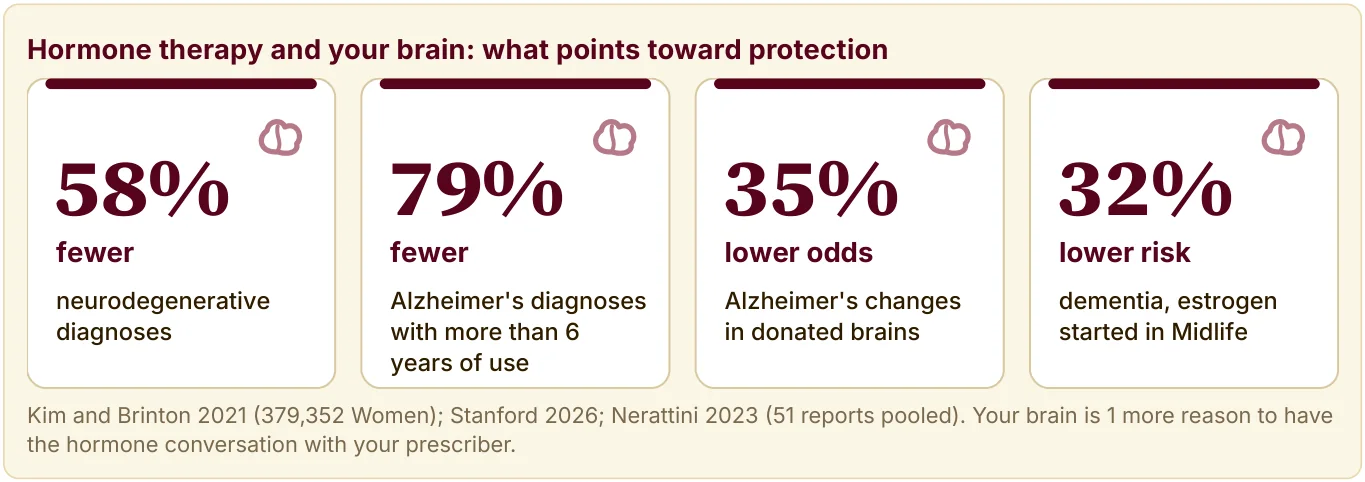
4 findings under the title 'Hormone therapy and your brain: what points toward protection'. 58% fewer neurodegenerative diagnoses. 79% fewer Alzheimer's diagnoses with more than 6 years of use. 35% lower odds of Alzheimer's changes in donated brains. 32% lower risk of dementia, with estrogen started in Midlife. Sources: Kim and Brinton 2021 (379,352 Women); Stanford 2026; Nerattini 2023 (51 reports pooled). Your brain is 1 more reason to have the hormone conversation with your prescriber.
The alarming headlines of the early 2000s came from studies that used different hormones, oral conjugated estrogens, alone or with a synthetic progestin, in older Women. In November 2025, the FDA moved to remove the boxed dementia warning from hormone therapy labels. In KEEPS, a trial of Women who started within 3 years of their final period, a follow-up about 10 years later found no harm to thinking and memory, and the researchers called it reassuring.
My conviction is that estradiol is 1 of the most powerful allies your brain has in Midlife. It is easier to prevent brain loss than to replace it, so the earlier the conversation, the more there is to protect. I believe hormones are most protective before major disease has developed.
Many Women start hormone therapy after 60, and it helps them tremendously. The Women in the Stanford study started at an average age of about 70. Whenever you begin, the decision is individual, and it belongs with a prescriber who knows the current evidence.
There is no age at which you must stop, as the Hormone Therapy 101 chapter explains. Every decision about hormone therapy, its form, its dose, and how long you stay on it, belongs to you and your prescriber. My own plan, described at the end of the Hormones chapter, was built for my body by my practitioners.
In 2005, Dr. Suzanne de la Monte and her team at Brown Medical School examined brain tissue from people who had died with Alzheimer's. The brains made far less insulin, had far fewer insulin receptors, and responded poorly to the insulin they had.
They proposed a name for what they saw: 'type 3 diabetes.'
In 2006, the same group injected a compound that blocks insulin signaling directly into the brains of rats. Their blood sugar and pancreas stayed normal. Their brains shrank and developed many Alzheimer's-like changes, including amyloid and abnormal tau protein. In 2008, de la Monte published a review in the Journal of Diabetes Science and Technology titled 'Alzheimer's disease is type 3 diabetes.'
I teach the idea in 3 lines:
The result is a brain that struggles to use glucose for energy. A brain that is slowly starving. Remember that estradiol helps the brain burn glucose too, so a Woman in the Menopause transition may be losing fuel support from 2 directions at once.
'Type 3 diabetes' is a research hypothesis and a label, and no medical classification lists it as a diagnosis. De la Monte's own review notes that type 2 diabetes alone falls well short of reproducing Alzheimer's.
The rat model is a chemical injury, which shows the idea is plausible and does not prove it. Brain insulin resistance remains an active field of study, with mixed results so far.
What about the plaques and tangles? Amyloid plaques and tau tangles are the hallmarks of Alzheimer's, and for decades science treated amyloid as the main cause. Drugs that clear amyloid now slow decline modestly.
Many researchers now see plaques and tangles as 1 part of a larger story that includes inflammation, blood vessel health, and brain metabolism. Some evidence even suggests amyloid forms partly as a defense response. In my view, the brain's ability to fuel itself belongs at the center of that story.
In 2024, the Lancet Commission on dementia, a panel of leading researchers, estimated that about 45 percent of dementia cases worldwide could be prevented or delayed by addressing 14 risk factors.
By life stage, with the share of cases each is estimated to account for:
Early life
Midlife
Late life
Look at how many of those sit in Midlife. 10 of the 14. High LDL cholesterol and untreated vision loss were added in 2024.
The Commission is careful to say these associations 'might be only partly causal', so the 45 percent is a best estimate of what is potentially preventable. It is still the strongest consensus number we have, and it suggests nearly half of dementia may be shaped by things you and your practitioner can see, measure, and change.
Menopause and hormone therapy do not appear on the list, and the research on them is still unsettled. That is 1 more reason to bring the hormone conversation to your prescriber.
During sleep, your brain appears to clean house. In a 2013 study in mice, sleep expanded the spaces between brain cells by about 60 percent, which let fluid flow through and wash out amyloid faster.
That work was done in animals, and scientists are still working out how the brain's cleaning system functions in humans. In people, long-term studies of sleep and dementia tell their own story.
In the Whitehall II study, which followed 7,959 people for 25 years, sleeping 6 hours or less at age 50 was linked to 22 percent higher dementia risk, and at 60, 37 percent higher. People who slept 6 hours or less at 50, 60, and 70 had 30 percent higher dementia risk.
Perimenopause is exactly when sleep falls apart for so many Women. Night sweats, falling progesterone, and a flipped cortisol curve can wake you at 3 AM.
Protecting your sleep in Midlife protects your brain in later life. The Stress chapter and the Cortisol chapter walk through how to rebuild it.
Your hippocampus can grow. In a 2011 study of 120 older adults, 1 year of brisk walking increased the size of the hippocampus by 2 percent, roughly reversing 1 to 2 years of age-related loss.
Memory improved too, while the comparison group, who did stretching and toning, lost volume.
Strength training matters as well. In the SMART trial, 100 adults with mild cognitive impairment, 68 percent of them Women, did high-intensity progressive resistance training 2 to 3 days a week for 6 months. Their thinking improved, and the benefit held 18 months later.
48 percent of those who lifted reached normal scores on a standard cognitive test, compared with 27 percent of those who did not.
Programs that combine everything show promise too. In the 2025 US POINTER trial, 2,111 older adults, 69 percent of them Women, followed a structured, supervised lifestyle program. Their thinking improved more than that of people who followed a self-guided version.
Both groups improved, and the effects in these combined trials are modest and real. Movement is 1 of the best-tested tools you have for your brain.
Orthopedic surgeon Dr. Vonda Wright's book Unbreakable: A Woman's Guide to Aging with Power is a practical guide to building the muscle and bone a Woman ages inside.
Movement, not being sedentary, is enormously impactful.
I move every day: an incline walk on my treadmill, walks outdoors and with our dogs, 30 minutes of swimming, and some strength training with weights.
What this can look like in a real week:
This article is a section of The Midlife Bible: The Essential Guide to the Women's Midlife Journey, by Daniela Hess, MSEd. It is the book's own text, so where it says 'this book' or points to another part, that means the Bible. The book has the full chapters, charts, and the Lab Wish List.
Educational content, not medical advice. Please work with your own practitioner before you change a medication or a supplement.
These 3 connect to what you just read.
Heart disease takes roughly 7 times as many Women's lives as breast cancer, and Menopause changes your cholesterol, your blood vessels, and your body fat. Here is how a heart attack can look in a Woman, which tests to ask about, and what protects your heart every day.
Read this article →What you may be feelingI had to narrate myself from room to room, and I Googled early dementia at midnight. Here are the physiological causes that stack in this season, the pattern clues that point to each, and what helps.
Read this article →Your hormones and your thyroidHormone therapy is 1 of the most effective tools for the Midlife years and 1 of the most misunderstood. Here is what happened in 2002, what changed in 2025, and what the evidence shows on timing, bones, heart, and breast cancer.
Read this article →FAQ
Fog and dementia are different, and the fog many Women feel in Perimenopause tends to lift. The longer view adds that the brain changes behind dementia can begin 20 years or more before the first symptom, and that the same things that clear your fog now are, in large part, the same things that protect your brain later.
In a 2021 imaging study, brain measures largely stabilized after Menopause and gray matter recovered in key regions. These studies are small, with roughly 40 to 160 participants. Amyloid on a scan in a healthy 50 year old Woman is a reason to pay attention, and it does not mean she will develop dementia. If your memory worries you, bring it to your practitioner. Brain Fog in Midlife covers the fog itself.
In 2026, 7.4 million Americans aged 65 and older live with Alzheimer's dementia, and 4.5 million of them are Women, nearly 2 in 3. Longevity explains much of the gap. When researchers pooled 205 studies from 43 countries, Women and men of the same age developed dementia at about the same rate until the 90's, where Women run higher.
Female biology is also 1 of the most active questions in Alzheimer's research. A gene variant called APOE4 appears to raise risk more in Women than in men in some analyses, and researchers are studying pregnancy history too.
The findings so far point toward protection, and researchers are still running the long trials that would prove it. A 2021 insurance-records study of 379,352 Women aged 45 and older found 58 percent fewer diagnoses of neurodegenerative diseases among Women who used hormone therapy, and a 2023 meta-analysis of 51 reports linked estrogen-only therapy started in Midlife to 32 percent lower dementia risk in observational studies.
If you had surgical Menopause, premature ovarian insufficiency, or early natural Menopause, bring it to your prescriber by name. Researchers recommend considering hormone therapy for Women in those groups until about 50. Every decision about hormone therapy belongs to you and your prescriber. See Hormone Therapy 101.
In 2024, the Lancet Commission on dementia estimated that about 45 percent of dementia cases worldwide could be prevented or delayed by addressing 14 risk factors. 10 of the 14 sit in Midlife: hearing loss and high LDL cholesterol at 7 percent each, depression, traumatic brain injury, physical inactivity, diabetes, smoking, high blood pressure, obesity, and excessive alcohol. Early life adds less education, and late life adds social isolation, air pollution, and untreated vision loss.
The Commission says these associations 'might be only partly causal', so 45 percent is a best estimate of what is potentially preventable. Heart Disease Risk for Women in Midlife covers LDL.
In the Whitehall II study, which followed 7,959 people for 25 years, sleeping 6 hours or less at age 50 was linked to 22 percent higher dementia risk, and at 60, to 37 percent higher. Perimenopause is when sleep falls apart for so many Women, and protecting your sleep in Midlife protects your brain in later life.
Movement helps too. In a 2011 study of 120 older adults, 1 year of brisk walking grew the hippocampus by 2 percent. In the SMART trial, 100 adults with mild cognitive impairment did progressive resistance training, and 48 percent of those who lifted reached normal scores on a standard cognitive test, against 27 percent of those who did not.

A 75-page PDF guide plus the 1 hour 43 minute talk, The Entire Midlife Journey.
Send me the guideYour thyroid, your gut, your hormones, and your labs.
Get The Midlife Bible3 hours with Daniela Hess and Kim Beekman, recorded live. The Midlife Bible is included.
See the workshop60 to 90 minutes one-on-one. Send a request to work with Daniela.
Work with Daniela